High-Precision GNSS Technology Empowers Intelligent Logistics Delivery
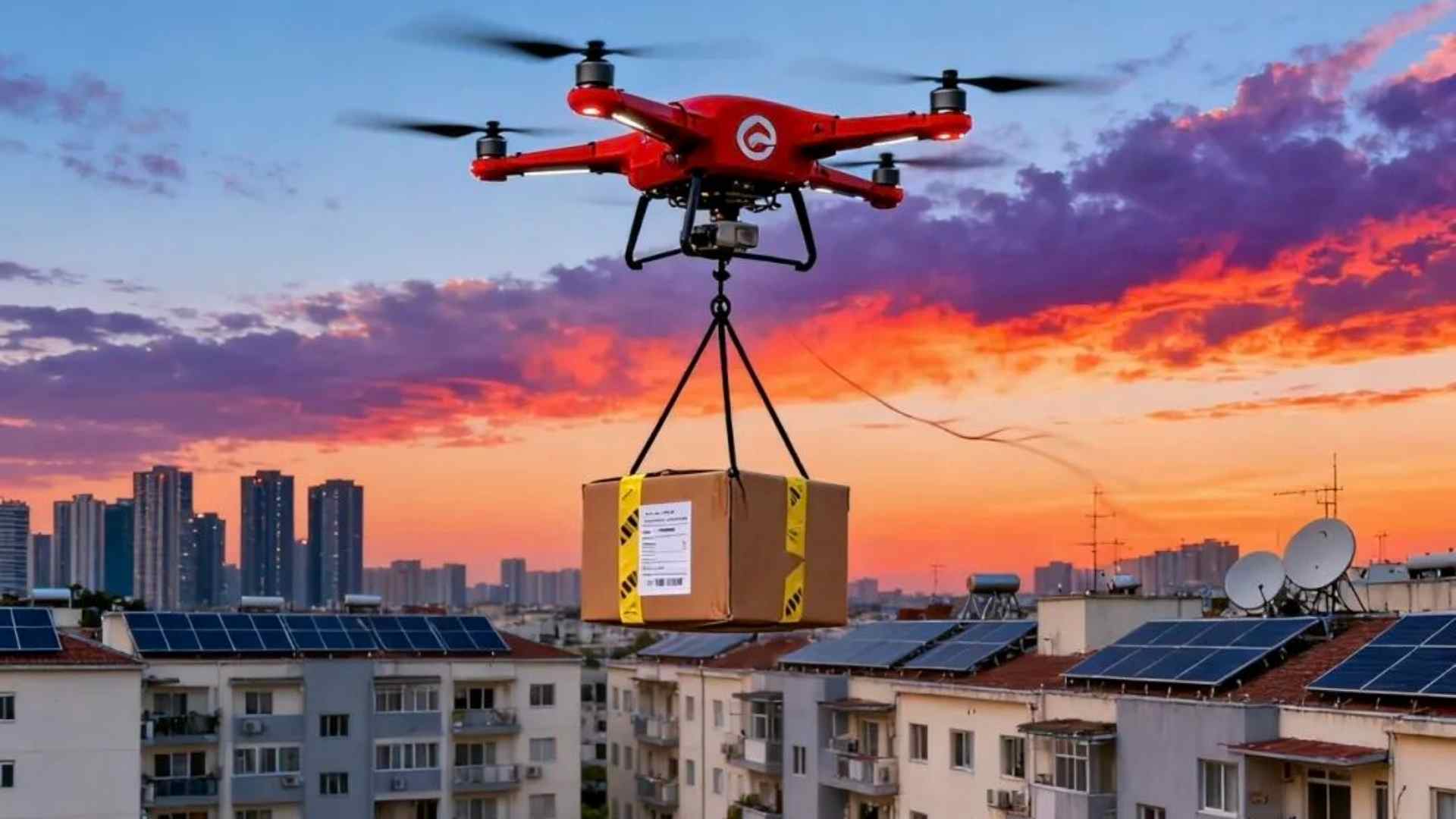
As drone delivery becomes an important part of urban logistics, it places high demands on the accuracy, reliability, anti-interference capability, and dynamic response of navigation systems. The Septentrio mosaic-G5 P3 is designed for delivery drones, empowering every flight segment with laboratory-grade precision.
Why Is Centimeter-Level GNSS Accuracy Crucial for Delivery Drones?
Quad-constellation GNSS receivers achieve centimeter-level accuracy by simultaneously tracking GPS, GLONASS, Galileo, and BeiDou satellites with RTK corrections. This level of precision not only improves delivery accuracy and reduces human intervention but is also the foundation for fully automated drone scheduling and cluster cooperative operations.
Core Advantages of the Septentrio mosaic-G5 P3 GNSS Receiver
The mosaic-G5 P3 is more than just a navigation module — it’s a high-precision positioning system optimized for drone delivery.
All-System, All-Frequency GNSS Performance
Despite its small volume of only 22.8 x 16.4 x 2.4 mm, the mosaic-G5 P3 features:
- 789 hardware channels for simultaneous tracking of all visible satellite signals, improving availability in partially obstructed urban environments
- All-constellation, all-frequency support: GPS (L1C/A, L1C, L2C, L2PY, L5), BeiDou (B1I, B1C, B2a, B2I, B2b, B3I), Galileo (E1, E5a, E5b, E6), GLONASS (L1CA, L2CA, L2P, L3 CDMA), QZSS (L1C/A, L1 C/B, L2C, L5, L6)
- Complete raw measurement data output supporting PPK post-processing verification
- Support for Galileo HAS and OSNMA for future signal upgrades and security enhancements
- Comprehensive protocol support: SBP, NMEA 0183 (v2.3/v3.03/v4.0), RTCM 3.x including MSM
- Wide temperature operation: -40°C to +85°C operating, -55°C to +85°C storage
GNSS+ Technology Ensures Stable Positioning in Complex Urban Scenarios
Septentrio’s unique GNSS+ technology suite maintains high-precision positioning in cities with dense buildings and complex electromagnetic environments:
- AIM+ Advanced: Real-time suppression of interference and spoofing, ensuring signal purity
- APME+: Effectively suppresses multipath errors from building and vehicle reflections
- LOCK+: Maintains stable signal lock during drone maneuvers and wind disturbances
- IONO+: Mitigates ionospheric disturbances for all-weather reliability
These technologies deliver outstanding RTK positioning performance (open sky, baseline <40 km):
- Horizontal Accuracy: 0.6 cm + 0.5 ppm
- Vertical Accuracy: 1.0 cm + 1 ppm
- Initialization Time: Typically 7 seconds
Integration Advantages in Delivery Drone Platforms
High Update Rate and Low Latency
Supports position output up to 20 Hz, with Event Marker pins (<3 ns accuracy) enabling precise synchronization with flight controllers and visual sensors for real-time trajectory correction and precise landing control.
Ultra-Low Power Consumption and Lightweight Design
Typical power consumption is only 0.44 W (max 0.57 W), dimensions are 22.8 x 16.4 x 2.4 mm, and weight is approximately 2.2 grams — significantly reducing the drone’s power burden and extending delivery range per charge.
Strong Environmental Adaptability
Operating temperature range from -40°C to +85°C with ENV-STD-810H vibration and shock compliance, adapting to climates from extreme heat to severe cold.
Fast Response and Efficient Task Execution
Cold start <35 seconds, warm start <10 seconds, reacquisition only 1 second, improving drone deployment and task response speed.
The Precision Navigation Foundation for Delivery Drones
Enhances Delivery Accuracy and Operational Efficiency
Drones integrated with the mosaic-G5 P3 can achieve centimeter-level landing accuracy, reducing manual corrections and improving automation levels and delivery throughput.
Enhances Flight Safety and Compliance
Reliable high-precision positioning supports precise obstacle avoidance, compliant airspace flight, and safe emergency landings, reducing operational risks.
Easy Integration and Rapid Deployment
Offers rich interfaces including 2x UART, USB, GPIO, Event Markers, and supports NMEA, RTCM, and SBF protocols combined with RxTools for rapid system integration and debugging.
Related GNSS Products
- HB21 GNSS Box Receiver — All-in-one RTK receiver with integrated 4G LTE, heading, and data logging
- HB6 GNSS Box Receiver — Compact quad-constellation RTK receiver powered by Septentrio Mosaic X5
- EV322 GNSS Receiver — Lightweight RTK receiver for UAVs and autonomous systems
- AIM+ Anti-Jamming Technology — Advanced interference and spoofing protection
Browse our full GNSS receiver collection for professional UAV applications.
Frequently Asked Questions
What GNSS accuracy is needed for precision delivery drones?
Precision delivery drones need better than 10 cm RTK accuracy for safe landing at designated drop zones, especially in urban or suburban environments. The mosaic-G5 P3 achieves 2.5 cm RTK accuracy, enabling the drone to consistently land within a small target area and avoid obstacles on final approach.
How does the mosaic-G5 P3 handle urban canyon GNSS challenges in delivery operations?
The mosaic-G5 P3 supports multi-constellation multi-frequency tracking, maximizing satellite availability in urban canyons where sky view is limited. Its AIM+ interference mitigation filters out RF noise from city infrastructure. For the most challenging urban deliveries, integrating GNSS with inertial sensors and vision-based landing provides redundancy.
What kind of GNSS receiver should a delivery drone choose?
The Septentrio mosaic-G5 P3 is an ideal choice. It features centimeter-level RTK positioning, complete raw data output supporting PPK post-processing verification, ultra-low power consumption, and small size suitable for various small and medium-sized delivery drones. Its anti-interference and multipath mitigation technologies ensure continuous, reliable positioning in dense urban areas.
Why do delivery drones need centimeter-level GNSS accuracy?
Centimeter-level positioning accuracy is key to ensuring drones land precisely at pickup and delivery points, enabling automated loading and unloading, and avoiding collisions with obstacles. Even decimeter-level deviations can cause drones to stray from the intended landing zone, impacting delivery safety and operational efficiency.