
High-Precision GNSS Technology Empowers Modern Aerial Surveying
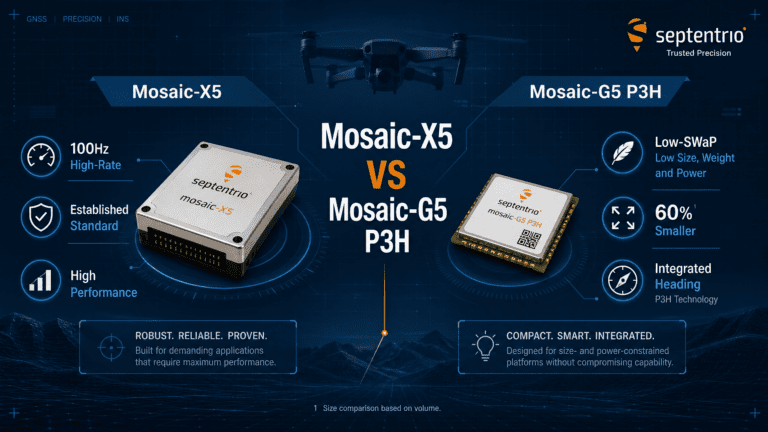
Modern aerial surveying has entered an era of high precision, efficiency, and automation. As a flexible data acquisition platform, drones place extreme demands on the accuracy, reliability, and dynamic performance of their positioning and navigation systems. The Septentrio mosaic-G5 P3 is designed specifically to meet professional surveying needs, integrating laboratory-grade high-precision GNSS performance into a miniaturized module, providing a powerful positioning core for surveying drones.
Why Is Centimeter-Level GNSS Accuracy Crucial for Aerial Surveying?
Quad-constellation GNSS receivers achieve centimeter-level accuracy by simultaneously tracking GPS, GLONASS, Galileo, and BeiDou satellites with RTK corrections. Whether it’s large-scale 1:500 topographic mapping, geological hazard monitoring, or engineering volume calculation, centimeter or even millimeter-level accuracy is the lifeline ensuring the usability and authority of the results. The stable RTK/PPK solution capability provided by the mosaic-G5 P3 is a key prerequisite for generating high-precision 3D models and true orthophotos.
Core Advantages of the Septentrio mosaic-G5 P3 GNSS Receiver
The mosaic-G5 P3 is more than just a GNSS module — it’s a complete, high-precision positioning solution optimized for professional surveying.
All-System, All-Frequency GNSS Performance
Despite its small volume of only 22.8 x 16.4 x 2.4 mm, the mosaic-G5 P3 features:
- 789 hardware channels for simultaneous tracking of all visible satellite signals
- All-constellation, all-frequency support: GPS (L1C/A, L1C, L2C, L2PY, L5), BeiDou (B1I, B1C, B2a, B2I, B2b, B3I), Galileo (E1, E5a, E5b, E6), GLONASS (L1CA, L2CA, L2P, L3 CDMA), QZSS (L1C/A, L1 C/B, L2C, L5, L6)
- Full raw measurement data output for post-processing PPP/PPK
- Support for Galileo HAS and OSNMA for future-proof accuracy and security
GNSS+ Technology Ensures Stable Positioning in Complex Environments
Septentrio’s GNSS+ suite maintains excellent performance in mountains, forests, and cities:
- AIM+ Advanced: Advanced jamming and spoofing detection and mitigation ensuring data authenticity
- APME+: Powerful multipath mitigation reducing measurement errors from environmental reflections
- LOCK+: Stable signal tracking during drone flight vibrations and maneuvers
- IONO+: Mitigates ionospheric delay effects for long-baseline RTK or PPK reliability
These technologies deliver outstanding RTK positioning performance:
- Horizontal Accuracy: 0.6 cm + 0.5 ppm
- Vertical Accuracy: 1.0 cm + 1 ppm
- Initialization Time: Typically 7 seconds
Integration Advantages in Aerial Surveying Drone Platforms
High Data Output Rate and Low Latency
Supports position and raw measurement data output rates up to 20 Hz, ensuring high-precision synchronization with the drone’s flight controller, gimbal, and camera shutter for precise instantaneous position and attitude reference for each aerial image.
High-Quality Data Source for PPK Post-Processing
Outputs complete multi-frequency raw observations (carrier phase, pseudorange, Doppler) with event marker pins for precise hardware synchronization with camera exposure — providing core data for high-accuracy surveying products with minimal or no ground control points.
Ultra-Low Power Consumption and Compact Design
Typical power consumption is only 0.44 W (max 0.57 W), dimensions are 22.8 x 16.4 x 2.4 mm, and weight is approximately 2.2 grams. This saves power and space on the drone platform, contributing to extended flight time and flexible airframe designs.
Robust Environmental Adaptability
Operating temperature range from -40°C to +85°C with ENV-STD-810H vibration and shock compliance, ensuring stable operation under harsh weather and complex flight conditions.
The Precise Spatiotemporal Core for Aerial Surveying Drones
Enhances Absolute Accuracy and Reliability of Surveying Deliverables
A surveying system integrated with the mosaic-G5 P3 produces high-quality data with accurate georeferencing, directly improving the absolute accuracy of Digital Orthophoto Maps (DOMs) and 3D models to meet high-standard surveying project requirements.
Simplifies Integration and Accelerates Development
The module offers comprehensive interfaces (2x UART, USB, GPIO, Event Markers, PPS), supports NMEA, RTCM, and SBF protocols, and comes with complete development documentation and RxTools configuration software — significantly reducing integration difficulty and accelerating POS system development.
A Future-Proof Professional Investment
Choosing the mosaic-G5 P3 means choosing a market-proven, high-performance technology platform with support for future GNSS signals and services like Galileo HAS, protecting your investment as surveying technology evolves.
Related GNSS Products
- HB21 GNSS Box Receiver — All-in-one RTK receiver with integrated 4G LTE, heading, and data logging
- HB6 GNSS Box Receiver — Compact quad-constellation RTK receiver powered by Septentrio Mosaic X5
- EV322 GNSS Receiver — Lightweight RTK receiver for UAVs and autonomous systems
- AIM+ Anti-Jamming Technology — Advanced interference and spoofing protection
Browse our full GNSS receiver collection for professional UAV applications.
Frequently Asked Questions
What RTK accuracy does the mosaic-G5 P3 deliver for aerial surveying drones?
The mosaic-G5 P3 delivers 0.6 cm + 0.5 ppm horizontal accuracy and 1.0 cm + 1 ppm vertical accuracy with RTK. This centimeter-level precision is essential for generating high-resolution orthophotos, accurate Digital Surface Models, and reliable 3D models for surveying and mapping applications.
How does APME+ technology benefit aerial survey data quality?
APME+ (a posteriori multipath estimator) suppresses multipath signal errors caused by reflections from ground structures, vegetation, and terrain. In urban or mountainous survey areas, this technology significantly improves carrier phase observation quality, ensuring higher RTK fix rates and cleaner survey data with reduced point cloud drift and image distortion.
Does the mosaic-G5 P3 support PPK post-processing for survey-grade accuracy?
Yes. The mosaic-G5 P3 outputs complete multi-frequency raw observations including carrier phase, pseudorange, and Doppler data. Combined with its event marker pins for precise camera exposure synchronization, it provides all the data needed for PPK post-processing to achieve the highest survey-grade accuracy with minimal or no ground control points.
How does the mosaic-G5 P3 maintain RTK lock in difficult survey environments?
In mountainous, forested, or urban environments with signal blockage and reflection, the mosaic-G5 P3 maintains positioning stability through all-frequency multi-system redundant tracking, APME+ multipath mitigation, AIM+ interference rejection, high-sensitivity tracking with fast reacquisition, and LOCK+ vibration robustness — ensuring continuous high-precision POS data delivery.