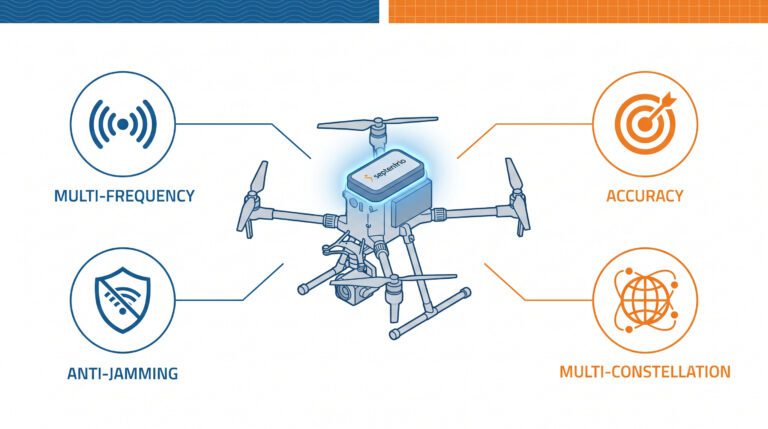

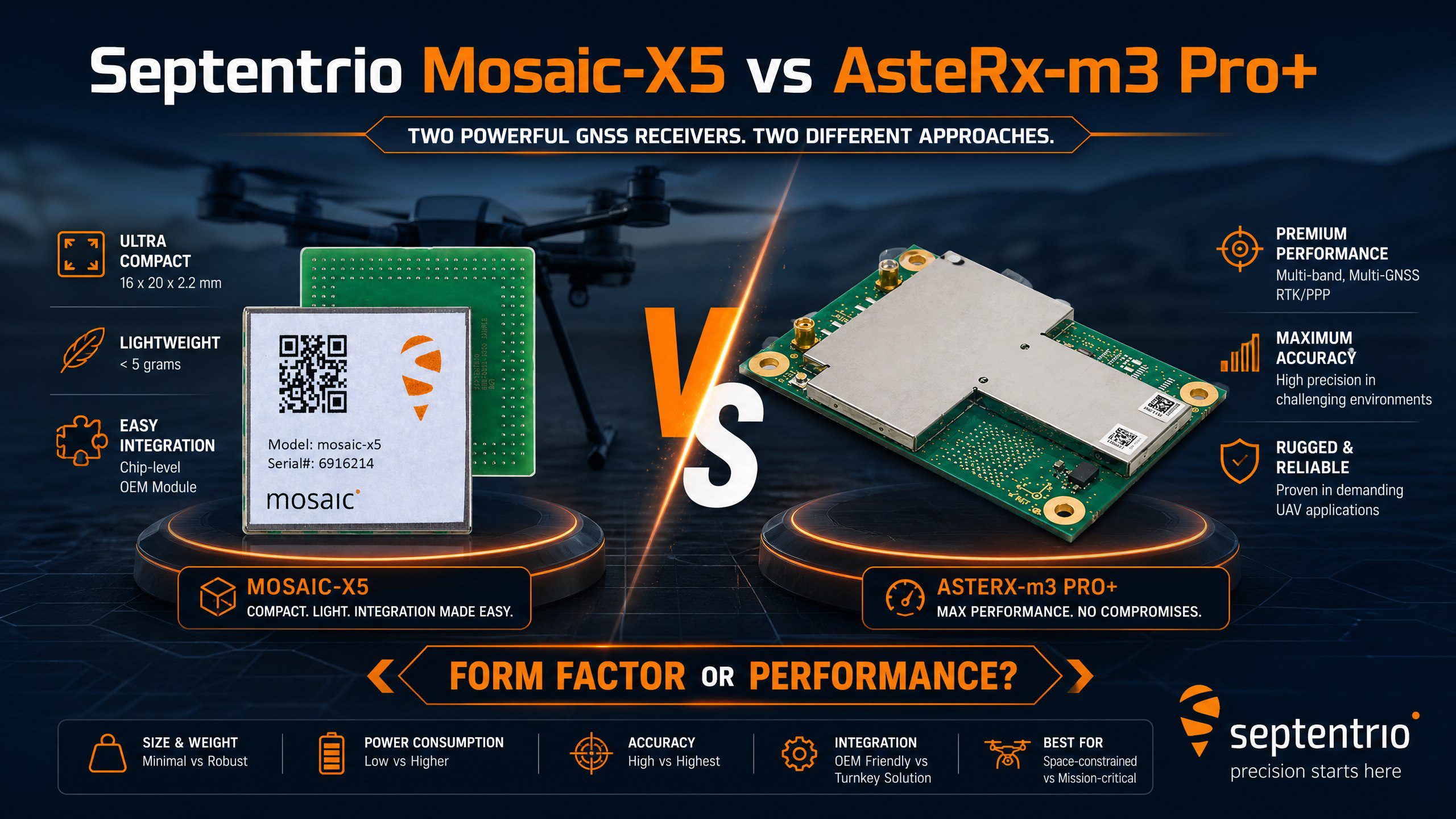
When you’re building a professional UAV — whether for precision agriculture, surveying, inspection, or autonomous delivery — the GNSS receiver is arguably the most critical sensor onboard. Two of Septentrio’s most compelling options sit at the heart of this decision: the compact Mosaic-X5 module and the rugged AsteRx-m3 Pro+ receiver. Both deliver centimeter-level RTK accuracy. Both run Septentrio’s field-proven GNSS+ firmware. But they target fundamentally different integration paths.
This comparison cuts through the marketing to answer a practical question: should you design around the tiny Mosaic-X5 chip, or buy the ready-to-deploy AsteRx-m3 Pro+? The answer depends on your timeline, technical resources, and deployment environment.
Why This Comparison Matters for UAV Builders
The GNSS receiver market has bifurcated in recent years. On one side, you have bare-board modules like the Mosaic-X5 — tiny, power-efficient, and designed for deep integration into custom PCBs. On the other, you have enclosed receivers like the AsteRx-m3 Pro+ — ready to mount on a drone frame with standard connectors. Both approaches have passionate advocates, but the right choice isn’t about which is “better” in absolute terms. It’s about what fits your specific build.
Septentrio’s product line reflects this reality. The Mosaic-X5 and AsteRx-m3 Pro+ share the same core GNSS engine — both track GPS, GLONASS, Galileo, BeiDou, and QZSS — but they diverge sharply on integration complexity, environmental resilience, and total system cost.
Septentrio Mosaic-X5 vs AsteRx-m3 Pro+: Head-to-Head Comparison
Core GNSS Performance
Let’s start with what matters most: positioning accuracy. Both receivers use Septentrio’s AIM+ technology for interference mitigation and both support RTK, PPK, and SSR corrections. The raw GNSS engine is essentially identical.
| Specification | Mosaic-X5 | AsteRx-m3 Pro+ |
|---|---|---|
| RTK Horizontal Accuracy | 0.6 cm + 0.5 ppm | 0.6 cm + 0.5 ppm |
| RTK Vertical Accuracy | 1.0 cm + 1 ppm | 1.0 cm + 1 ppm |
| Convergence Time (RTK) | < 10 seconds | < 10 seconds |
| Constellations | GPS + GLONASS + Galileo + BeiDou + QZSS | GPS + GLONASS + Galileo + BeiDou + QZSS |
| Channels | 448 | 448 |
| Update Rate | Up to 100 Hz | Up to 100 Hz |
| Anti-Jamming | AIM+ Advanced Interference Monitoring | AIM+ Advanced Interference Monitoring |
| L-Band (SSR) | Yes | Yes |
In raw positioning terms, there is zero difference. Both receivers will deliver identical RTK-fixed positions under the same sky conditions. The Mosaic-X5 is not a “downgraded” version — it is the same GNSS engine in a different physical package.
Form Factor: Size and Weight
This is where the two products diverge most dramatically.
| Parameter | Mosaic-X5 | AsteRx-m3 Pro+ |
|---|---|---|
| Dimensions | 31 × 31 × 4.5 mm (LGA module) | 112 × 69 × 26.5 mm (enclosed receiver) |
| Weight | ~6 grams | ~210 grams |
| Volume | ~4.3 cm³ | ~205 cm³ |
The Mosaic-X5 is a surface-mount LGA module. It weighs about the same as two paperclips and occupies roughly the footprint of a postage stamp. The AsteRx-m3 Pro+, by contrast, is a fully enclosed industrial receiver with robust connectors, status LEDs, and mounting flanges — 35× heavier and 48× larger by volume.
For ultra-lightweight UAVs — especially small quadcopters under 2 kg, racing drones, or experimental platforms — the Mosaic-X5’s tiny footprint is transformative. You can embed it directly onto your flight controller PCB, eliminating the need for a separate GNSS mounting bracket, housing, and connector harness.
Power Consumption
Battery life matters on every drone mission. Here again the two receivers diverge significantly.
| Parameter | Mosaic-X5 | AsteRx-m3 Pro+ |
|---|---|---|
| Typical Power Draw | ~0.9 W | ~2.5 W |
| Voltage Input | 3.3 V (module) | 4.5 – 36 V (wide input) |
The Mosaic-X5 draws roughly 1.7 W less than the AsteRx-m3 Pro+. On a 10-minute flight with a 6S 6000 mAh battery, that’s a meaningful difference — freeing up ~0.28 Ah for other systems. Over hundreds of flights, it adds up.
However, the AsteRx-m3 Pro+’s wide input voltage range (4.5 – 36 V) simplifies power integration. You can connect it directly to your drone’s battery without a separate voltage regulator. The Mosaic-X5 requires a clean 3.3 V supply, adding a modest BOM cost and PCB design consideration.
Integration Complexity
This is arguably the most important axis of comparison.
Mosaic-X5: The Embedded Engineer’s Choice
The Mosaic-X5 is a component, not a finished product. Integrating it requires:
- A custom PCB with proper RF layout for the LGA package
- A GNSS antenna (active or passive) with appropriate front-end filtering
- A stable 3.3 V power supply with low ripple
- UART, SPI, or USB interface to your flight controller
- Thermal management for the tightly packed module
If your team has embedded hardware experience, this is the path to the smallest, lightest, most power-efficient integration possible. But the learning curve is real — RF layout mistakes can degrade C/N0 ratios by 3–5 dB, directly impacting time-to-fix and RTK reliability.
AsteRx-m3 Pro+: The Integrator’s Solution
The AsteRx-m3 Pro+ arrives as a complete, tested receiver. You mount it to your frame, connect an antenna (TNC or SMA), supply power (4.5–36 V), and connect a serial or USB cable to your flight controller. That’s it.
- No PCB design required
- No RF layout validation
- No separate enclosure (IP67-rated)
- No voltage regulator needed
- LED indicators for status at a glance
For a team that wants to go from concept to flying prototype in a weekend, the AsteRx-m3 Pro+ is the clear winner. It also includes a built-in IMU and supports Septentrio’s advanced dual-antenna heading capability — features the bare Mosaic-X5 module does not include onboard.
Environmental Resilience
Dust, rain, vibration, and temperature swings are facts of life in field UAV operations.
| Parameter | Mosaic-X5 | AsteRx-m3 Pro+ |
|---|---|---|
| Operating Temperature | -40°C to +85°C | -40°C to +75°C |
| Ingress Protection | Depends on enclosure (module only) | IP67 (dust-tight, waterproof to 1 m) |
| Shock / Vibration | Requires proper PCB mounting | Mil-spec ruggedized enclosure |
The AsteRx-m3 Pro+ is IP67 rated out of the box. You can mount it on the outside of a drone frame in rain, dust, or mud without concern. The Mosaic-X5 needs an enclosure — either your flight controller’s housing or a custom 3D-printed case — to match that level of protection.
Price and Total Cost of Ownership
Exact pricing varies by volume and region, but the general relationship is clear:
- Mosaic-X5 (module): ~$800–$1,200 per unit at single quantity
- AsteRx-m3 Pro+ (enclosed receiver): ~$2,000–$3,000 per unit at single quantity
The Mosaic-X5 module is roughly 50–60% the price of the full AsteRx-m3 Pro+ receiver. However, that price gap narrows when you account for the additional BOM cost of a custom carrier PCB ($50–$200 in NRE per board iteration), enclosure design, regulatory testing, and the engineering time required to bring up the module. For a one-off prototype or low-volume production (1–50 units), the AsteRx-m3 Pro+ often works out cheaper on a total-cost basis.
At scale (500+ units), the Mosaic-X5 becomes dramatically more cost-effective — especially when you can share a single PCB with your flight controller, eliminating redundant housing, connectors, and cabling.
Which One Should You Choose?
Choose the Mosaic-X5 When:
- You’re designing a custom flight controller or integrating GNSS into an existing PCB
- Every gram matters — racing drones, nano-UAVs, or extended flight time requirements
- You have embedded hardware engineers who can handle RF layout and module bring-up
- You’re planning mid-to-high volume production (100+ units)
- Power budget is extremely tight (sub-1 W for GNSS processing)
Choose the AsteRx-m3 Pro+ When:
- You need a ready-to-deploy GNSS receiver with minimum integration effort
- Your drone operates in harsh environments — rain, dust, mud, extreme temperatures
- You need dual-antenna heading and onboard IMU for attitude initialization
- You’re building a prototype or low-volume system (1–50 units)
- The wide input voltage range saves you a separate power regulator
The Verdict: Form Factor or Performance?
Having walked through the detailed comparison, the answer should be clear: neither. Both the Septentrio Mosaic-X5 and AsteRx-m3 Pro+ deliver identical GNSS performance. The choice is between integration depth (Mosaic-X5) and integration speed (AsteRx-m3 Pro+).
The Mosaic-X5 is a component for engineers who want maximum design flexibility and are willing to invest in the PCB layout, validation, and testing to achieve it. The AsteRx-m3 Pro+ is a system for integrators who want to get airborne fast with a proven, robust receiver that handles field conditions without extra effort.
Septentrio made a smart move offering both — because they serve different customers, not different tiers of quality. The core GNSS technology is the same. The packaging is what changes everything.
Related GNSS Products
- HB21 GNSS Box Receiver — All-in-one RTK receiver with 4G LTE, heading, and data logging
- HB6 GNSS Box Receiver — Compact RTK receiver powered by Septentrio Mosaic X5
- EV322 GNSS Receiver — Lightweight RTK receiver for UAVs and autonomous systems
- AIM+ Anti-Jamming Technology — advanced interference and spoofing protection
Browse our full GNSS receiver collection for professional UAV applications.
Frequently Asked Questions
Which has better RTK accuracy — the Mosaic-X5 or AsteRx-m3 Pro+?
They are identical. Both use the same core GNSS engine — 0.6 cm + 0.5 ppm horizontal, 1.0 cm + 1 ppm vertical with RTK. The choice comes down to form factor and integration, not accuracy.
Can I use the Mosaic-X5 without designing a custom PCB?
Not practically. The Mosaic-X5 is a 31x31mm LGA module requiring custom PCB design with proper RF layout. If you don’t have embedded hardware capability, choose the AsteRx-m3 Pro+ or a pre-integrated product like the HB6 GNSS box receiver.
Is the AsteRx-m3 Pro+ worth the extra cost over the Mosaic-X5?
For low-volume builds (1-50 units), yes — the AsteRx-m3 Pro+ saves engineering time on PCB design, enclosure, and regulatory testing. At 500+ units, the Mosaic-X5 becomes cheaper. The AsteRx also includes onboard IMU and dual-antenna heading natively.
Do both receivers support dual-antenna heading?
The AsteRx-m3 Pro+ supports dual-antenna heading out of the box (requires two antennas). The Mosaic-X5 module does not have onboard heading — you would need the Mosaic-G5 P3H variant for dual-antenna support, or add an external IMU for attitude.
Which receiver is better for harsh outdoor drone operations?
The AsteRx-m3 Pro+ with its IP67 rating, wide input voltage (4.5-36V), and rugged enclosure is ready for rain, dust, and vibration. The Mosaic-X5 needs additional enclosure design to match that protection level.
Which has better RTK accuracy — the Mosaic-X5 or AsteRx-m3 Pro+?
They are identical. Both use the same core GNSS engine — 0.6 cm + 0.5 ppm horizontal, 1.0 cm + 1 ppm vertical with RTK. The choice comes down to form factor and integration, not accuracy.
Can I use the Mosaic-X5 without designing a custom PCB?
Not practically. The Mosaic-X5 is a 31x31mm LGA module requiring custom PCB design with proper RF layout. If you don’t have embedded hardware capability, choose the AsteRx-m3 Pro+ or a pre-integrated product like the HB6 GNSS box receiver.
Is the AsteRx-m3 Pro+ worth the extra cost over the Mosaic-X5?
For low-volume builds (1-50 units), yes — the AsteRx-m3 Pro+ saves engineering time on PCB design, enclosure, and regulatory testing. At 500+ units, the Mosaic-X5 becomes cheaper. The AsteRx also includes onboard IMU and dual-antenna heading natively.
Do both receivers support dual-antenna heading?
The AsteRx-m3 Pro+ supports dual-antenna heading out of the box (requires two antennas). The Mosaic-X5 module does not have onboard heading — you would need the Mosaic-G5 P3H variant for dual-antenna support, or add an external IMU for attitude.
Which receiver is better for harsh outdoor drone operations?
The AsteRx-m3 Pro+ with its IP67 rating, wide input voltage (4.5-36V), and rugged enclosure is ready for rain, dust, and vibration. The Mosaic-X5 needs additional enclosure design to match that protection level.