

RTK Drops at Sunset? Ionospheric Scintillation for Drones
A sunset RTK dropout in low latitudes is usually the ionosphere, not the airframe: what scintillation does to drone GNSS and how IONO+ keeps a fix.
Practical GNSS guides, how-tos and technical explainers.
A sunset RTK dropout in low latitudes is usually the ionosphere, not the airframe: what scintillation does to drone GNSS and how IONO+ keeps a fix.
Jamming can move a drone’s GNSS timestamps while position looks fine. Why PPS drifts, and how in-band zero-delay anti-jamming stops it. Request a quote.
A drone has no driver to notice a silently wrong fix. How RAIM+ integrity monitoring catches bad GNSS measurements on UAV receivers. Request a quote.
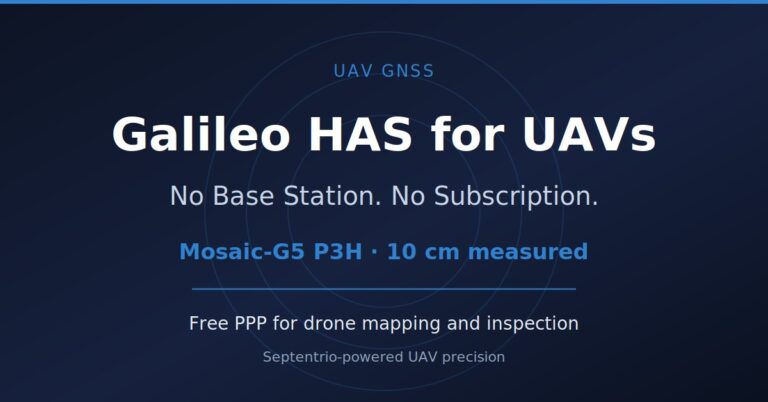
A Mosaic-G5 P3H field test measured Galileo HAS at 10 cm in open sky – about 5 minutes to 20 cm and 12 minutes to 10 cm. What free satellite PPP changes for drone mapping, inspection and survey flights.
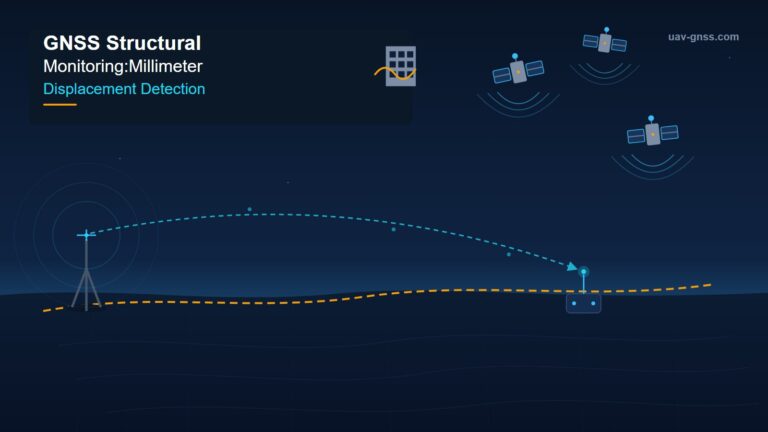
Millimeter-level GNSS displacement monitoring for bridges, dams and buildings. How RTK receivers keep critical infrastructure safe.

Jammertest 2025 tested Septentrio AIM+ receivers through ~100 jamming and spoofing scenarios. Here’s what the results mean for UAV operators — and which receivers carry that protection.
How the official Septentrio ROSaic driver (septentrio_gnss_driver) integrates mosaic-X5 / AsteRx GNSS/INS receivers with ROS 1 & ROS 2 for UAVs: 30+ topics, firmware requirements, INS YAML setup, OSNMA and multi-source RTK.
Why RxTools is the professional configuration and diagnostics software for Septentrio GNSS receivers in UAV integration: native Linux, integrated spectrum analysis, ASCII commands, and message-level differential link monitoring.
How to determine GNSS-based attitude (heading, pitch, roll) from a moving base with dual-antenna RTK — hardware, data links, MovingBase configuration, and accuracy for UAVs and vehicles.
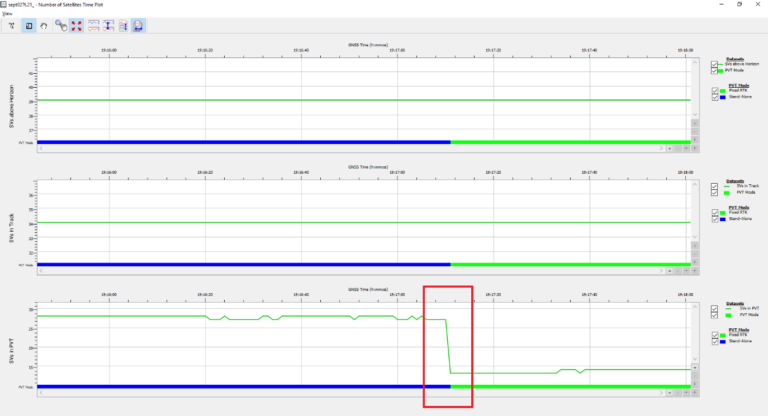
Why did the satellite count drop from 27 to 13 after RTK Fixed? An SBF Analyzer guide to Above Horizon, In Track, In PVT, and when a low satellite count signals a problem.