GNSS Receiver Firmware Updates: Why They Matter for Drone Performance
If you fly drones professionally — whether for mapping, survey, inspection, or autonomous operations — you already know your GNSS receiver…
Practical GNSS guides, how-tos and technical explainers.
If you fly drones professionally — whether for mapping, survey, inspection, or autonomous operations — you already know your GNSS receiver…
When you’re building a professional UAV — whether for precision agriculture, surveying, inspection, or autonomous delivery — the GNSS receiver is…
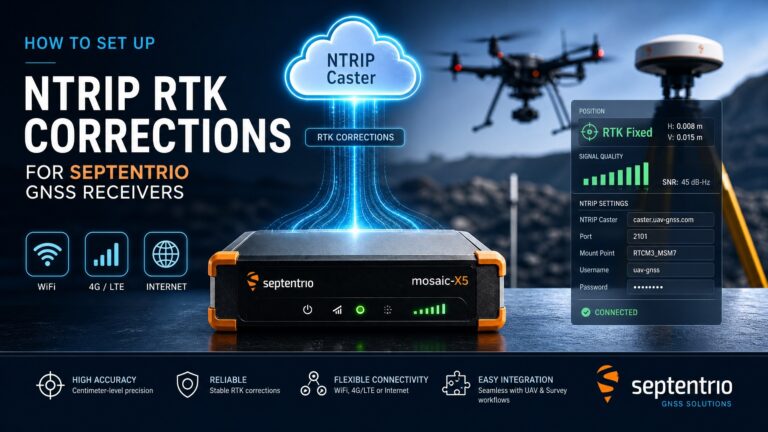
Learn how to set up NTRIP RTK corrections for Septentrio mosaic-X5 and mosaic-G5 GNSS receivers. Step-by-step guide for achieving centimeter-level UAV drone RTK positioning.
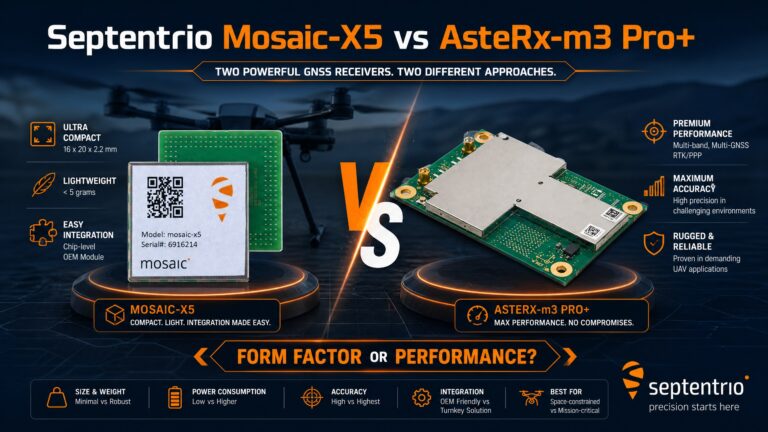
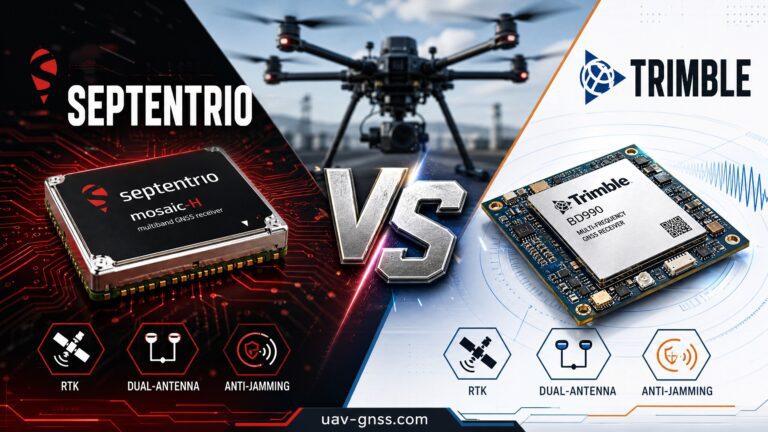
Compare Septentrio vs Trimble GNSS receivers for drone integration. Side-by-side comparison of form factor, RTK accuracy, power consumption, anti-jamming, and flight controller compatibility.
As drone technology matures and the global commercial drone market pushes toward $55 billion by 2027, the GNSS receiver inside each drone has become a critical differentiator. We surveyed what drone manufacturers look for in a GNSS receiver in 2026.
Galileo HAS (High Accuracy Service) provides free satellite-delivered centimeter corrections for GNSS receivers. Learn how it benefits UAV drones and RTK positioning without a base station.
RTK GNSS for drone swarms enables centimeter-level multi-UAV coordination and synchronization. Learn about positioning, timing, and anti-jamming for drone light shows and inspection swarms.
The difference between GPS and GNSS for UAV applications. Why multi-constellation matters for professional drones.
PPP-RTK convergence: how satellite-delivered corrections eliminate local base stations for drone operations.
Discover the Septentrio mosaic-X5 GNSS receiver for power line inspection UAVs. AIM+ anti-interference for reliable positioning near high-voltage lines.
Typically replies within a day