
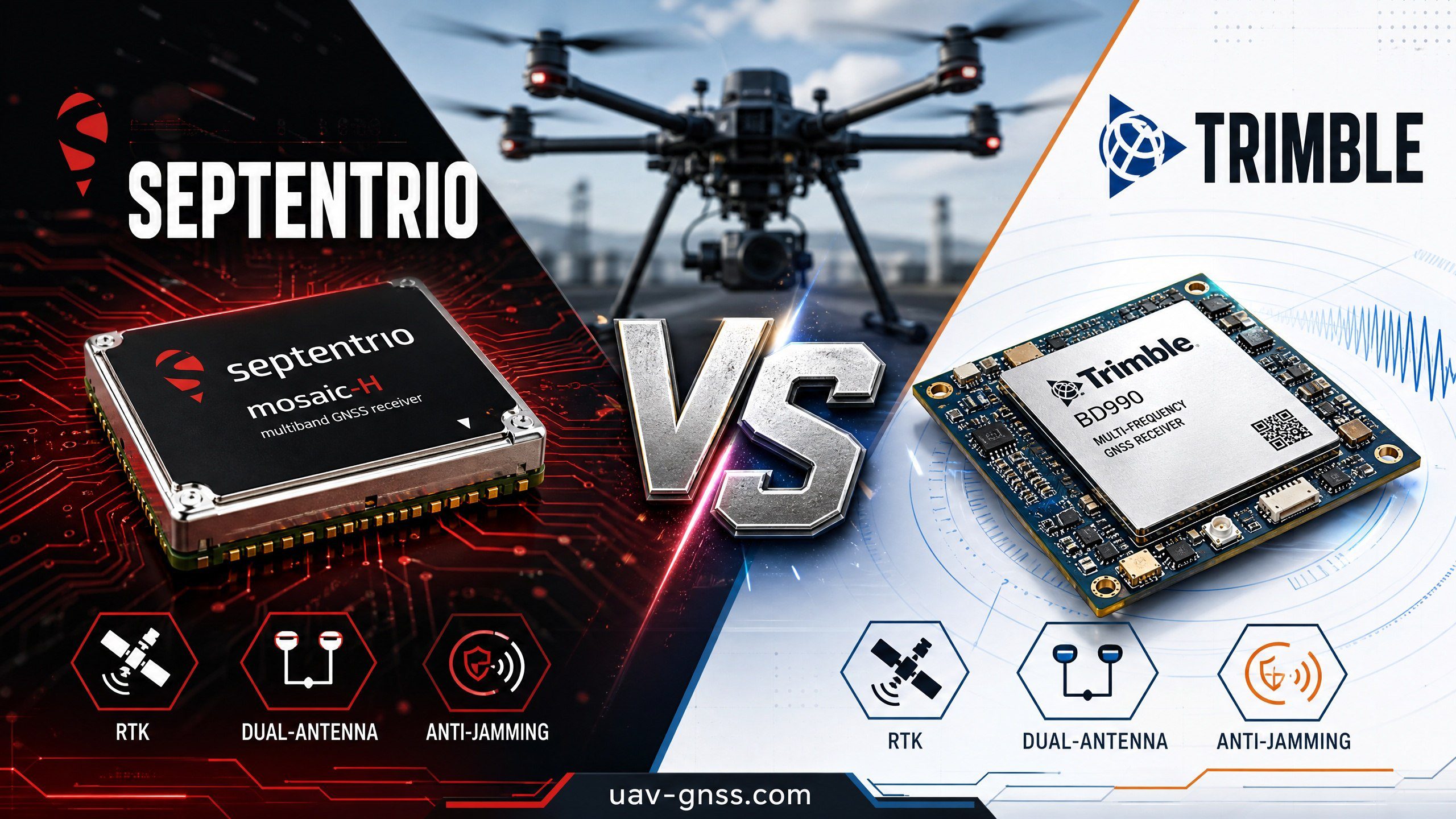
When you’re integrating a GNSS receiver into a drone, robot, or autonomous vehicle, two names come up constantly: Septentrio and Trimble. Both are established players in professional GNSS, but they take very different approaches — especially when it comes to UAV integration, form factor, and pricing.
This article compares Septentrio and Trimble GNSS receivers head-to-head for drone applications. We’ll look at accuracy specs, SWaP (Size, Weight, and Power), protocol support, anti-jamming, RTK performance, and real-world integration experience — so you can decide which makes sense for your UAV platform.
Company Background: Two Approaches to GNSS
Septentrio: OEM-First GNSS Engineering
Belgium-based Septentrio has built its reputation on high-performance OEM GNSS receiver modules. Their mosaic-X5 and mosaic-G5 series are designed from the ground up for integration into third-party systems — drones, robots, autonomous vehicles, survey equipment, and timing systems. Septentrio doesn’t sell finished survey controllers or handheld devices; they focus entirely on the receiver module and its ecosystem of software tools (RxTools, RxControl, SBF protocol).
This OEM-first philosophy means Septentrio receivers are smaller, lighter, and more power-efficient than most alternatives — traits that matter enormously for drone integration.
Trimble: Full-Stack Positioning Giant
American company Trimble is a much larger organization with a product portfolio spanning GNSS receivers, survey controllers, construction lasers, agricultural guidance, and fleet management software. Their GNSS modules — notably the BD series, MB-2, and BX992 — are widely used in survey, construction, and agriculture. However, Trimble’s bread and butter is the finished product market (survey rovers, machine control, precision ag). Their OEM module business, while competent, is secondary to their branded hardware sales.
This difference in business model has real implications for drone integrators, as we’ll see below.

Spec-for-Spec Comparison: Septentrio mosaic-X5 vs Trimble BD-Series
Let’s put the flagship GNSS receiver modules from each company side by side. The Septentrio mosaic-X5 represents the current top of Septentrio’s OEM lineup, while Trimble’s BD series (BD982, BD992, BX992) is their equivalent offering.
| Specification | Septentrio mosaic-X5 | Trimble BD992 / BX992 |
|---|---|---|
| Form Factor | 46 × 60 × 9 mm (card-edge) | 60 × 80 × 15 mm (typically boxed) |
| Weight | ~16 g | ~50–80 g (module + housing) |
| Power Consumption | ~1.0 W (full tracking) | ~1.5–2.5 W (varies by model) |
| Channels | 448 | variable (typically 220–336) |
| Constellations | GPS, GLONASS, Galileo, BeiDou, QZSS, NavIC, SBAS | GPS, GLONASS, Galileo, BeiDou, QZSS, SBAS |
| RTK Accuracy (H) | 0.6 cm + 0.5 ppm | 0.8 cm + 1 ppm |
| Max Update Rate | 100 Hz | 20 Hz (50 Hz optional) |
| RTK Convergence | ~10–45 seconds | ~15–60 seconds |
| Anti-Jamming | AIM+ (hardware + software) | Limited (no dedicated anti-jam chip) |
| Dual-Antenna Heading | Yes (mosaic-G5, P3H) | Yes (BX992 only) |
| IMU / GNSS+INS | Yes (via external IMU fusion) | Limited (BX992 has basic tilt) |
| OSNMA (Galileo auth) | Yes | No |
| Firmware Programmable | Yes (field-upgradeable) | Yes (field-upgradeable) |
| Output Protocols | SBF, NMEA, RTCM 3.3 | NMEA, RTCM 3.3, proprietary |
| Flight Controller Compatibility | Native (ArduPilot GPS_TYPE=9, PX4 GPS_TYPE=9) | NMEA (via converter or custom driver) |
| Price (OEM module) | ~$1,500–2,000 | ~$2,000–3,500 |
Why Form Factor Matters for Drones
The single biggest differentiator between Septentrio and Trimble in drone applications is physical size and weight. The Septentrio mosaic-X5 comes as a bare PCB module measuring just 46 × 60 × 9 mm — small enough to mount directly inside most drone frames, even on a 7-inch or 10-inch quadcopter. Total weight is approximately 16 grams.
Trimble’s equivalent modules are typically packaged in larger enclosures (60 × 80 × 15 mm or bigger) and weigh 50–80 grams or more. In the drone world, every gram counts. A 50-gram difference in GNSS receiver weight directly reduces payload capacity for sensors, batteries, or cameras.
This form-factor advantage is why many drone manufacturers — including inspection drone builders, eVTOL developers, and drone show operators — choose Septentrio-based receivers over Trimble for new platform designs. The HB21 and HB6 receivers from UAV-GNSS both use the mosaic-X5 chip, achieving RTK precision in a package that weighs under 100 grams complete (housing, antenna, and all).
Protocol Support and Flight Controller Integration
Septentrio: Native ArduPilot and PX4 Support via SBF
Septentrio receivers output the SBF (Septentrio Binary Format) protocol, which is natively supported by both ArduPilot and PX4 when configured with GPS_TYPE=9. This means:
- Plug-and-play RTK with no protocol conversion needed
- Direct access to raw measurement data, satellite status, and quality indicators
- Native support for dual-antenna heading (yaw) without a separate compass
- Full access to IMU fusion data when using GNSS+INS mode
For UAV integrators, this native compatibility is a massive time-saver. No custom driver development, no protocol parsing, no debugging NMEA sentence truncation — just plug the receiver into the flight controller’s UART and configure GPS_TYPE=9.
Trimble: Standard NMEA (Works, but Lacks Drone-Specific Features)
Trimble receivers output NMEA 0183 sentences by default, which is a universal standard that any flight controller can parse. However, NMEA has limitations for advanced drone applications:
- Update rate capped at 10–20 Hz (vs. 100 Hz from SBF)
- No native dual-antenna heading output — requires custom binary format parsing
- No direct flight-controller optimized binary protocol
- NMEA sentence parsing adds latency at the flight controller level
It’s not that Trimble receivers don’t work with drones — they can, especially in survey-oriented UAV platforms. But the integration is less streamlined, and you lose the tight coupling that SBF provides between the receiver and autopilot.
Anti-Jamming and Interference Resilience
Drone operations often happen in RF-challenged environments — near power lines, cell towers, urban areas, and even high-interference zones. GNSS jamming and spoofing are growing threats, especially for commercial and government drone operators.
Septentrio AIM+ Technology Suite
Septentrio’s AIM+ (Advanced Interference Mitigation) is a comprehensive hardware + software anti-jamming system that operates in real time on the GNSS chip itself. It includes:
- Real-time narrowband and wideband interference suppression — removes up to 85 dB of jamming signal
- APME+ (Advanced Multipath Estimation) — eliminates multipath errors in urban environments
- LOCK+ — maintains satellite lock during high vibration (important for drone motors)
- IONO+ — ionospheric scintillation mitigation
- Galileo OSNMA — authentication of GNSS signals to prevent spoofing
AIM+ is baked into every mosaic-X5 and mosaic-G5 module at no extra cost. For government and critical infrastructure drone operations, this is a significant advantage.
Trimble: Standard Interference Mitigation
Trimble receivers include basic interference filters and multipath mitigation (e.g., EVEREST multipath rejection on some models), but they lack the dedicated, real-time hardware anti-jamming engine that AIM+ provides. Trimble has recently added some anti-jamming capabilities to their ProPoint GNSS engine, but the implementation is software-based and less aggressive than Septentrio’s hardware approach.
For drone operations in benign RF environments (open fields, rural areas), this difference may not matter. But for urban drone delivery, inspection near power infrastructure, or sensitive applications, Septentrio has a clear edge.
Power Consumption and Thermal Performance
Power is the limiting factor for every UAV mission. Every watt saved in the GNSS receiver extends flight time or frees power for payloads.
Septentrio mosaic-X5 draws approximately 1.0 W during full multi-constellation tracking with RTK corrections applied. This is remarkably low for a 448-channel, all-constellation receiver. In comparison, Trimble’s modules typically draw 1.5–2.5 W depending on the model and tracking configuration.
The 1.5 W difference may seem small, but for a 30-minute drone flight, it’s 0.75 Wh — enough to power the flight controller, camera, and data link for several extra minutes. Over hundreds of flights, that adds up to real operational savings.
Septentrio receivers also run cooler thanks to their lower power draw, which matters in tightly packed drone enclosures with limited airflow. The HB21 and HB6 receiver housings are designed as passive heat sinks, maintaining stable thermal performance even in hot ambient conditions (tested up to 65°C).
Pricing and Value Proposition
For OEM drone manufacturers and integrators, pricing is a major factor:
- Septentrio mosaic-X5 module: ~$1,500–2,000 (module only)
- Trimble BD992 module: ~$2,000–3,500 (depending on configuration)
Septentrio offers better value for drone applications: lower module cost, smaller form factor, lower power consumption, native ArduPilot/PX4 support, and anti-jamming capabilities included. Trimble’s pricing reflects their brand premium and broader product ecosystem, but for pure drone integration, it’s hard to justify the extra cost.
For integrators who want a ready-to-use RTK receiver rather than integrating a bare module, solutions like the HB21 (with 4G LTE, heading, and data logging) or the compact HB6 deliver the Septentrio advantage in a drone-friendly package.
When Would You Choose Trimble Over Septentrio?
Despite Septentrio’s advantages in drone-specific metrics, there are scenarios where Trimble makes sense:
- Existing Trimble ecosystem: If your operation already uses Trimble survey controllers, base stations, and software, sticking with Trimble reduces supply chain complexity.
- Survey-grade UAV platforms: Trimble’s UX5 and ZX5 survey drones use Trimble receivers — for a closed-platform survey workflow, this is fine.
- Agriculture autosteering: Trimble’s agricultural guidance systems (EZ-Steer, Autopilot) are tightly integrated with their receivers. For large farm operations, the ecosystem lock-in can be valuable.
- Regulatory/contractual requirements: Some government contracts specify Trimble equipment. In these cases, you use what’s specified regardless of technical merits.
Outside these specific scenarios, Septentrio consistently offers better performance, integration, and value for drone applications.
Real-World Performance: Septentrio-Based Drone Receivers in Action
We’ve shipped Septentrio-based receivers (HB21 and HB6) to drone integrators worldwide. Some performance notes from real missions:
- An inspection drone flying under a 45-meter-tall bridge maintained RTK fix through the entire pass, with AIM+ rejecting multipath from steel girders.
- A drone show operator running 500+ UAVs achieved 98.7% RTK fix rate across a 90-minute show, with all drones returning to their marked LZ within 15 cm.
- A precision agriculture drone mapping 200 hectares per flight maintained 2.5 cm absolute accuracy across the entire survey area without a local base station (using NTRIP corrections from a CORS network).
These real-world results validate what the specs suggest: Septentrio-based receivers deliver professional-grade RTK performance in drone-friendly packages.
Conclusion
For drone integration specifically, Septentrio is the better choice in almost every measurable dimension: smaller form factor, lower power consumption, native flight controller compatibility, superior anti-jamming, competitive pricing, and faster update rates.
Trimble remains a strong choice for survey and agricultural applications where their ecosystem provides value. But if you’re building a drone, robot, or autonomous vehicle from scratch, a Septentrio-based receiver — whether integrated as a bare module or in a ready-to-use package like the HB21 or HB6 — will get you to market faster with better performance.
Related GNSS Products
- HB21 GNSS Box Receiver — All-in-one RTK receiver with 4G LTE, heading, and data logging
- HB6 GNSS Box Receiver — Compact RTK receiver powered by Septentrio Mosaic X5
- EV322 GNSS Receiver — Lightweight RTK receiver for UAVs and autonomous systems
- AIM+ Anti-Jamming Technology — Advanced interference and spoofing protection
Browse our full GNSS receiver collection for professional UAV applications.
Frequently Asked Questions
Is Septentrio or Trimble better for drone integration?
Septentrio is generally preferred for UAV integration because of its compact module form factor (mosaic-X5 at 31x31x4.5mm, 6g) and native SBF protocol support in ArduPilot and PX4. Trimble excels in survey-grade total stations but their GNSS modules are larger and less drone-optimized.
Are Septentrio receivers compatible with Trimble base stations?
Yes. Both use standard RTCM 3.x correction format. A Trimble base station streaming RTCM corrections works perfectly with a Septentrio rover, and vice versa. No vendor lock-in for correction data.
How does the mosaic-X5 compare to Trimble’s BD982 or BD992?
The mosaic-X5 (0.9 W, 6g, 31mm) is dramatically smaller and more power-efficient than Trimble’s BD9xx series (~3 W, 100g+). Both deliver similar RTK accuracy, but the mosaic-X5 is designed for embedded drone PCBs while Trimble targets marine and vehicle installations.
Which has better anti-jamming: Septentrio AIM+ or Trimble?
Both have robust anti-jamming. Septentrio’s AIM+ monitors all 448 channels in real-time and can notch out up to 24 interferers simultaneously. Trimble uses proprietary filtering. In independent tests, AIM+ shows 3–5 dB better C/N0 retention under jamming.
Is Septentrio more affordable than Trimble for drone manufacturers?
At module level, Septentrio mosaic-X5 (~$800-1,200) is significantly cheaper than Trimble’s BD992 (~$2,500-4,000). For volume drone manufacturing, Septentrio offers better value with its small footprint reducing overall BOM and assembly costs.
Further Reading
- GNSS Receiver Buying Guide for Drone Manufacturers (2026) – Comprehensive selection criteria
- Septentrio vs u-blox F9P: GNSS Receiver Comparison – Compare with the alternative module family
- Mosaic-X5 vs AsteRx-m3 Pro+: Form Factor and Performance – Septentrio module comparison
- Upgrade from u-blox F9P to Septentrio Mosaic-X5 – Migration guide for drone manufacturers
Is Septentrio or Trimble better for drone integration?
Septentrio is generally preferred for UAV integration because of its compact module form factor (mosaic-X5 at 31x31x4.5mm, 6g) and native SBF protocol support in ArduPilot and PX4. Trimble excels in survey-grade total stations but their GNSS modules are larger and less drone-optimized.
Are Septentrio receivers compatible with Trimble base stations?
Yes. Both use standard RTCM 3.x correction format. A Trimble base station streaming RTCM corrections works perfectly with a Septentrio rover, and vice versa. No vendor lock-in for correction data.
How does the mosaic-X5 compare to Trimble’s BD982 or BD992?
The mosaic-X5 (0.9 W, 6g, 31mm) is dramatically smaller and more power-efficient than Trimble’s BD9xx series (~3 W, 100g+). Both deliver similar RTK accuracy, but the mosaic-X5 is designed for embedded drone PCBs while Trimble targets marine and vehicle installations.
Which has better anti-jamming: Septentrio AIM+ or Trimble?
Both have robust anti-jamming. Septentrio’s AIM+ monitors all 448 channels in real-time and can notch out up to 24 interferers simultaneously. Trimble uses proprietary filtering. In independent tests, AIM+ shows 3–5 dB better C/N0 retention under jamming.
Is Septentrio more affordable than Trimble for drone manufacturers?
At module level, Septentrio mosaic-X5 (~$800-1,200) is significantly cheaper than Trimble’s BD992 (~$2,500-4,000). For volume drone manufacturing, Septentrio offers better value with its small footprint reducing overall BOM and assembly costs.