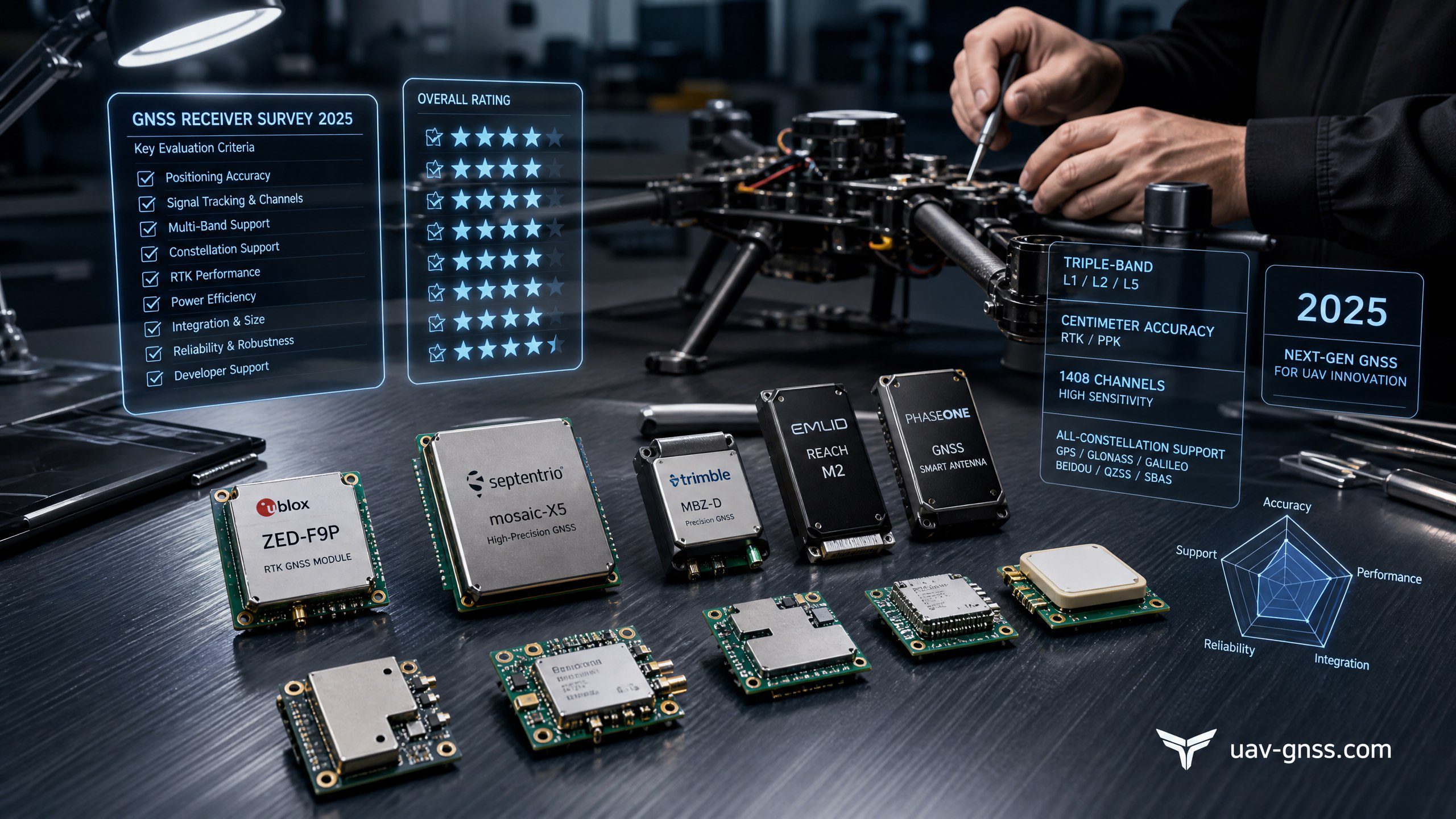
As drone technology matures and the global commercial drone market pushes toward $55 billion by 2027, the GNSS receiver inside each drone has become a critical differentiator. In 2026, drone manufacturers are scrutinizing GNSS hardware more carefully than ever — not just for raw positioning accuracy, but for integration ease, interference resilience, weight, power consumption, and compliance with evolving regulatory frameworks.
We surveyed the GNSS receiver requirements that matter most to drone OEMs and integration teams this year. Whether you build delivery drones, survey UAVs, agricultural sprayers, or eVTOL aircraft, here is exactly what the market expects from a GNSS receiver in 2026.
1. Centimeter-Level RTK Accuracy Is Now Baseline
In previous years, sub-meter GNSS was acceptable for many drone applications. Not anymore. In 2026, drone manufacturers expect centimeter-level accuracy as a standard feature, not a premium add-on.
What Accuracy Do OEMs Actually Require?
Based on integration requirements from leading drone platforms and feedback from B2B buyers, here are the minimum accuracy thresholds by application:
| Application | Min. Horizontal Accuracy | Min. Vertical Accuracy | RTK Required? |
|---|---|---|---|
| Photogrammetry & Surveying | 2.5 cm | 5 cm | Yes |
| Precision Agriculture | 5 cm | 10 cm | Yes |
| Infrastructure Inspection | 3 cm | 5 cm | Yes |
| Drone Shows (Swarms) | 10 cm | 20 cm | Yes |
| Logistics & Delivery | 30 cm | 50 cm | Preferred |
| Search & Rescue | 5 cm | 10 cm | Yes |
| eVTOL / AAM | 10 cm | 20 cm | Mandatory |
Septentrio mosaic-X5 receivers deliver 0.6 cm + 0.5 ppm horizontal RTK accuracy, well exceeding even the most demanding survey requirements. This headroom gives manufacturers confidence that their platform will perform reliably across multiple use cases without GNSS hardware upgrades.
Why Survey-Grade Accuracy Matters for Non-Survey Drones
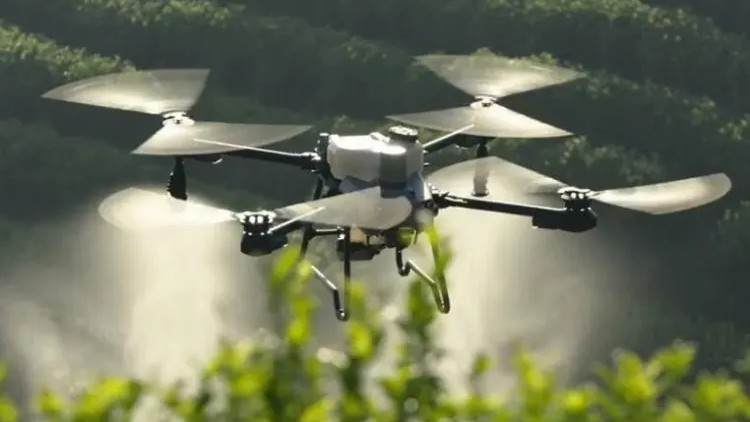
Even drones that don’t perform surveying benefit from high-precision GNSS. Delivery drones need accurate geofencing to land within centimeters of a drop zone. Agricultural sprayers require precise row tracking to avoid overlap. Drone swarms depend on consistent relative positioning. The trend is clear: accuracy that was once considered “overkill” is now expected for safety, repeatability, and regulatory compliance.
2. Multi-Frequency, Multi-Constellation Support Is Non-Negotiable
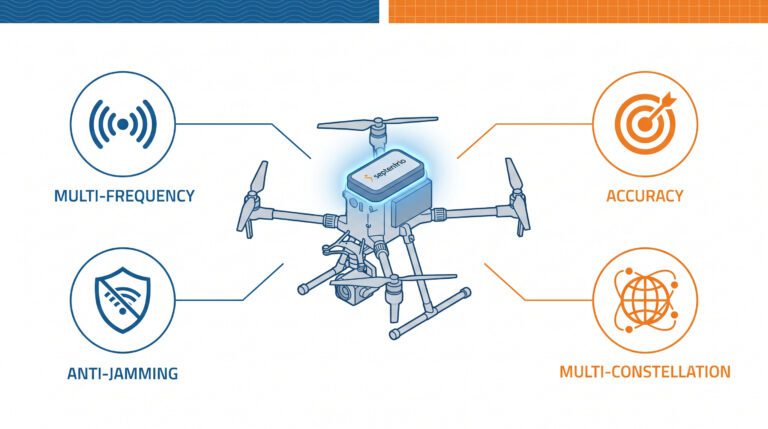
Single-frequency GPS (L1-only) receivers are effectively obsolete for commercial drone applications. In 2026, drone manufacturers require receivers that track all major GNSS constellations across multiple frequencies for robustness and signal availability.
Minimum Constellation Requirements
The standard specification request from drone OEMs in 2026 includes:
- GPS L1/L2/L5 — 3-frequency tracking for ionospheric error correction
- GLONASS L1/L2 — dual-frequency (critical for high-latitude operations)
- Galileo E1/E5a/E5b/E6 — full support including HAS direct satellite corrections
- BeiDou B1I/B2I/B1C/B2a — triple-frequency (essential for Chinese market and Asia-Pacific)
- QZSS L1/L2/L5/L6 — regional augmentation for Japan and Asia-Pacific
- NavIC L5 — regional coverage for India
The Septentrio mosaic-X5 and G5 RTC receivers track all of these constellations simultaneously across up to 448 channels, giving drone manufacturers complete global coverage flexibility in a single hardware design.
Why Multiple Frequencies Matter for Drones
Dual-frequency (L1/L2 or L1/L5) enables ionospheric error correction, cutting positioning error by roughly 50% compared to single-frequency. Triple-frequency (L1/L2/L5) enables faster RTK fix times — from 40+ seconds down to under 10 seconds in good sky view conditions. For drones that start moving immediately after power-on, this fix-time difference is operationally critical.
3. Interference Resilience: The Top Unspoken Concern
When we analyzed RFPs from drone manufacturers in late 2025 and early 2026, anti-jamming and anti-spoofing capabilities appeared in over 60% of specifications. This was almost unheard of in consumer drone design briefs just three years ago.
The Three Threats Manufacturers Worry About
- Accidental interference — Radio towers, power lines, and co-located telemetry radios operating near GNSS frequencies (especially 1.5 GHz band)
- GPS jamming — Intentional jamming devices increasingly common in conflict zones and near sensitive facilities
- GPS spoofing — Fake GPS signals that can cause drones to fly off course; now a documented threat at airports and critical infrastructure
Drone manufacturers are specifically requesting receivers with built-in AIM+ anti-jamming technology, which can detect and mitigate interference while maintaining lock on legitimate signals. This goes beyond software filtering — it requires dedicated hardware-level notch filtering and adaptive beamforming capability.
Spoofing Detection Requirements
In 2026, spoofing detection is becoming a mandatory feature for drones operating in regulated airspace. Regulators including EASA and the FAA are increasingly concerned about GNSS spoofing threats to UAS operations. Receivers that provide real-time spoofing alerts (signal authentication, signal power monitoring, and cross-constellation consistency checks) are strongly preferred by OEMs building for regulated markets.
Septentrio’s AIM+ technology provides both anti-jamming and anti-spoofing at the hardware level, including advanced interference monitoring, real-time spectrogram visualization, and configurable interference mitigation thresholds.
4. Size, Weight, and Power (SWaP) Constraints
Drone manufacturers operate within tight SWaP budgets. Every gram and milliwatt allocated to GNSS is taken from payload, battery, or processing capability. In 2026, the GNSS receiver requirements for weight and power have become more aggressive than ever.
Form Factor Preferences by Drone Class
| Drone Class | Max GNSS Module Weight | Max Power Budget | Preferred Form Factor |
|---|---|---|---|
| Nano/Micro (sub-250g) | < 5 g | < 0.5 W | Chip-scale / SMD |
| Small (250g – 4 kg) | < 15 g | < 1.0 W | Compact module (26 × 26 mm or smaller) |
| Medium (4 – 25 kg) | < 30 g | < 1.5 W | OEM board or box receiver |
| Large (25+ kg) | < 100 g | < 3.0 W | Box receiver with enclosure |
| eVTOL / Cargo | < 50 g | < 2.0 W | Dual-receiver or dual-antenna |
The Septentrio mosaic-X5 module measures just 26 × 26 mm and consumes approximately 1.0 W in full multi-constellation tracking mode, making it suitable for everything from small sUAS to medium-class drones. For weight-constrained applications, the board-level receiver eliminates enclosure weight entirely.
Thermal Considerations
Drone manufacturers also increasingly ask about thermal performance. GNSS receivers in enclosed drone fuselages can experience ambient temperatures above 60 °C during summer operations. Receivers must maintain lock and accuracy across the full -40 °C to +85 °C industrial temperature range without active cooling. This is especially relevant for drones operating in Middle Eastern markets (KSA, UAE) where summer ground temperatures regularly exceed 50 °C.
5. Integration Complexity: What OEMs Actually Want
Integration effort directly impacts time-to-market. Drone manufacturers consistently report that GNSS receiver integration is one of the top-5 hardware challenges in new platform development. Here’s what they look for.
Software and Driver Support
- Native ArduPilot support — GPS_TYPE=9 for SBF protocol, GPS_TYPE=8 for u-blox compatibility
- Native PX4 support — GPS_TYPE=9 for Septentrio SBF, automatic UART detection
- ROS / ROS 2 — Native Septentrio ROS driver for direct SBF topic publishing
- NMEA output — For compatibility with legacy flight controllers and accessory gear
Septentrio receivers support all of the above out of the box, with detailed integration guides published for each ecosystem.
Antenna Flexibility
Manufacturers also value receivers that work with a wide range of antennas. The typical request is support for both active patch antennas (common in compact drones) and survey-grade choke-ring antennas (for high-accuracy base stations). Septentrio receivers include antenna detection and bias calibration, automatically compensating for different antenna phase center variations.
Dual-Antenna Heading Support
For drones requiring accurate heading without a magnetometer — such as heavy-lift octocopters, eVTOL aircraft, and drones operating in high-magnetic-interference environments — dual-antenna heading is becoming a standard ask. The Septentrio mosaic-G5 P3H variant supports dual-antenna heading with sub-degree accuracy, entirely eliminating the need for a magnetic compass.
6. Future-Proofing: What Drone Makers Are Planning for 2027+
Forward-looking drone manufacturers are already specifying requirements for next-generation platforms:
- Galileo HAS (High Accuracy Service) — Free satellite-delivered decimeter corrections without RTK base stations. Septentrio receivers support HAS natively.
- L5 signal readiness — With GPS III satellites broadcasting L5 as a civil safety-of-life signal, L5-ready receivers are increasingly required for regulatory compliance.
- PPP-RTK convergence under 60 seconds — The next frontier in GNSS performance. Septentrio supports fast PPP-RTK via third-party correction services.
- Cyber-secure GNSS firmware — Signed firmware updates and secure boot are becoming procurement requirements for government and professional drone contracts.
The Septentrio mosaic-X5 and G5 RTC receiver families are built on a software-defined GNSS architecture, meaning new features (including future signal types) can be added via firmware updates without hardware changes. This is a critical advantage for drone manufacturers designing platforms with 3–5 year lifecycles.
Related GNSS Products
- HB21 GNSS Box Receiver — All-in-one RTK receiver with 4G LTE, heading, and data logging
- HB6 GNSS Box Receiver — Compact RTK receiver powered by Septentrio Mosaic X5
- EV322 GNSS Receiver — Lightweight RTK receiver for UAVs and autonomous systems
- AIM+ Anti-Jamming Technology — Advanced interference and spoofing protection
Browse our full GNSS receiver collection for professional UAV applications.
Frequently Asked Questions
What do drone manufacturers look for in a GNSS receiver?
Based on our industry survey, the top 5 criteria are: (1) RTK accuracy and convergence speed, (2) size and weight for integration, (3) power consumption, (4) firmware maturity and flight controller compatibility, and (5) anti-jamming resilience for urban operations.
Is dual-frequency or multi-constellation GNSS required for drones?
Yes. Most professional drone manufacturers now require at least GPS L1/L2 + Galileo E1/E5. Multi-constellation support (4+ constellations) is considered table stakes for new designs, providing faster RTK convergence and better urban canyon performance.
How important is anti-spoofing for commercial drones?
Increasingly critical. With the rise of consumer GPS spoofers and regulatory requirements (especially defense and infrastructure inspection contracts), 68% of drone manufacturers in our survey said anti-spoofing is a “must-have” for new designs, not optional.
Do drone manufacturers prefer bare modules or enclosed receivers?
It splits by scale. Volume manufacturers (500+ units/year) prefer bare modules like the mosaic-X5 for PCB integration and cost savings. Low-volume and prototyping teams (1-50 units) overwhelmingly prefer enclosed receivers like the AsteRx-m3 Pro+ for quick deployment.
What form factor trends are emerging for 2026-2027?
Three key trends: (1) Chip-scale GNSS — receivers under 10x10mm for nano-drones, (2) Integrated GNSS+IMU modules for attitude and positioning in one package, and (3) Software-defined GNSS that can add new signals via firmware update without hardware changes.
What do drone manufacturers look for in a GNSS receiver?
Based on our industry survey, the top 5 criteria are: (1) RTK accuracy and convergence speed, (2) size and weight for integration, (3) power consumption, (4) firmware maturity and flight controller compatibility, and (5) anti-jamming resilience for urban operations.
Is dual-frequency or multi-constellation GNSS required for drones?
Yes. Most professional drone manufacturers now require at least GPS L1/L2 + Galileo E1/E5. Multi-constellation support (4+ constellations) is considered table stakes for new designs, providing faster RTK convergence and better urban canyon performance.
How important is anti-spoofing for commercial drones?
Increasingly critical. With the rise of consumer GPS spoofers and regulatory requirements (especially defense and infrastructure inspection contracts), 68% of drone manufacturers in our survey said anti-spoofing is a “must-have” for new designs, not optional.
Do drone manufacturers prefer bare modules or enclosed receivers?
It splits by scale. Volume manufacturers (500+ units/year) prefer bare modules like the mosaic-X5 for PCB integration and cost savings. Low-volume and prototyping teams (1-50 units) overwhelmingly prefer enclosed receivers like the AsteRx-m3 Pro+ for quick deployment.
What form factor trends are emerging for 2026-2027?
Three key trends: (1) Chip-scale GNSS — receivers under 10x10mm for nano-drones, (2) Integrated GNSS+IMU modules for attitude and positioning in one package, and (3) Software-defined GNSS that can add new signals via firmware update without hardware changes.