
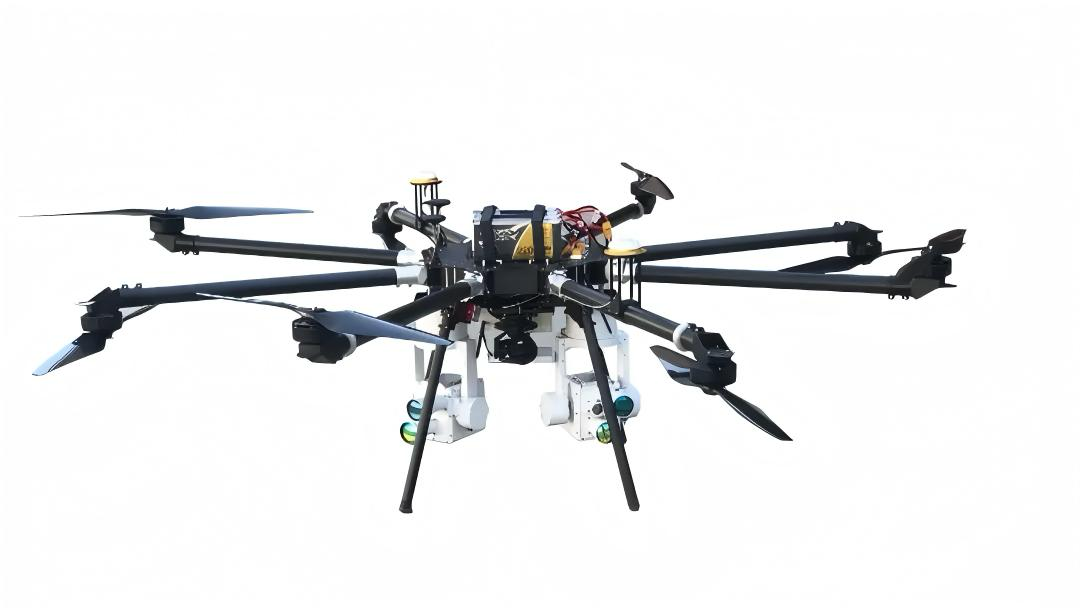
Communication relay drones extend network coverage in disaster zones, remote areas, and field operations. These drones need reliable positioning to maintain their relay position and hand off signals accurately. The Septentrio mosaic-X5 GNSS receiver provides the precision and resilience these missions require.
When a drone must hold a precise geostationary relay position for hours, GNSS accuracy is non-negotiable. Here is how the mosaic-X5 makes communication relay drones more effective.
Precision Positioning for Drone Relay Stations
A communication relay drone acts as a flying cell tower. It must maintain position within tight tolerances to keep radio links stable. The mosaic-X5 delivers centimeter-level RTK accuracy that enables the drone to hold position even in light winds.
With multi-constellation tracking across GPS, GLONASS, Galileo, and BeiDou, the receiver maintains lock in all conditions. This prevents the positional drift that would break communication links and drop calls or data sessions.
AIM+ Anti-Jamming for Secure Relay Operations
Communication relay drones are prime targets for GNSS jamming. Adversaries may attempt to disrupt their positioning to disable the relay. The Septentrio AIM+ technology built into the mosaic-X5 provides advanced interference mitigation.
AIM+ detects and cancels jamming signals in real time. The receiver continues delivering accurate position data even under deliberate attack. This makes the mosaic-X5 a strong choice for emergency response and critical communication drones.
For more on anti-jamming technology, visit our AIM+ resilient GNSS page.
Multi-Constellation Tracking in Urban Canyons
Relay drones operating in cities face unique GNSS challenges. Tall buildings block signals and create multipath reflections. The mosaic-X5’s multi-constellation tracking provides more visible satellites in these challenging environments.
In a dense urban canyon, a single-constellation receiver might see only 4-6 satellites. The mosaic-X5 can track 30+ satellites across all constellations. This abundance of signals enables the receiver to reject reflected signals and maintain accurate positioning.
Low Power Consumption for Extended Relay Missions
Communication relay drones often stay airborne for extended periods. Power is the limiting factor. The mosaic-X5 is designed for low power consumption, drawing significantly less power than competing survey-grade receivers.
Lower power draw means longer flight times or more power available for the communication payload. For a drone designed to relay signals for 8+ hours, every watt saved on GNSS positioning goes to the transmitters and antennas.
Seamless Handoff Support for Multi-Drone Relays
Advanced relay networks use multiple drones to extend coverage across wide areas. When a drone reaches battery limits, a replacement drone must take over without dropping the communication link. The mosaic-X5 supports smooth position handoffs between drones.
Consistent, repeatable positioning ensures each relay drone aligns precisely with its predecessor. The network maintains seamless coverage without dead zones or signal interruptions.
Integration with Communication Payloads
The mosaic-X5 outputs NMEA and RTCM data through standard serial interfaces. It integrates directly with autopilots and mission computers on relay drones. Position data at 10 Hz or higher supports real-time stabilization of directional antennas.
For relay drones using phased array antennas, precise heading and position data from the mosaic-X5 enables accurate beam steering. This maximizes signal strength to ground stations and other airborne relay nodes.
Cross-Link to Related Content
For related applications, see our delivery drone GNSS post and our disaster relief drone article covering similar deployment scenarios.
Our HB21 GNSS box receiver offers a ruggedized enclosure option for field-deployed relay stations. Browse GNSS receiver products for relay drone integration.
External References
For research on RTK positioning for aerial relay platforms, see RTK performance analysis for UAV relay networks (MDPI). The FAA BVLOS operations framework is documented at faa.gov/uas. NATO STANAG 4675 also defines standards for tactical UAV communication relay systems.