Why Industrial Inspection Drones Need Resilient GNSS
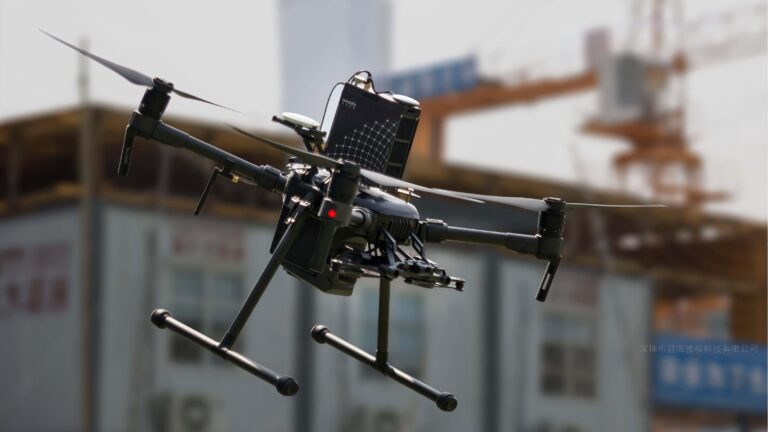
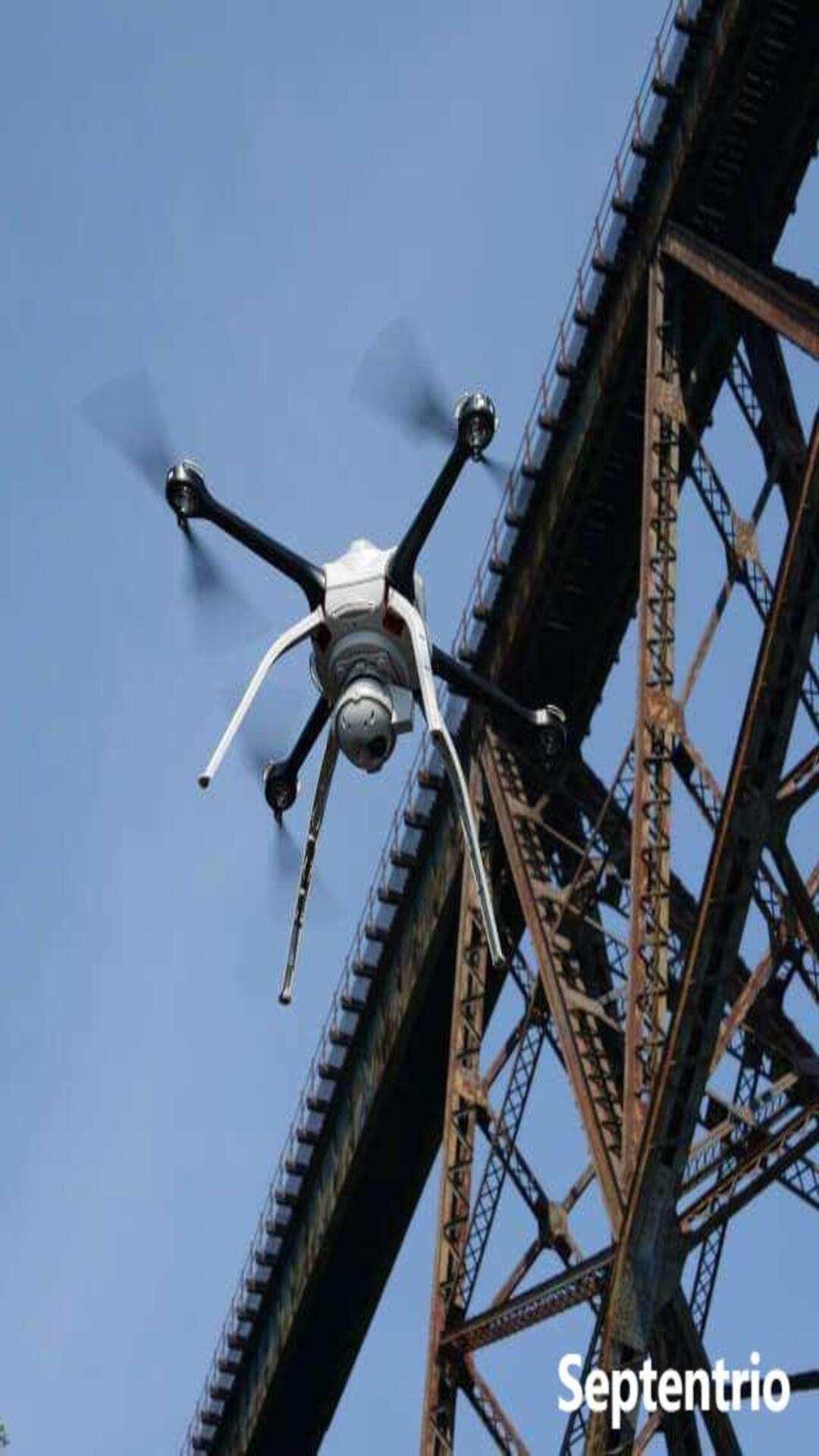
Industrial asset inspection drones operate in some of the most challenging RF environments imaginable — inside steel-framed structures, beneath bridges, along power lines, and near refinery equipment. These settings create signal reflections, multipath interference, and partial sky occlusion that cause standard GNSS receivers to lose lock or drift by meters.
For professionals inspecting bridges, storage tanks, transmission towers, and industrial facilities, positioning reliability is non-negotiable. A momentary position error during close-quarters inspection can result in collisions, incomplete data, or safety incidents. The Septentrio mosaic-G5 P3H is purpose-built for these conditions, delivering centimeter-level accuracy where other receivers fail.
For a complete overview of solutions, explore Septentrio-powered GNSS receivers at uav-gnss.com.
The Mosaic-G5 P3H: Engineered for Inspection Environments
Why Metal Structures and RF Equipment Degrade GNSS Performance
Inspection drones frequently fly within meters of large metal surfaces — bridge girders, storage tank walls, transmission towers, and industrial piping. These surfaces cause GNSS signals to reflect, creating multipath errors that can reach several meters with standard receivers. Additionally, nearby RF equipment such as power transformers, radio antennas, and industrial machinery generates interference that further degrades signal quality.
Research from the 2025 ISPRS Archives demonstrates that integrated LiDAR/IMU/RTK fusion is required for bridge inspection localization near large structures, highlighting the challenge that standard GNSS alone faces in these environments.
AIM+ Anti-Interference for Industrial Environments
The mosaic-G5 P3H incorporates Septentrio’s AIM+ interference mitigation technology, which actively scans the RF spectrum and suppresses narrowband, broadband, and swept interference signals. This ensures that inspection drones maintain reliable positioning even when operating near active industrial equipment, power lines, and communications infrastructure.
Learn more about AIM+ resilient GNSS technology for interference-free inspection operations.
Key Specifications for Inspection Drone Applications
| Specification | Details |
|---|---|
| Constellations | GPS, GLONASS, Galileo, BeiDou, QZSS |
| RTK Accuracy | Centimeter-level (8 mm + 1 ppm) |
| Multipath Rejection | AIM+ with APME+ technology |
| Anti-Jamming | Built-in interference mitigation |
| Heading | Dual-antenna real-time heading |
| Update Rate | Up to 100 Hz |
| Operating Temp | -40°C to +85°C |
Key Applications for Inspection Drones
Bridge and Infrastructure Inspection
Inspecting bridge substructures requires precise positioning despite partial GNSS occlusion under the deck and multipath reflections from steel and concrete surfaces. The mosaic-G5 P3H’s APME+ multipath suppression technology separates direct signals from reflections, maintaining centimeter accuracy for close-proximity bridge surveys.
Products like the EV322 GNSS Receiver, based on the mosaic-G5 P3H module, provide a lightweight RTK solution specifically designed for inspection drone integration. At just 14 g, it adds minimal payload weight.
Power Line and Transmission Tower Inspection
For power line corridor inspection, drones must navigate near high-voltage conductors that generate electromagnetic interference. The mosaic-G5 P3H’s built-in interference mitigation maintains reliable lock even in these challenging RF environments, enabling safe automated inspection flights.
Refinery and Industrial Facility Inspection
Refineries, chemical plants, and industrial facilities present complex environments with metal structures, pipes, and active RF equipment. The mosaic-G5 P3H’s multi-constellation tracking (GPS, GLONASS, Galileo, BeiDou) ensures strong satellite geometry even when sky visibility is restricted by structures.
Like the mosaic-G5 P3H used in industrial cleaning drone applications, this receiver shares the same GNSS+ technology suite for reliable operation near building surfaces.
Integration with Inspection Drone Systems
The mosaic-G5 P3H is compatible with all major flight controllers including PX4 and ArduPilot via standard UART interface. Our EV322 GNSS Receiver provides plug-and-play integration, making it the ideal choice for inspection drone manufacturers. The module’s compact 22.8 × 16.4 × 2.4 mm footprint and 2.2 g weight allow seamless integration into space-constrained drone designs.
The HB21 GNSS Box Receiver offers additional features including dual-antenna heading and 4G LTE for remote RTK correction streaming.
For further reading, refer to the MDPI Sensors research on RTK positioning reliability for drones in critical GNSS environments — directly applicable to bridge and infrastructure inspection missions.
Why the Mosaic-G5 P3H Is the Right GNSS Receiver for Inspection Drones
- AIM+ anti-interference for reliable positioning near industrial RF equipment
- APME+ multipath suppression for accuracy near metal structures and building surfaces
- Centimeter-level RTK accuracy for close-proximity inspection safety
- Multi-constellation tracking for reliable lock in restricted sky visibility
- Compact 2.2 g, 22.8 × 16.4 × 2.4 mm footprint for weight-sensitive platforms
- Dual-antenna heading for precise orientation near structures
- Wide -40°C to +85°C operating range for industrial environments
- Compatible with PX4 and ArduPilot flight controllers
For asset inspection professionals requiring reliable positioning in the most challenging industrial environments, the Septentrio mosaic-G5 P3H delivers the resilience and accuracy that mission-critical inspections demand.
Building Inspection Drones: Mosaic-X5 for Structural Surveys
Why Building Inspection Drones Need Precision GNSS
Building inspection drones operate near large structures where GNSS signals reflect off glass, steel, and concrete surfaces. These reflections create multipath errors that can degrade positioning accuracy by several meters with standard receivers. For professionals conducting structural health monitoring, facade inspections, and deformation surveys, reliable centimeter-level positioning near building surfaces is essential — not optional.
The Septentrio mosaic-X5 is purpose-built for these challenging environments, delivering AIM+ multipath rejection, centimeter-level RTK accuracy, and 100 Hz update rate in an ultra-compact form factor designed for building inspection drones.
For a complete overview of solutions, explore Septentrio-powered GNSS receivers at uav-gnss.com.
Why Traditional GNSS Fails in Building Monitoring
Building inspection drones require GNSS receivers with advanced multipath rejection to maintain centimeter accuracy near large structures that reflect and block satellite signals. Standard consumer-grade GPS modules use basic filtering that cannot distinguish between the true satellite signal and its reflected copy. When a drone flies within meters of a glass curtain wall or steel frame, the receiver sees multiple versions of the same signal arriving at slightly different times, causing position errors of 1-5 meters or more.
Research published in MDPI Sensors (2024) specifically studied RTK GNSS positioning near tall walls, finding that signal reflections cause significant degradation, extended re-acquisition times of 9-13 seconds, and risk of false fixes. These issues make standard receivers unreliable for professional building inspection workflows.
The Mosaic-X5: Designed for Near-Building Navigation
APME+ Multipath Suppression for Urban Environments
The mosaic-X5 incorporates Septentrio’s APME+ multipath suppression technology, which precisely identifies signal characteristics to separate direct line-of-sight signals from reflections. In building inspection scenarios — where glass facades, steel beams, and concrete surfaces create complex multipath environments — this technology maintains centimeter-level accuracy where standard receivers experience meter-level drift.
Learn more about AIM+ resilient GNSS technology for interference-free building inspection operations.
GNSS+ Technology Suite for Inspection Environments
- APME+ multipath suppression: Filters reflected signals from building surfaces, preserving only direct signals for accurate positioning
- AIM+ anti-interference: Suppresses RF interference from construction equipment, communication systems, and other urban RF sources
- LOCK+ vibration-resistant tracking: Maintains stable signal lock during wind gusts and inspection maneuvers
- IONO+ ionospheric compensation: Ensures consistent positioning across day-night temperature swings
Key Specifications for Building Inspection
- RTK accuracy: 0.6 cm + 0.5 ppm horizontal, 1 cm + 1 ppm vertical
- Multi-constellation tracking: GPS, GLONASS, Galileo, BeiDou (448 channels)
- Update rate: Up to 100 Hz with sub-10 ms latency
- RTK initialization: 7 seconds for rapid pre-inspection setup
- Ultra-compact: 31 × 31 × 4 mm, 7 g for weight-sensitive platforms
- Ultra-low power: 0.6 W typical for extended inspection missions
- Operating range: -40°C to +85°C for all-weather operations
Key Applications for Building Inspection Drones
Structural Health Monitoring
For long-term structural monitoring, the mosaic-X5 enables repeatable centimeter-level positioning across multiple inspection flights spanning weeks, months, or years. This allows engineers to detect sub-centimeter structural movement, crack propagation, and deformation that would be invisible with standard GNSS.
Products like the HB21 GNSS Box Receiver package the mosaic-X5 with dual-antenna heading and 4G NTRIP for permanent monitoring installations, while the EV322 GNSS Receiver offers a lightweight solution for periodic inspection flights.
Facade and Cladding Inspection
Inspecting building facades requires precise positioning relative to the structure to accurately map defects, cracks, and deterioration. The mosaic-X5’s 100 Hz update rate with sub-10 ms latency enables responsive control for close-proximity facade surveys, while dual-antenna heading (0.08°) provides accurate orientation data for knowing exactly which section of the building is being inspected.
Like the mosaic-X5 used in construction machinery applications, this receiver shares the same robust positioning core for demanding built-environment operations.
Deformation and Settlement Monitoring
For monitoring building settlement and ground deformation around construction sites, the mosaic-X5’s consistent sub-centimeter accuracy ensures that apparent changes reflect actual movement rather than positioning noise. RTK initialization in just 7 seconds enables efficient multi-site monitoring campaigns.
Integration with Inspection Workflows
The mosaic-X5 is compatible with all major flight controllers (PX4, ArduPilot) and outputs standard RINEX and RTCM data for photogrammetry and LiDAR processing. Our u-blox to Septentrio upgrade guide explains why the mosaic-X5 achieves RTK fix 40-60% faster than competing modules — critical for time-efficient building inspection campaigns.
For further reading, refer to the MDPI Sensors research on RTK positioning reliability for drones operating near tall walls and structures.
Why the Mosaic-X5 Is the Right GNSS Receiver for Building Inspection Drones
- APME+ multipath suppression for reliable accuracy near glass, steel, and concrete surfaces
- Centimeter-level RTK accuracy for precise defect mapping and structural monitoring
- 100 Hz update rate for responsive inspection flight control
- Multi-constellation tracking for reliable lock in urban environments
- Ultra-compact 7 g design for weight-sensitive platforms
- Ultra-low 0.6 W power consumption for extended inspection missions
- Dual-antenna heading for accurate orientation data near structures
- Compatible with PX4 and ArduPilot flight controllers
For structural engineers, building surveyors, and infrastructure monitoring professionals, the Septentrio mosaic-X5 delivers the positioning reliability that professional building inspection demands.
Bridge Monitoring UAVs: Mosaic-G5 P3H for Infrastructure Inspection
Precision GNSS Positioning for Bridge Structural Monitoring with UAVs
Bridges are critical infrastructure assets that require regular structural health monitoring to ensure safety and longevity. Unlike point-in-time inspections, structural monitoring involves repeated measurements over weeks, months, or years to detect subtle changes in deformation, settlement, and alignment. Unmanned Aerial Vehicles (UAVs) equipped with high-precision GNSS receivers are transforming how engineers approach bridge monitoring, offering centimeter-level repeatability without disrupting traffic or requiring extensive scaffolding.
At the heart of this capability is the Septentrio Mosaic-G5 P3H GNSS module, a compact, multi-frequency receiver that delivers RTK-fixed positioning with centimeter accuracy. When integrated into UAV platforms for bridge monitoring, it enables surveyors and civil engineers to capture consistent, georeferenced measurements over repeated flights — data that reveals structural drift, thermal expansion effects, and early signs of instability long before they become visible to the naked eye.
Why Bridge Monitoring Demands More Than Inspection-Grade Accuracy
Bridge inspection focuses on visible defects: cracks, corrosion, spalling concrete. Bridge monitoring goes deeper — it tracks the structure’s geometric behavior over time. A bridge that shifts 5 mm at a critical load-bearing joint over six months may indicate foundation settlement or bearing degradation. Detecting this requires positioning repeatability at the centimeter level, flight after flight, season after season.
Standard consumer-grade GNSS receivers cannot deliver this consistency. Their single-frequency positioning drifts by meters under changing atmospheric conditions and satellite geometry. The Septentrio Mosaic-G5 inside the EV322 GNSS receiver overcomes these limitations with multi-constellation, multi-frequency tracking (GPS L1/L2/L5, GLONASS, BeiDou, Galileo), coupled with an RTK engine that locks phase ambiguities to deliver fixed solutions with 1-2 cm horizontal accuracy.
The P3H Advantage: Dual-Antenna Heading for Consistent Cross-Track Positioning
The “P3H” designation in the Mosaic-G5 P3H indicates support for dual-antenna heading. This is particularly valuable for bridge monitoring UAVs flying in confined corridors alongside or beneath bridge decks, where GPS satellite visibility may be partially obstructed. Dual-antenna heading provides an absolute, GNSS-based yaw reference that remains stable even when the UAV is hovering at low velocity — conditions where single-antenna systems struggle to maintain heading accuracy.
Research published in the ISPRS Archives demonstrates that UAV-based bridge inspection systems integrating RTK positioning and dual-antenna GNSS achieve localization errors below 2 cm, even in challenging multi-path environments under bridge superstructures. The Mosaic-G5 P3H brings this level of performance to a module weighing just 19 grams — small enough for any UAV payload budget.
Real-World Applications in Bridge Monitoring Workflows
Repeated Photogrammetric Surveys
By mounting a high-resolution camera on a UAV equipped with the Mosaic-G5 P3H, engineers can fly the same waypoint path at monthly or quarterly intervals. RTK-tagged images produce dense point clouds that are compared across epochs using cloud-to-cloud distance analysis. The AIM+ resilient GNSS anti-jamming technology ensures that positioning remains reliable even near power lines, radio towers, or other sources of electromagnetic interference commonly found on bridge structures.
Deformation Monitoring of Suspension Bridge Cables and Towers
Long-span suspension bridges are sensitive to thermal expansion, wind loading, and traffic-induced vibration. UAVs flown along cable planes and around towers capture centimeter-precision positions that, when compared with finite element models, reveal whether the structure is behaving within design parameters. The Septentrio receiver’s low-signal tracking capability maintains lock even when the UAV maneuvers between cable stays where sky visibility is limited.
Post-Earthquake Rapid Structural Assessment
After a seismic event, rapid assessment of bridge displacement is critical for reopening transport corridors. Deploying a UAV with RTK GNSS within hours provides immediate measurement of pier displacement, deck offset, and approach settlement — data that informs whether a bridge is safe for emergency vehicles. The Mosaic-G5’s fast RTK initialization, typically under 10 seconds, is essential in these time-critical scenarios.
GPS Spoofing and Jamming Protection for Infrastructure UAVs
Bridge monitoring UAVs operate in urban and industrial environments where GNSS interference is increasingly common. The Septentrio Mosaic-G5 incorporates built-in AIM+ anti-jamming and anti-spoofing technology that filters out narrow-band and wide-band interference while maintaining phase lock on authentic satellite signals. This is especially important for long-term monitoring programs where data integrity across multiple flight campaigns must be guaranteed. The HB6 GNSS box receiver offers similar protection in a rugged enclosure suitable for ground-based reference stations used in differential processing.
Comparison with Traditional Monitoring Methods
Traditional bridge monitoring relies on total stations, inclinometers, and prism-based survey networks. These methods are accurate but expensive, slow, and often require lane closures. UAV-based GNSS monitoring offers:
- Speed: A 500-meter bridge can be surveyed in under 15 minutes of flight time
- Repeatability: Automated flight paths ensure identical camera stations across surveys
- Cost: Eliminates scaffolding, traffic control, and survey crew mobilization costs
- Safety: Keeps personnel away from traffic and heights
The HB21 GNSS box receiver serves as an ideal base station for differential correction, providing a stable reference that anchors the entire monitoring network across years of data collection.
Key GNSS Performance Metrics for Bridge Monitoring
For structural monitoring to detect meaningful deformation, the GNSS system must deliver specific performance characteristics:
- Horizontal accuracy: ≤ 2 cm RMS in RTK fixed mode
- Vertical accuracy: ≤ 3 cm RMS (vertical is typically 1.5x worse than horizontal in GNSS)
- Time-to-first-fix: Under 15 seconds from cold start
- Heading accuracy (dual-antenna): ≤ 0.1° at 1 m baseline
- Update rate: 10 Hz or higher for capturing dynamic displacement
The Septentrio Mosaic-G5 P3H meets or exceeds all these specifications, making it one of the most capable GNSS modules available for bridge monitoring UAV applications today.
Conclusion: The Future of Bridge Structural Health Monitoring
As infrastructure ages and monitoring budgets tighten, UAV-based structural health monitoring with high-precision GNSS will become the standard for bridge management agencies worldwide. The Septentrio Mosaic-G5 P3H, with its dual-antenna heading, RTK positioning, and anti-jamming resilience, provides the positioning backbone that makes this possible.
For teams already using UAVs for bridge inspection, adding long-term monitoring capability requires only the GNSS hardware upgrade — the same UAV platform, the same pilot, the same software workflow. The result is a quantum leap in the quality and quantity of structural data available to engineers.
Explore the EV322 receiver or the AIM+ GNSS resilience module for your bridge monitoring program. For the full range of GNSS solutions for UAV infrastructure inspection, visit uav-gnss.com.
External reference: ISPRS Archives — “A seamless LiDAR/IMU/RTK fused localization method for UAV-Based bridge inspection” (2025). Available at: https://isprs-archives.copernicus.org/articles/XLVIII-G-2025/937/2025/
External reference: MDPI Sensors — “Reliability of Real-Time Kinematic (RTK) Positioning for Low-Cost Drones’ Navigation across GNSS Critical Environments” (2024). Available at: https://www.mdpi.com/1424-8220/24/18/6096
Frequently Asked Questions
Q: How does the mosaic-G5 P3H handle multipath interference near metal structures?
A: APME+ multipath suppression technology analyzes signal characteristics to identify and reject reflected signals from metal surfaces, steel structures, and building facades — ensuring only direct line-of-sight signals are used for position calculation.
Q: Can inspection drones maintain RTK fix near power lines and industrial RF equipment?
A: Yes. AIM+ anti-interference technology actively monitors and suppresses interference from power lines, transformers, and industrial equipment, maintaining centimeter-level RTK fix even in high-RF environments.
Q: What accuracy can the mosaic-G5 P3H achieve for bridge inspection?
A: With RTK corrections, the module delivers centimeter-level accuracy (8 mm + 1 ppm horizontal). Combined with dual-antenna heading, it enables precise positioning for automated bridge and infrastructure inspection flights.
Q: Is the EV322 GNSS Receiver compatible with PX4 and ArduPilot?
A: Yes. The EV322 works with any drone running PX4 or ArduPilot firmware via standard UART interface, providing plug-and-play integration for inspection drone manufacturers.
Related GNSS Products
- EV322 GNSS Receiver — Lightweight RTK receiver for inspection drones and autonomous systems
- HB21 GNSS Box Receiver — All-in-one RTK receiver with integrated 4G LTE, heading, and data logging
- HB6 GNSS Box Receiver — Compact quad-constellation RTK receiver powered by Septentrio Mosaic X5
- AIM+ Anti-Jamming Technology — Advanced interference and spoofing protection
Browse our full GNSS receiver collection for professional UAV inspection applications.
Further Reading
- Septentrio Mosaic-G5 P3H for Bridge Monitoring UAVs – Application-specific inspection guide
- Septentrio Mosaic-X5 for Building Inspection Drones – Structural inspection applications
- Anti-Jamming GNSS Drones: Threats and Protection Guide – Protect inspection missions from interference
- Why GNSS Firmware Updates Matter for Drone Performance – Keep your inspection drone up to date