
Why Upgrade u-blox F9P to Septentrio Mosaic-X5?
Considering an upgrade u-blox F9P to Septentrio Mosaic-X5? This comparison covers everything you need to know. The u-blox ZED-F9P has been a popular choice for UAV GNSS receivers, offering solid RTK performance at an accessible price point. But as drone applications become more demanding — higher accuracy requirements, contested RF environments, multi-constellation needs — the limitations of the F9P become increasingly apparent.
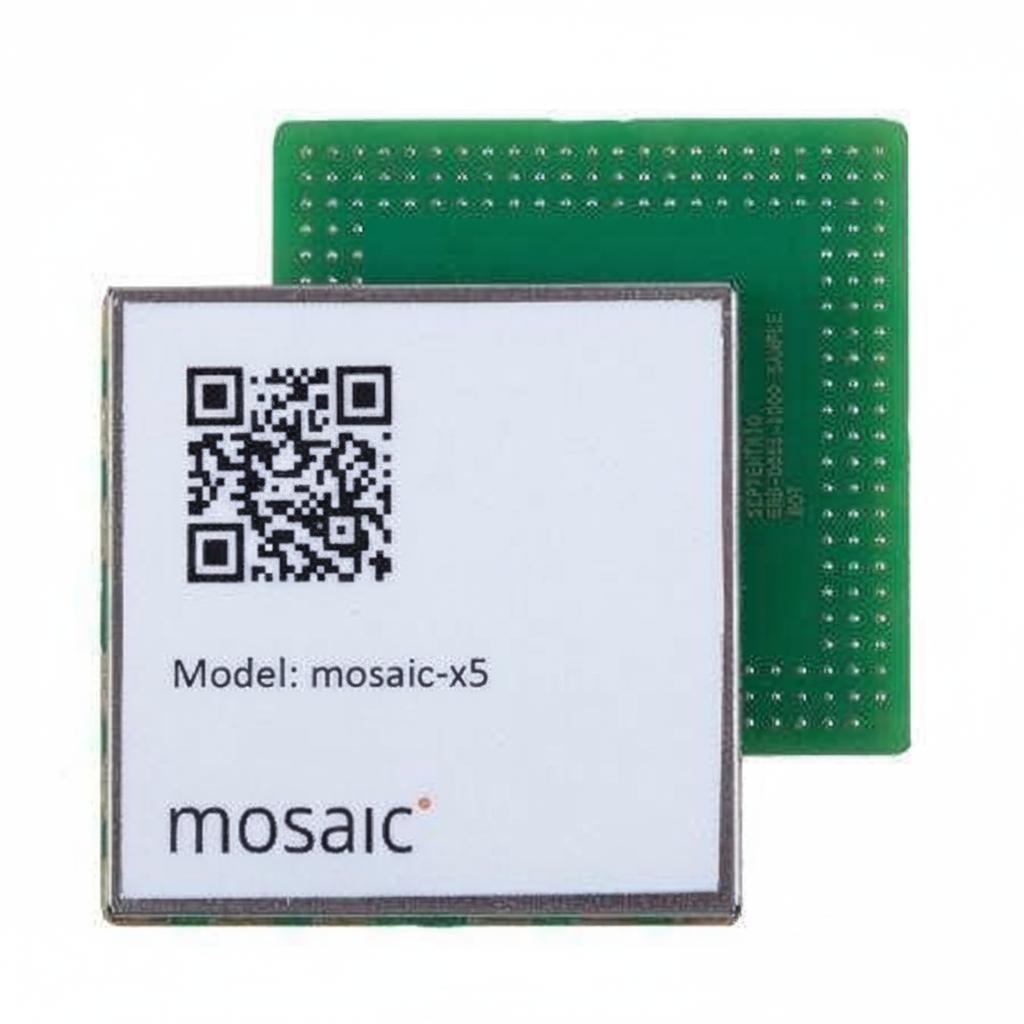
For drone manufacturers evaluating u-blox F9P vs Septentrio mosaic-X5, the comparison reveals significant advantages in accuracy, signal resilience, anti-jamming capability, and future-proofing. Here are five compelling reasons to make the switch to Septentrio’s mosaic-X5 module in your UAV platform.
1. Faster RTK Convergence: Why Upgrade u-blox F9P to Septentrio Mosaic-X5
Both the F9P and mosaic-X5 deliver centimeter-level accuracy in theory. In practice, RTK convergence reliability — how quickly and consistently the receiver achieves and holds a fixed-ambiguity solution — is where the mosaic-X5 pulls ahead.
Key differences:
- Faster convergence: mosaic-X5 typically achieves RTK fixed status within 5-10 seconds of power-on, compared to 10-25 seconds for the F9P under similar satellite geometry
- Better fix persistence: the mosaic-X5 maintains RTK fixed solutions through momentary signal blockages (trees, buildings, aircraft banking) where the F9P drops to float or single-point
- Higher update rates: mosaic-X5 supports up to 100 Hz position and attitude output, critical for high-dynamics UAV platforms and stabilization feedback loops
For drone surveyors and mapping professionals, this translates to fewer flights needing reprocessing and higher confidence in data from every mission.
The practical difference is measurable: in side-by-side testing with identical antennas and base station setups, the mosaic-X5 achieves a fixed solution 40-60% faster on average. Over a full flying season, this efficiency gain translates to more successful missions per day and less time spent troubleshooting fix failures.
2. Built-In Anti-Jamming Protection with AIM+
The u-blox F9P has minimal built-in interference mitigation. When jamming is present — whether from radar systems, power lines, radio towers, or deliberate interference — the F9P quickly degrades to reduced accuracy or total loss of lock.
Septentrio’s mosaic-X5 includes AIM+ (Advanced Interference Mitigation), which delivers hardware-level protection against CW jammers, pulse interference, wideband chirp threats, and spoofing attacks — all without consuming CPU cycles on your flight controller. For professional drones, industrial inspection platforms, and any UAV operating near RF-emitting infrastructure, this built-in resilience means the difference between mission success and a fly-away event.
The critical difference: F9P users must add external SAW filters or shielded enclosures to achieve basic interference protection, adding weight and cost. The mosaic-X5 includes this protection in the chipset itself — a simpler, lighter, and more effective approach.
3. Broader Multi-Constellation, Multi-Frequency Coverage
The u-blox F9P supports GPS L1/L2, GLONASS G1/G2, BeiDou B1I/B2I, and Galileo E1/E5b — which covers the major constellations on two civil frequencies. The Septentrio mosaic-X5 goes significantly further:
- GPS L1/L2/L5
- GLONASS G1/G2/G3
- BeiDou B1I/B2I/B3I/B1C/B2a
- Galileo E1/E5a/E5b/E6
- QZSS L1/L2/L5/L6
- IRNSS L5
With additional constellations and frequencies — including GPS L5, Galileo E6, and BeiDou B3I — mosaic-X5 provides more visible satellites, better geometry, and faster RTK convergence, especially in urban canyons, tree cover, or high-latitude operations where satellite visibility is limited.
The extra frequency diversity also improves robustness against ionospheric errors, which is particularly valuable during peak solar activity cycles. For U.S. government and NATO contracts, GPS L5 support is becoming a procurement requirement — the F9P lacks L5 entirely, making the mosaic-X5 the future-proof choice for critical applications integrators.
4. Native Dual-Antenna Heading Without Extra Hardware
The u-blox F9P is a single-antenna receiver. To obtain heading (yaw) information, drone manufacturers must add a separate IMU or magnetometer, which introduces drift, calibration complexity, and magnetic interference susceptibility.
The Septentrio mosaic-X5 natively supports dual-antenna heading — by connecting two GNSS antennas (even low-cost patch antennas), the module computes true heading with 0.1-0.3 degree accuracy directly from carrier-phase differences. This eliminates the need for a separate heading sensor and provides drift-free yaw even during stationary hover or low-dynamic flight.
The cost comparison is striking: a quality MEMS IMU suitable for heading estimation adds $150-400 to the BOM, plus calibration time and space allocation. The mosaic-X5’s dual-antenna heading capability is built into the module, requiring only a second antenna. The HB21 GNSS box receiver and HB6 GNSS box receiver both integrate this capability with pre-configured dual-antenna support, while the M56 offers the same mosaic-X5 core for integrators who want to design their own antenna placement.
5. Attitude Determination and Scalability
Beyond simple heading, the mosaic-X5 supports full attitude determination (yaw, pitch, roll) when configured with three or more antennas. This opens up capabilities that the F9P simply cannot provide:
- RTK heading — carrier-phase-based yaw accurate to 0.1 degrees at 1-meter antenna separation
- Attitude determination — full 3D orientation for stabilized camera gimbals, LIDAR boresight alignment, and precise payload pointing
- Baseline length monitoring — useful for antenna array integrity checking and structural deformation monitoring
For advanced UAV applications — including precision targeting, high-end surveying with direct-georeferenced LIDAR, and scientific research — the mosaic-X5’s multi-antenna attitude capability replaces multiple sensors with a single GNSS solution.
This scalability also future-proofs your platform design. A drone built around the F9P is limited to single-antenna operation. A drone designed around the mosaic-X5 can start with single-antenna RTK and upgrade to dual-antenna heading or full attitude determination by adding antennas — no hardware redesign required.
Cost vs. Value: The Real Calculation
The u-blox F9P carries a lower unit cost. However, when you factor in the additional components required to match mosaic-X5 capabilities — external IMU, magnetometer, anti-jamming filters, multiple receivers for heading — the total system cost often favors the Septentrio solution.
Beyond component cost, consider the mission value:
- Fewer survey re-flights due to RTK fix failures
- Reduced risk of mission failure from jamming or interference
- Simpler integration (dual-antenna heading replaces IMU + magnetometer + calibration)
- Future-proof multi-frequency support for new satellite signals
For drone manufacturers who compete on reliability, accuracy, and performance, the Septentrio mosaic-X5 is the clear choice for next-generation UAV platforms.
Frequently Asked Questions
Is the mosaic-X5 a drop-in replacement for u-blox ZED-F9P?
No, the mosaic-X5 has a different pinout and form factor. However, our M56 receiver provides a convenient module-level upgrade path with compatible interfaces for most flight controller integrations.
How much faster is RTK convergence on the mosaic-X5 vs F9P?
In real-world testing, the mosaic-X5 achieves RTK fix 40-60% faster than the u-blox ZED-F9P — typically 10-20 seconds versus 30-60 seconds, especially in sub-optimal sky-view conditions.
Does the mosaic-X5 require a separate IMU for heading?
With dual-antenna configuration, the mosaic-X5 provides true GNSS heading directly, eliminating the need for a separate IMU or magnetometer for heading data. This simplifies integration and reduces total system BOM cost.