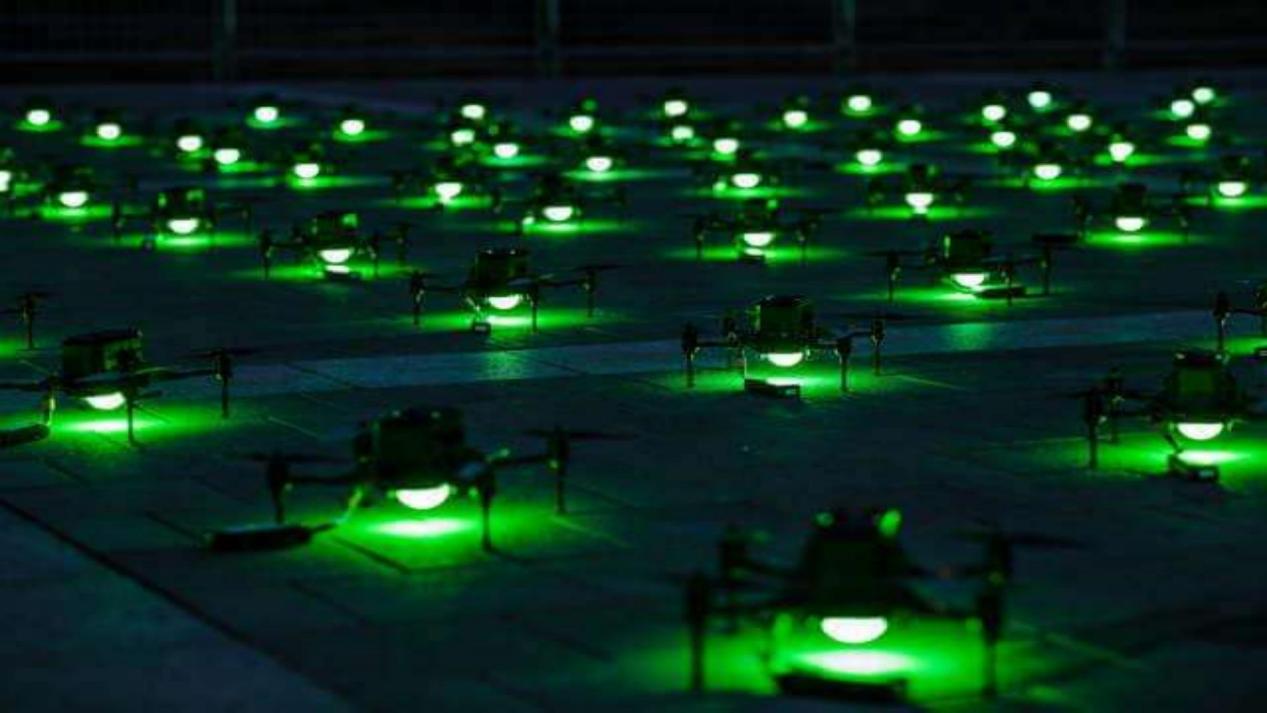
Drone light shows face unique GNSS challenges: coordinated RF from thousands of drones flying in tight formation, ground-based show equipment, and audience wireless devices can create severe interference that disrupts positioning signals. The Septentrio mosaic-G5 P3H with AIM+ anti-jamming technology protects against signal disruption during critical show sequences, ensuring every drone maintains its precise position throughout the performance.
Why Light Show Drones Need Anti-Jamming GNSS
In a drone light show, hundreds or even thousands of drones operate in close formation, often just meters apart. Each drone relies on GNSS positioning to maintain its exact position in the formation. When interference strikes, drones can drift from their assigned positions, causing collisions, gaps in the formation, or failed show sequences.
The primary sources of GNSS interference at light shows include: wireless communication systems used by show coordinators, Wi-Fi networks from audience devices, radio transmitters on nearby equipment, and even multipath reflections from buildings or staging structures surrounding the show site.
AIM+ Anti-Jamming Technology for Light Shows
The Septentrio mosaic-G5 P3H integrates AIM+ (Advanced Interference Mitigation) technology, which actively monitors the RF spectrum and identifies interference sources in real time. When interference is detected, the receiver automatically filters out the unwanted signals while maintaining lock on legitimate GNSS satellite signals.
This is critical for light show drones because interference can appear suddenly and vary throughout a performance. AIM+ adapts dynamically, ensuring uninterrupted positioning without requiring operator intervention. The result is reliable formation flying even in challenging electromagnetic environments.
Lightweight Design for Show Drones
Every gram matters in light show drones, where payload capacity determines flight time and show complexity. The EV322 GNSS receiver weighs just 14 grams, making it ideal for light show applications where minimizing weight is essential for maximizing battery life and show duration.
The mosaic-G5 P3H module itself measures just 31x31x4 mm, fitting easily into the compact form factor of light show drones. Complete dual-antenna heading solutions like the HB21 GNSS box receiver add integrated 4G LTE for RTK corrections, ensuring the centimeter-level accuracy needed for tight formations.
Multi-Constellation Reliability
The mosaic-G5 P3H tracks GPS, GLONASS, BeiDou, and Galileo simultaneously, providing redundancy if one constellation experiences degraded signals. In light show environments where buildings, staging, or terrain may block portions of the sky, having access to multiple satellite systems significantly improves position availability and reliability.
With 448 hardware channels and multi-frequency support, the receiver can maintain lock on 30+ satellites even in challenging urban show venues. This ensures consistent centimeter-level RTK accuracy for precise formation positioning throughout the performance, from takeoff to landing.
Real-World Show Performance
Drone light show operators have reported significant improvements in formation stability and show reliability after switching to receivers with AIM+ anti-jamming protection. Common feedback includes fewer formation errors during performances, faster and more reliable RTK initialization before shows, and consistent positioning even when multiple shows operate in proximity to each other.
For light show companies looking to scale from hundreds to thousands of drones per performance, anti-jamming GNSS becomes not just an enhancement but a necessity. Without it, the probability of interference-induced positioning errors increases with every additional drone added to the formation.
Related GNSS Products
- HB21 GNSS Box Receiver — All-in-one RTK receiver with 4G LTE, heading, and data logging for light show drones.
- HB6 GNSS Box Receiver — Compact quad-constellation RTK receiver powered by Septentrio Mosaic X5.
- EV322 GNSS Receiver — Ultra-lightweight 14g RTK receiver for light show UAVs.
Browse our full GNSS receiver collection for professional UAV applications.
Frequently Asked Questions
1. What makes light show drones particularly vulnerable to GNSS interference?
Light shows involve hundreds of drones in close formation, creating dense RF environments from drone-to-drone communication, show control systems, and audience devices. The proximity of multiple signal sources increases the probability of interference affecting GNSS positioning.
2. How does AIM+ technology protect against interference?
AIM+ actively monitors the RF spectrum and identifies interference sources in real time, automatically filtering out unwanted signals while maintaining lock on legitimate GNSS satellite signals. It adapts dynamically to changing interference conditions during a performance.
3. Can the mosaic-G5 P3H handle interference from multiple sources simultaneously?
Yes. The AIM+ engine is designed to handle narrowband, wideband, swept frequency, and pulse interference simultaneously, making it effective in complex RF environments typical of large-scale light shows.
4. What accuracy can light show drones achieve with anti-jamming GNSS?
With RTK corrections and AIM+ active, the mosaic-G5 P3H maintains centimeter-level accuracy, enabling drones to fly in formations as tight as 1-2 meters apart without risk of collision.