For years, drone operators chasing centimeter-level positioning had two options: buy a base station for RTK or pay for a commercial PPP (Precise Point Positioning) subscription. Both cost money, add complexity, and create dependencies on infrastructure or service providers.
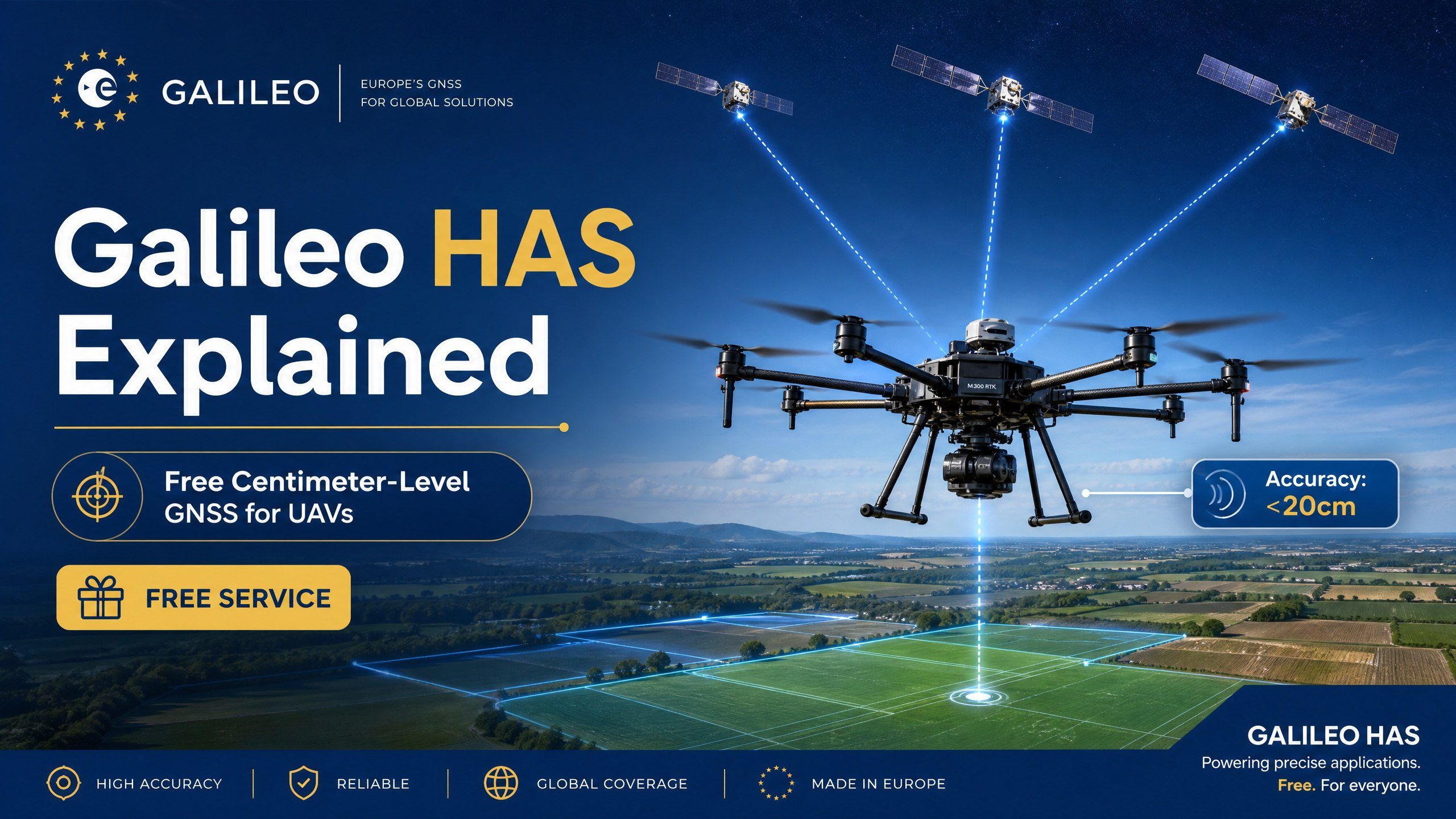
Galileo HAS (High Accuracy Service) changes that equation completely. It delivers free, real-time decimeter-to-centimeter positioning corrections directly through the Galileo satellite signal — no base station, no subscription, no internet required in the field. Since its Initial Service declaration in January 2023, Galileo HAS has been quietly reshaping what’s possible for drone navigation, surveying, and autonomous operations.
This article breaks down exactly what Galileo HAS is, how it works, what accuracy you can expect, and — most importantly — how UAV operators can start using it today with Septentrio-powered GNSS receivers.
What Is Galileo HAS?
Galileo HAS is a free, globally-available Precise Point Positioning (PPP) correction service broadcast by the European Galileo GNSS constellation. Unlike traditional RTK (which requires a nearby base station transmitting corrections over radio or cellular), HAS delivers its corrections through two channels:
- Signal-in-Space (SiS): Corrections are broadcast directly via the Galileo E6-B signal at 1278.75 MHz, with a data rate of 448 bits per second per satellite. No internet connection required.
- Internet Data Distribution (IDD): The same corrections are available via NTRIP from the Galileo Service Centre (GSC), useful for initial convergence or hybrid solutions.
The service is completely free — no subscription, no license fee, no registration required for the SiS channel. It represents the first time a global navigation satellite system has offered a high-accuracy PPP service at no cost, directly through the signal in space.
How Galileo HAS Works: Service Levels Explained
Galileo HAS is structured across two service levels, with a phased rollout timeline.
Service Level 1 (SL1) — Global Coverage
SL1 provides high-accuracy orbit and clock corrections plus code biases for both Galileo and GPS. The key parameters are:
- Coverage: Global
- Horizontal Accuracy (95%): < 20 cm
- Vertical Accuracy (95%): < 40 cm
- Convergence Time: < 300 seconds (5 minutes)
- Availability: 99%
- Supported Constellations: Galileo (E1/E5a/E5b/E5 AltBOC/E6) + GPS (L1/L2C/L5)
Service Level 2 (SL2) — Regional Coverage (Europe)
SL2 extends SL1 with atmospheric (ionospheric) corrections, enabling faster convergence:
- Coverage: European Coverage Area (ECA)
- Horizontal Accuracy (95%): < 20 cm
- Vertical Accuracy (95%): < 40 cm
- Convergence Time: < 100 seconds (under 2 minutes)
- Availability: 99%
- Additional Corrections: SL1 + atmospheric corrections
Phased Rollout Timeline
The Galileo HAS program is deployed in three phases. As of June 2026, we’re at Phase 1 (Initial Service) with Phase 2 (Full Service) expected in Q4 2026, followed by the official Full Service Declaration in Q1–Q2 2027. The Full Service will add phase biases to the correction stream, enabling integer ambiguity resolution (PPP-AR) and unlocking true centimeter-level positioning with faster convergence.
| Phase | Timeline | Key Features |
|---|---|---|
| Phase 1 — Initial Service | Jan 2023 — Q3 2026 | SL1 with reduced performance; code biases included; no phase biases yet |
| Phase 2 — Full Service | Q4 2026 — Q1 2027 | SL1 + SL2 at full targets; phase biases added; 20 cm horizontal achieved |
| Phase X — Evolution | 2027+ | 2nd generation Galileo improvements; authentication and enhanced integrity |
What Accuracy Can Drone Operators Really Expect?
While the official specification promises <20 cm horizontal, real-world tests consistently show better performance. A 2026 study published in Engineering Proceedings (Savchuk et al.) tested Galileo HAS using a Septentrio Mosaic-X5 receiver in both static and UAV kinematic experiments.
Static Performance Results
After convergence in static open-sky conditions, the HAS-based PPP solution achieved:
- Horizontal RMS: 3.6 cm (north: 1.88 cm, east: 0.88 cm) after integer ambiguity resolution
- Vertical RMS: 7.6 cm (3.96 cm after PPP-AR)
- Convergence Time: 2.5 minutes to reach centimeter-level accuracy (with phase biases via comparative CNES stream)
Kinematic (Drone) Performance
In real UAV flight tests, the PPP solution using Galileo HAS corrections converged in under 3 minutes for north and height components. The study concluded that HAS-based PPP was “well suited for aviation applications — such as precision approaches or drone navigation — where vertical accuracy and rapid initialization are critical.”
Compared to traditional standalone GPS (which delivers 2-5 meter accuracy), Galileo HAS represents a 10x to 50x improvement in horizontal positioning — all without any additional hardware or subscription costs.
Galileo HAS vs. RTK: When to Use Each
| Factor | Galileo HAS (PPP) | RTK (Real-Time Kinematic) |
|---|---|---|
| Accuracy | 10-20 cm horizontal (3-5 cm with Full Service phase biases) | 1-3 cm horizontal |
| Infrastructure | None — corrections come from satellites | Requires base station or NTRIP caster |
| Cost | Free | Base station hardware ($1,000-$5,000) or NTRIP subscription ($200-$1,200/yr) |
| Convergence | 3-5 minutes (initial) | Instant (fix-and-hold) |
| Range | Global | 10-40 km from base station |
| Internet Required | No (via E6-B signal) | Often yes (for NTRIP corrections) |
| Best For | BVLOS operations, remote areas, surveying, agricultural robotics | Precision surveying, close-range construction, absolute cm-level tasks |
The key insight: Galileo HAS is not a direct replacement for RTK — it’s a complementary technology that fills the gap for scenarios where RTK is impractical. For BVLOS drone operations over wide areas, delivery routes, or pipeline inspections, Galileo HAS eliminates the need for base station deployment at every launch site.
Integrating Galileo HAS with Septentrio GNSS Receivers
Septentrio receivers are among the few GNSS modules on the market with native support for Galileo HAS. The mosaic-X5 and mosaic-G5 modules both support E6-B signal reception and can decode HAS corrections in real time.
Septentrio Mosaic-X5: The HAS-Ready Module
Announced in 2023 and widely deployed in UAV systems, the mosaic-X5 is a multi-band, multi-constellation GNSS module that tracks all major constellations and signals including Galileo E6. Key specs for HAS users:
- Constellations: GPS, GLONASS, BeiDou, Galileo, QZSS, NavIC
- Galileo Signals: E1, E5a, E5b, E5 AltBOC, E6
- HAS Support: Decodes Galileo HAS corrections from E6-B data component
- Form Factor: Surface-mount module, 31 x 31 x 4 mm
- Power: ~1 W typical
Septentrio Mosaic-G5: New Generation HAS Optimization
Released in May 2025, the mosaic-G5 extends the mosaic family with optimized firmware support for Galileo HAS positioning. Firmware version 1.1 (May 2026) includes:
- Built-in dual-frequency PPP algorithm using decoded HAS corrections
- Improved convergence time vs. standard PPP (reduced from 15-20 minutes to under 5 minutes)
- Static and kinematic position modes optimized for UAV dynamics
- Backward compatible with all mosaic-X5 ecosystem hardware
How to Enable Galileo HAS on Your Receiver
- Enable E6-B signal tracking: In Septentrio’s RxControl software, navigate to Admin → Expert Control → Control Panel → Navigation → Advanced User Settings → Signal Tracking, and enable
GALE6BC. - Configure SBF output: Add
GALRawCNAVto your SBF output stream to decode the HAS correction message. - Activate PPP mode: For mosaic-G5 running firmware 1.1+, the HAS corrections are automatically applied in the receiver’s internal PPP solution.
- Antenna requirements: Ensure your antenna supports the E6 frequency band (1278.75 MHz). Most multi-band GNSS antennas with L-band support work.
Galileo HAS Use Cases for UAVs and Autonomous Systems
1. BVLOS Drone Delivery
Delivery drones operating beyond visual line of sight need reliable positioning without depending on cellular networks or base stations. Galileo HAS provides global, free decimeter-level accuracy suitable for precision landing zones, obstacle avoidance, and route adherence — all without any ground infrastructure.
2. Agricultural Robotics
Farming robots and autonomous tractors operate over vast areas where RTK base station deployment is impractical. Galileo HAS at 10-20 cm accuracy is well within spec for precision agriculture tasks like spraying, weeding, and crop monitoring.
3. Drone Show Swarms
Coordinating hundreds of drones for light shows requires sub-meter synchronization and positioning. Galileo HAS eliminates the need for a local RTK infrastructure at each show venue, allowing drone show operators to deploy anywhere globally with the same GNSS receiver setup.
4. Surveying and Mapping
For UAV photogrammetry and LiDAR surveys, Galileo HAS corrections provide reliable positioning without deploying ground control points or base stations at every survey site. While RTK remains preferred for sub-centimeter work, HAS fills the gap for rapid reconnaissance surveys and inspections.
5. Inspection Drones in Remote Areas
Power line, pipeline, and wind turbine inspections often take drones into areas with no cellular coverage. Galileo HAS corrections delivered via E6-B signal work anywhere within satellite visibility, making it ideal for remote infrastructure inspections.
The Road to Full Service: What Changes in 2027
The transition to Galileo HAS Full Service (expected Q4 2026 to Q2 2027) brings three critical improvements for drone operators:
Phase Biases Enable True Centimeter-Level PPP
Today’s Initial Service provides orbit, clock, and code bias corrections. The Full Service adds phase biases, enabling integer ambiguity resolution (PPP-AR). Real-world tests show this alone cuts convergence time from 5 minutes to under 2.5 minutes and pushes horizontal accuracy below 5 cm RMS.
Service Level 2 for European Operators
Drone operators in Europe will benefit from SL2’s atmospheric corrections, reducing convergence time to under 100 seconds. Combined with phase biases, this makes HAS competitive with RTK for many applications.
Authentication for Critical Operations
The evolution phase will introduce Galileo HAS message authentication, adding protection against spoofed correction data — critical for safety-of-life drone operations like eVTOL and urban air mobility.
Related GNSS Products
- HB21 GNSS Box Receiver — All-in-one RTK receiver with 4G LTE, heading, and data logging
- HB6 GNSS Box Receiver — Compact RTK receiver powered by Septentrio Mosaic X5
- EV322 GNSS Receiver — Lightweight RTK receiver for UAVs and autonomous systems
- AIM+ Anti-Jamming Technology — Advanced interference and spoofing protection
Browse our full GNSS receiver collection for professional UAV applications.
Frequently Asked Questions
What is Galileo HAS and how accurate is it?
Galileo High Accuracy Service (HAS) is a free satellite-delivered correction service providing sub-meter to decimeter accuracy across GPS and Galileo constellations, without any reference station or internet connection.
Does Galileo HAS require an RTK base station?
No. HAS corrections come directly from Galileo satellites via the E6-B signal. You only need a receiver that supports HAS decoding — like Septentrio’s mosaic-X5 or AsteRx-m3 Pro+ with recent firmware.
How does Galileo HAS compare to RTK for drone surveying?
HAS delivers 10–30 cm accuracy, while RTK delivers 1–3 cm. HAS is ideal for mapping and reconnaissance where real-time corrections matter but absolute centimeter precision isn’t required. For precision landing or automated construction, use RTK.
Which Septentrio receivers support Galileo HAS?
mosaic-X5, mosaic-G5 (all variants), and AsteRx-m3 Pro+ all support Galileo HAS via firmware update. Enable HAS in the receiver configuration under “SSR Corrections → Galileo HAS”.
Does Galileo HAS work globally or only in Europe?
Galileo HAS has global coverage via the Galileo satellite constellation. The initial service covers Europe, but Phase 2 (expected 2026) extends full global coverage with tighter accuracy.
What is Galileo HAS and how accurate is it?
Galileo High Accuracy Service (HAS) is a free satellite-delivered correction service providing sub-meter to decimeter accuracy across GPS and Galileo constellations, without any reference station or internet connection.
Does Galileo HAS require an RTK base station?
No. HAS corrections come directly from Galileo satellites via the E6-B signal. You only need a receiver that supports HAS decoding — like Septentrio’s mosaic-X5 or AsteRx-m3 Pro+ with recent firmware.
How does Galileo HAS compare to RTK for drone surveying?
HAS delivers 10–30 cm accuracy, while RTK delivers 1–3 cm. HAS is ideal for mapping and reconnaissance where real-time corrections matter but absolute centimeter precision isn’t required. For precision landing or automated construction, use RTK.
Which Septentrio receivers support Galileo HAS?
mosaic-X5, mosaic-G5 (all variants), and AsteRx-m3 Pro+ all support Galileo HAS via firmware update. Enable HAS in the receiver configuration under “SSR Corrections → Galileo HAS”.
Does Galileo HAS work globally or only in Europe?
Galileo HAS has global coverage via the Galileo satellite constellation. The initial service covers Europe, but Phase 2 (expected 2026) extends full global coverage with tighter accuracy.