
Why Antenna Selection Matters for UAV GNSS
The GNSS antenna is the first link in your positioning chain. A suboptimal antenna can degrade RTK accuracy even with the best receiver. For professional drone platforms, antenna selection is as critical as the receiver choice.
Key Antenna Parameters
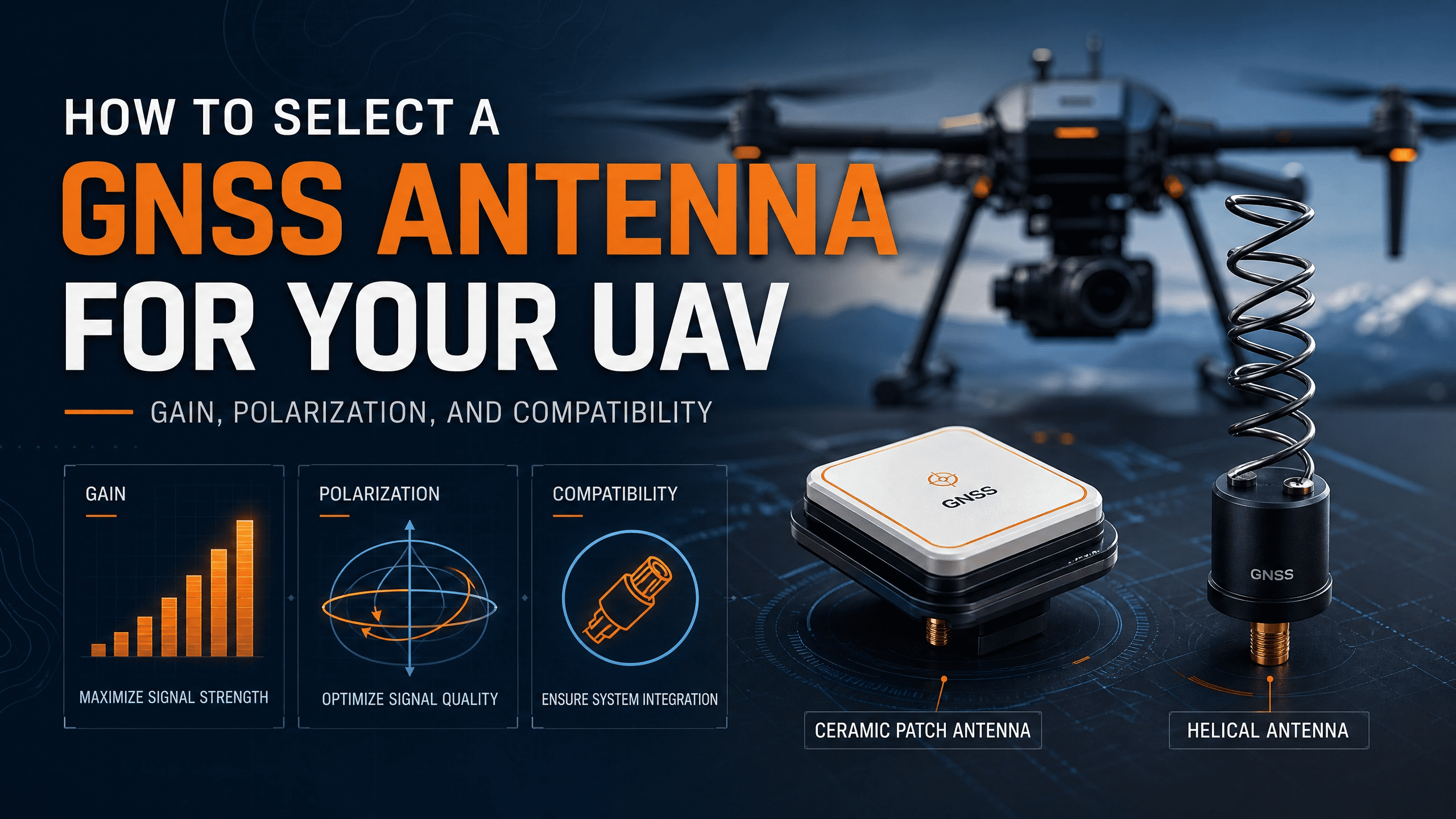
- Gain: 25-35 dB typical for active GNSS antennas; higher gain improves weak signal tracking
- Polarization: RHCP (Right-Hand Circular Polarization) is standard for GNSS
- Bandwidth: Dual-band (L1+L2) minimum; tri-band (L1+L2+L5) recommended for future-proofing
- Noise Figure: Lower is better (<2 dB ideal) for weak signal environments
- Form Factor: Patch antennas suit compact drones; survey-grade antennas for mapping platforms
Compatibility with Septentrio Receivers
Septentrio mosaic and AsteRx receivers require active antennas with 3.3V or 5V bias voltage support. The receiver provides bias voltage through the antenna connector. Ensure your antenna’s current draw does not exceed the receiver’s bias supply capability (typically 50-100 mA).
Recommended Antenna Placements
- Single antenna: Top center of the drone, away from carbon fiber and batteries
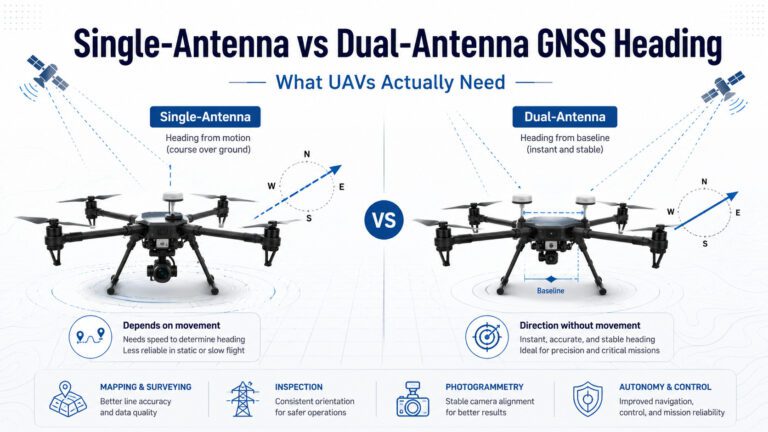
- Dual antennas: Minimum 30 cm separation, along the aircraft longitudinal axis
- Ground plane: At least 5 cm diameter metal ground plane below the antenna
Related GNSS Products
- HB21 GNSS Box Receiver — All-in-one RTK receiver with 4G LTE, heading, and data logging
- HB6 GNSS Box Receiver — Compact RTK receiver powered by Septentrio Mosaic X5
- EV322 GNSS Receiver — Lightweight RTK receiver for UAVs and autonomous systems
- AIM+ Anti-Jamming Technology — Advanced interference and spoofing protection
Browse our full GNSS receiver collection for professional UAV applications.
Frequently Asked Questions
What accuracy can I expect from this GNSS solution?
Septentrio GNSS receivers deliver 0.6 cm + 0.5 ppm horizontal and 1.0 cm + 1 ppm vertical accuracy with RTK. The exact performance depends on satellite geometry, atmospheric conditions, and correction data quality.
Does this work with ArduPilot or PX4 flight controllers?
Yes. Septentrio receivers output SBF protocol which is natively supported by both ArduPilot (GPS_TYPE=9) and PX4 (GPS_TYPE=9). Simply connect the UART interface and configure the GPS parameter for plug-and-play operation.
Can I use this receiver without an RTK base station?
Yes. You can use NTRIP corrections via a cellular connection, or use Galileo HAS (free satellite-delivered corrections on supported modules). For post-processing, the receiver logs raw data for PPK processing.
How do I order or get technical support?
Contact our sales team at sales@uav-gnss.com for pricing and availability. Technical documentation, integration guides, and configuration tools are available through our website resources section.