
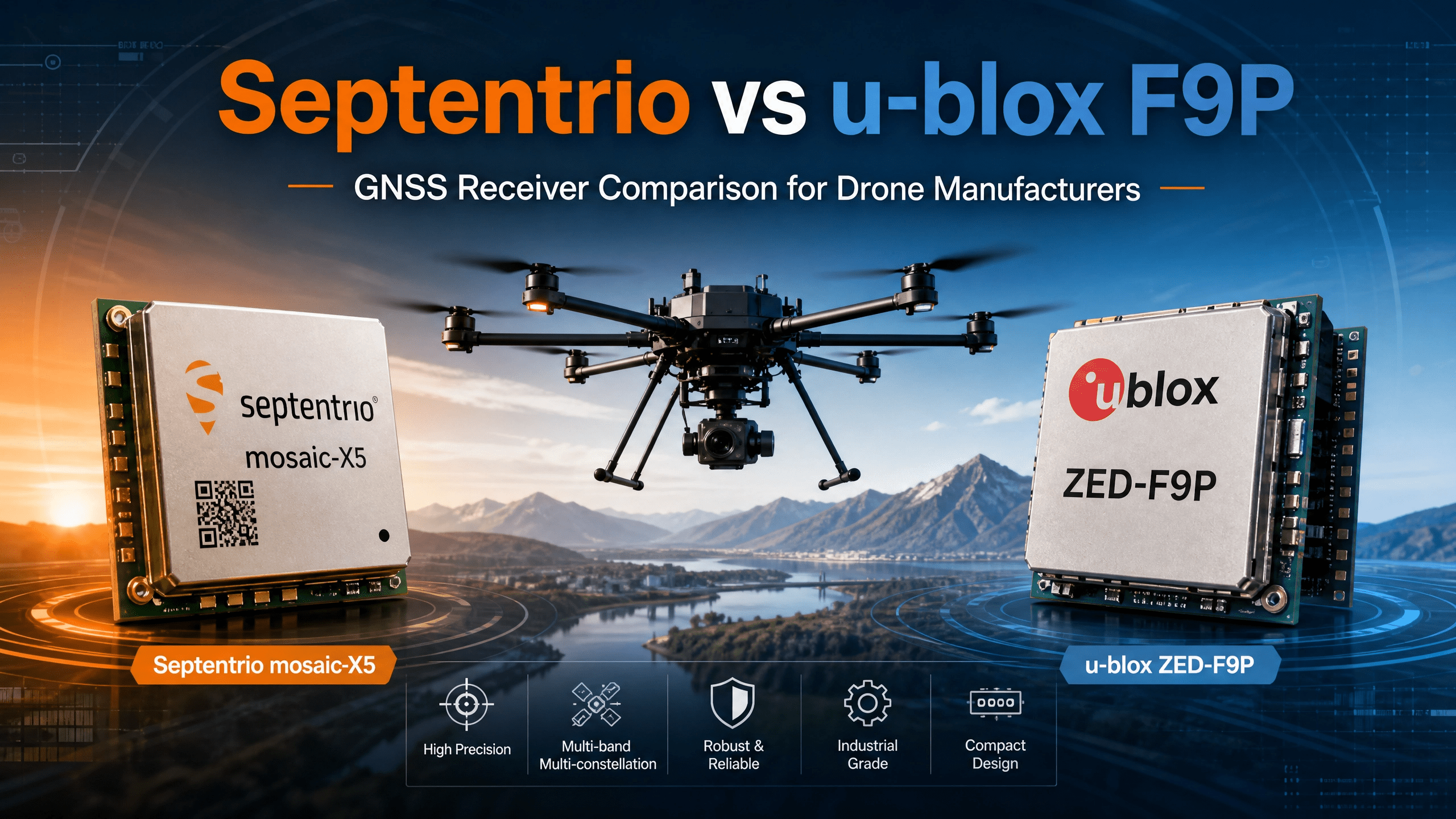
Septentrio vs u-blox F9P: Head-to-Head GNSS Receiver Comparison
When selecting a GNSS receiver for a professional drone platform, two names dominate the conversation: Septentrio and u-blox. The Septentrio mosaic-X5 and u-blox ZED-F9P are both popular choices, but they serve different segments of the market. This comparison examines their performance, features, and total cost of ownership for drone manufacturers.
Core Specifications Comparison
| Specification | Septentrio Mosaic-X5 | u-blox ZED-F9P |
|---|---|---|
| Constellations | GPS, GLONASS, Galileo, BeiDou, QZSS, NavIC | GPS, GLONASS, Galileo, BeiDou |
| Frequencies | L1, L2, L5, E6 (quad-band) | L1, L2 (dual-band) |
| Channels | 448 | 184 |
| RTK Accuracy (H) | 0.6 cm + 0.5 ppm | 1.0 cm + 1 ppm |
| RTK Accuracy (V) | 1.0 cm + 1 ppm | 1.5 cm + 1 ppm |
| Heading (Dual Antenna) | Yes (0.15° with mosaic-G5 P3H) | No (requires external solution) |
| Update Rate | Up to 100 Hz | Up to 20 Hz |
| Anti-Jamming | AIM+ (hardware + software) | Basic (software only) |
| Anti-Spoofing | Multi-layer (OSNMA, signal auth) | Basic (RAIM only) |
| Power Consumption | 0.6 W typical | 0.5 W typical |
| Dimensions | 31 x 31 mm (SMT) | 17 x 22 mm (LGA) |
| Operating Temp | -40°C to +85°C | -40°C to +85°C |
Key Differences That Matter for Drone Integration
Anti-Jamming and Anti-Spoofing
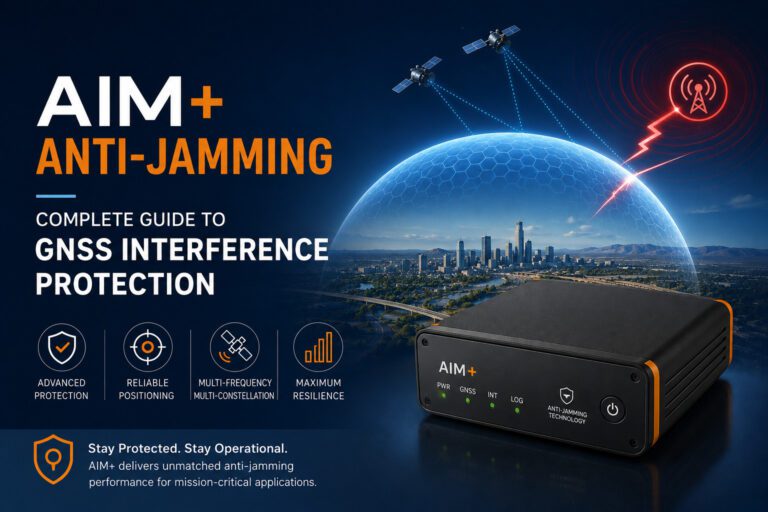
The biggest differentiator is Septentrio’s AIM+ technology. The mosaic-X5 includes hardware-level filtering, adaptive notch filters, and multi-frequency consistency checking to detect and mitigate interference. The u-blox ZED-F9P relies on software-level RAIM, which can detect but cannot actively filter interference. For drones operating in urban environments or near infrastructure, this difference is critical.
Multi-Frequency Support
The mosaic-X5 supports L1, L2, L5, and E6 bands, providing redundancy if one frequency is jammed or degraded. The ZED-F9P supports only L1 and L2. For applications requiring robust RTK performance in challenging environments, the additional frequency bands of the Septentrio receiver provide a measurable advantage.
Heading Capability
The Septentrio ecosystem offers the mosaic-G5 P3H variant with true dual-antenna heading (0.15° accuracy), while the ZED-F9P has no native dual-antenna heading support. For applications requiring accurate heading without a magnetometer, Septentrio is the clear choice.
Cost Consideration
The u-blox ZED-F9P is approximately 30-50% lower in unit cost, making it attractive for cost-sensitive consumer drones and basic RTK applications. The Septentrio mosaic-X5 commands a premium but delivers professional-grade anti-jamming, higher accuracy, and dual-antenna heading capability. The total cost difference narrows when considering development time, certification, and field reliability.
When to Choose Each Receiver
Choose Septentrio Mosaic-X5 When:
- Your drone operates in urban environments with RF interference risk
- You need dual-antenna heading without a magnetometer
- Your application requires the highest RTK accuracy and fix reliability
- You serve security or critical infrastructure markets
- You need >20 Hz position update rate for high-dynamic flight
Choose u-blox ZED-F9P When:
- Cost is the primary constraint for consumer or light-commercial drones
- Your operating environment has minimal interference risk
- You can rely on magnetometer-based heading
- Your application does not require multi-frequency redundancy
- You need a smaller LGA package for space-constrained designs
Related GNSS Products
- HB21 GNSS Box Receiver — All-in-one RTK receiver with integrated 4G LTE, heading, and data logging
- HB6 GNSS Box Receiver — Compact quad-constellation RTK receiver powered by Septentrio Mosaic X5
- EV322 GNSS Receiver — Lightweight RTK receiver for UAVs and autonomous systems
- AIM+ Anti-Jamming Technology — Advanced interference and spoofing protection
Browse our full GNSS receiver collection for professional UAV applications.
Frequently Asked Questions
Is the u-blox ZED-F9P compatible with ArduPilot and PX4 flight controllers?
Yes, the ZED-F9P is widely supported by both ArduPilot and PX4 via UBX protocol. It connects to the flight controller’s GPS port and outputs standard NMEA and UBX messages. For RTK operation, a radio or 4G link is needed to stream RTCM correction data from a base station or NTRIP caster.
Can the Septentrio mosaic-X5 replace the u-blox ZED-F9P in an existing drone design?
Mechanically, the mosaic-X5 (31×31 mm SMT) is larger than the ZED-F9P (17×22 mm LGA), requiring PCB redesign. Electrically, both use UART interfaces with similar pinout conventions. The SBF protocol of Septentrio is natively supported by ArduPilot (GPS_TYPE=9) and PX4 (GPS_TYPE=9), so software migration is straightforward.
Does the u-blox ZED-F9P support Galileo OSNMA anti-spoofing?
The ZED-F9P supports Galileo OSNMA through firmware updates, but the implementation is software-based and does not include the hardware-level signal authentication that Septentrio receivers provide. For critical applications, Septentrio’s multi-layer anti-spoofing approach offers more robust protection.
Which is better for precision agriculture drones: Septentrio or u-blox?
For basic RTK spraying where cost is the priority, the u-blox ZED-F9P is sufficient. For advanced applications requiring dual-antenna heading for wind compensation and spray alignment, or for drones operating near RF interference from irrigation equipment, the Septentrio mosaic-X5 or G5 P3H delivers superior reliability and performance.