The GNSS industry is transforming rapidly in 2026. With four major constellations — GPS, GLONASS, Galileo, and BeiDou — all fully operational, multi-constellation GNSS receivers are now the standard for UAV navigation. This article covers the key GNSS trends 2026, RTK accuracy breakthroughs, and what they mean for your precision navigation applications.
What Are the Key GNSS Trends Shaping 2026
The GNSS trends 2026 landscape is defined by four major developments: multi-constellation receiver adoption, RTK accuracy reaching new benchmarks, AI integration in GNSS processing, and the convergence of PPP-RTK correction technologies. These advancements are transforming UAV GNSS receivers from simple positioning tools into intelligent navigation systems capable of maintaining centimeter-level accuracy in challenging environments.
What Is Multi-Constellation GNSS and Why Does It Matter
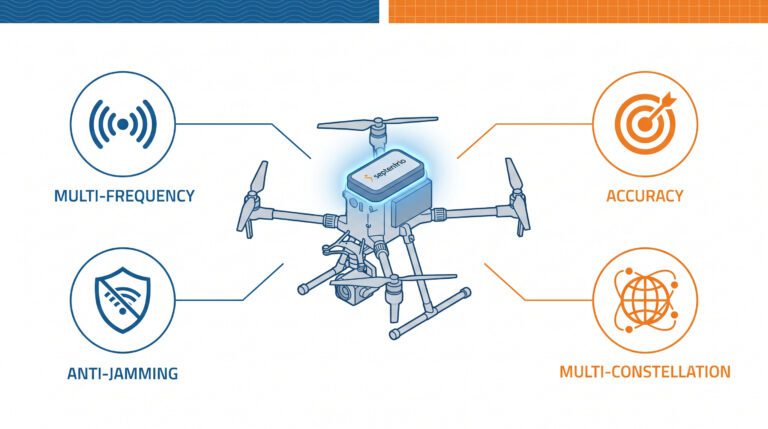
A multi-constellation GNSS receiver tracks signals from GPS, GLONASS, Galileo, and BeiDou simultaneously for better accuracy, reliability, and coverage than single-constellation systems. Unlike single-constellation receivers that track 8-12 satellites, a quad-constellation receiver accesses 30-50+ satellites at once.
What Are the Benefits of Multi-Constellation GNSS for UAVs?
- Signal availability in challenging environments: Urban canyons, forests, and mountainous terrain no longer cause signal loss
- Higher positioning accuracy: Better satellite geometry means lower DOP (Dilution of Precision)
- Faster time-to-first-fix (TTFF): More visible satellites enable quicker acquisition
- Improved integrity: Redundant measurements enable robust fault detection and exclusion
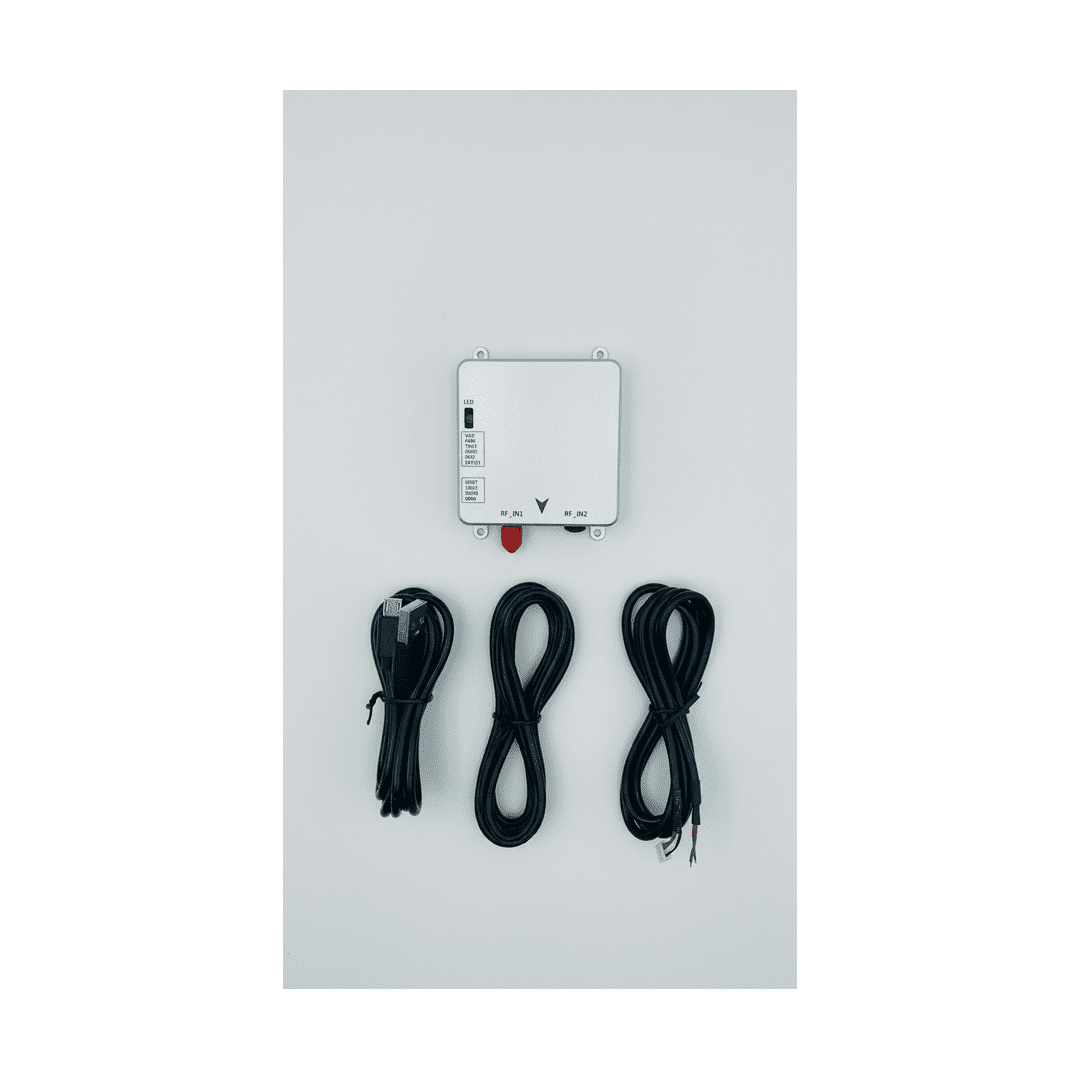
Our EV322 GNSS receiver and HB21 GNSS box receiver both feature full quad-constellation tracking, making them ideal for BVLOS UAV operations where signal reliability is critical.
What RTK Accuracy Can UAVs Achieve in 2026
RTK accuracy for UAV applications has reached new milestones in 2026. Modern RTK-enabled GNSS receivers consistently deliver:
These performance levels make RTK-equipped drones viable for drone surveying and mapping, precision agriculture, and structural inspection applications.
What Is PPP-RTK and How Does It Improve GNSS Positioning
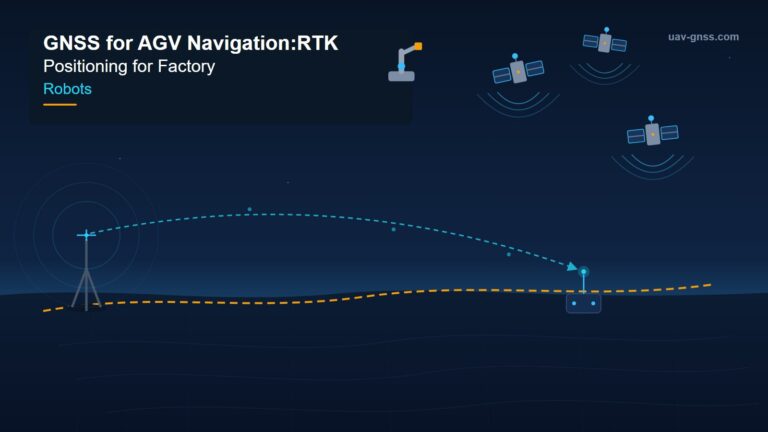
PPP-RTK convergence is one of the most significant GNSS receiver advancements in 2026. This hybrid approach combines Precise Point Positioning (PPP) with Real-Time Kinematic (RTK) corrections to deliver centimeter-level accuracy without requiring a local base station. Benefits include:
- Instant high accuracy over wide areas using satellite-delivered corrections
- Compatibility with NTRIP correction networks
- Reduced operational complexity for UAV field teams
- Consistent RTK FIX status even in marginal sky-view conditions
The HB6 GNSS box receiver supports both RTK and PPP-RTK correction methods, making it a versatile choice for UAV operators working across different regions.
How Is AI Being Integrated Into GNSS Receivers
Artificial intelligence is increasingly embedded in GNSS receiver firmware, enabling smarter signal processing and adaptive navigation. Key applications include:
- Adaptive interference detection: AI algorithms automatically identify and notch out RF interference without user intervention
- Intelligent constellation weighting: Dynamic prioritization of healthy satellites and de-weighting of degraded signals
- Predictive RTK: Using historical data and IMU fusion to maintain FIX quality through brief GNSS outages
This AI-driven approach is especially valuable for UAV operations in dynamic environments where signal conditions change rapidly — such as mining and construction sites and coastal areas.
What Is the Market Outlook for High-Precision GNSS Receivers
The global high-precision GNSS receiver market was valued at USD 1.55 billion in 2025 and is projected to reach USD 2.52 billion by 2034, growing at a CAGR of 7.1% (Intel Market Research, 2025). Key growth drivers include:
- Smart city infrastructure demanding precise geospatial data
- Autonomous vehicle deployment requiring high-integrity positioning
- Precision agriculture with sub-inch accuracy for variable-rate application
- critical infrastructure and security applications requiring assured PNT
Frequently Asked Questions About GNSS Trends 2026
What is the difference between single-constellation and multi-constellation GNSS?
Single-constellation receivers track satellites from one system (e.g., GPS only), typically accessing 8-12 satellites. Multi-constellation receivers track satellites from GPS, GLONASS, Galileo, and BeiDou simultaneously, accessing 30-50+ satellites for better accuracy, availability, and reliability.
Can UAVs achieve centimeter-level accuracy without a base station?
Yes. PPP-RTK technology combines satellite-delivered corrections with RTK algorithms to deliver centimeter-level accuracy without a local base station. This is ideal for UAV operations in remote areas or across large geographic regions.
How does AI improve GNSS receiver performance?
AI improves GNSS receivers through adaptive interference detection, intelligent constellation weighting, and predictive RTK. These capabilities allow receivers to maintain positioning accuracy in challenging RF environments and during temporary signal blockages.
What GNSS bands are supported by modern UAV receivers?
Modern UAV GNSS receivers like those powered by Septentrio mosaic chipsets support GPS L1/L2/L5, GLONASS L1/L2/L3, Galileo E1/E5a/E5b/E6, and BeiDou B1I/B2I/B3I/B1C/B2a across 789-1408 super-channels.
What is the best GNSS receiver for professional UAV surveying?
The best receiver depends on your application requirements. For general UAV surveying, we recommend the EV322 (compact, lightweight) or HB21 (rugged, multi-constellation). For extended operations requiring high reliability, the HB6 with Septentrio mosaic X5 offers the best performance envelope. Explore our full GNSS receiver collection for detailed specifications.
Looking Ahead: GNSS Beyond 2026
Several emerging trends will shape GNSS technology beyond 2026:
- L5 signal proliferation: The safety-of-life GPS L5 band provides higher power and wider bandwidth, improving urban GNSS performance
- LEO-enhanced GNSS: Low-earth orbit satellite constellations will complement MEO GNSS for faster convergence times
- Next-generation anti-jamming: Advanced interference mitigation technologies like AIM+ anti-jamming continue to evolve for contested environments
These developments promise to make GNSS modules even more robust, accurate, and secure — directly benefiting UAV operators, surveyors, and autonomous systems integrators worldwide.
Related GNSS Products
- HB21 GNSS Box Receiver — All-in-one RTK receiver with integrated 4G LTE, heading, and data logging.
- HB6 GNSS Box Receiver — Compact quad-constellation RTK receiver powered by Septentrio Mosaic X5.
- EV322 GNSS Receiver — Lightweight RTK receiver for UAVs and autonomous systems.
- AIM+ Anti-Jamming Technology — Advanced interference and spoofing protection.
Browse our full GNSS receiver collection for professional UAV applications.