GNSS signals are weak. At the Earth’s surface, a GPS signal arrives with less power than a light bulb from 10,000 miles away. This vulnerability makes every GNSS receiver a potential target for interference. Whether it’s a hobbyist drone losing positioning over a jammer near an airport or a professional UAVs navigating contested airspace, the need for GNSS anti-jamming technology has never been more urgent.
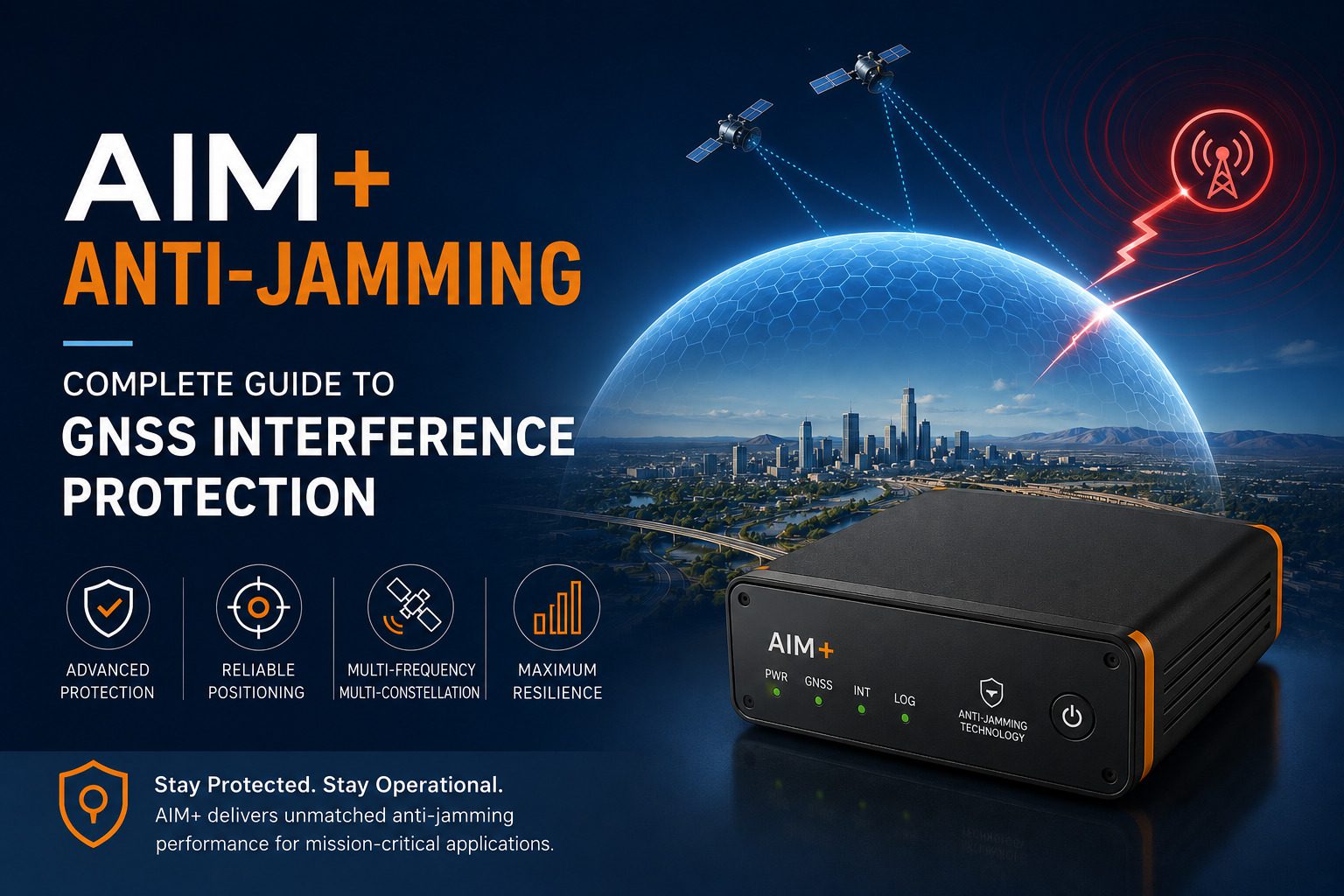
Enter AIM+ anti-jamming technology from Septentrio. This proprietary suite of hardware and software protections is engineered to keep GNSS receivers locked onto authentic signals — even when the RF environment turns hostile. In this complete guide, we answer every important question about AIM+ and how it protects your GNSS systems.
What Is AIM+ Anti-Jamming GNSS Technology?
AIM+ (Advanced Interference Mitigation) is Septentrio’s proprietary technology that detects, filters, and mitigates GNSS jamming and spoofing attacks in real time. Unlike basic filtering that blocks only narrowband interference, AIM+ combines multiple protection layers — adaptive notch filtering, null steering, and intelligent signal processing — to maintain positioning integrity even under sustained attack.
At its core, AIM+ continuously monitors the RF spectrum across all GNSS bands (L1, L2, L5, E1, E5a, E5b, E6, and more). When it detects an anomalous signal — whether from a consumer-grade jammer or a sophisticated spoofer — AIM+ automatically engages countermeasures. The system can suppress interferers up to 80 dB stronger than the GNSS signal itself, a level of protection that places it firmly in the professional GNSS module category.
Septentrio developed AIM+ specifically for applications where GNSS reliability is not optional: autonomous UAVs, survey-grade RTK systems, and critical infrastructure. It operates silently in the background, requiring no user intervention to activate its defenses.
Why Do GNSS Receivers Need Anti-Jamming Protection?
GNSS receivers need anti-jamming protection because they face real-world threats from RF jammers, spoofing devices, and electromagnetic interference that can disrupt or falsify positioning signals.
- Consumer jammers: Inexpensive plug-in devices that broadcast noise across GNSS frequencies. Widely misused by drivers evading fleet tracking, they can disrupt GNSS reception within a 50–300 meter radius.
- industrial-grade jammers: High-power transmitters designed to deny GNSS positioning across kilometers of territory. These are used in electronic conflict scenarios (EW) operations.
- Spoofers: Devices that broadcast fake GNSS signals to trick a receiver into computing a false position, course, or time. Spoofing is far more insidious than jamming because the receiver believes it is functioning normally.
GNSS receivers need anti-jamming protection because they face real-world threats from RF jammers, spoofing devices, and electromagnetic interference that can disrupt or falsify positioning signals. A jammed drone can lose its position hold, drift off course, or enter failsafe mode. A spoofed drone can be hijacked mid-flight. Without GNSS jamming mitigation UAV technology, modern drones are defenseless against these threats.
How Does AIM+ Detect and Mitigate GNSS Jamming?
AIM+ detects and mitigates GNSS jamming through adaptive notch filtering and real-time spectral analysis that isolate legitimate satellite signals from interference.
- Spectral monitoring: AIM+ continuously scans the RF spectrum across all GNSS bands, building a baseline of the ambient noise floor. Any deviation from this baseline — whether an impulse, a continuous wave, or a swept-frequency signal — is flagged for analysis.
- Adaptive notch filtering: When narrowband interference is detected (e.g., from a consumer GPS jammer broadcasting at 1575.42 MHz), AIM+ deploys notch filters that carve out the affected frequencies while preserving the surrounding spectrum. These filters adapt dynamically as the jammer changes frequency.
- Null steering: For wideband interference and pulsed jamming, AIM+ can steer antenna nulls in the direction of the jammer’s signal arrival. By reducing gain in the interference direction, the receiver effectively “looks away” from the threat while maintaining lock on satellites in other directions.
- Intelligent signal processing: AIM+ uses machine learning-inspired algorithms to distinguish between authentic GNSS signals and interference. It analyzes signal structure, correlation peaks, Doppler shifts, and power levels to reject invalid signals while preserving legitimate satellite tracks.
AIM+ detects and mitigates GNSS jamming through adaptive notch filtering and real-time spectral analysis that isolate legitimate satellite signals from interference. The receiver’s standard positioning output continues uninterrupted through most interference events. Only the most extreme jamming scenarios will cause a momentary degradation before AIM+ fully engages its countermeasures.
Can AIM+ Protect Against GNSS Spoofing Attacks?
Yes. AIM+ includes dedicated anti-spoofing capabilities that go beyond simple jamming mitigation. While jamming drowns out GNSS signals, spoofing requires a fundamentally different defense: signal authentication.
AIM+ uses several techniques to detect and reject spoofed signals:
- Signal consistency checks: AIM+ cross-references multiple metrics — carrier-to-noise ratio (C/N0), Doppler consistency across satellites, code-carrier divergence — to flag suspicious signals. A spoofer broadcasting fake signals from a single antenna will create measurable inconsistencies that AIM+ detects immediately.
- OSNMA (Open Service Navigation Message Authentication): Aim+ supports Galileo OSNMA, the first open-standard civilian GNSS authentication service. OSNMA cryptographically signs navigation data, allowing the receiver to verify that signals originate from genuine Galileo satellites and not from a spoofing transmitter.
- Multi-constellation cross-checking: By working across GPS, GLONASS, Galileo, and BeiDou simultaneously, AIM+ can cross-verify positions. A spoofer that mimics GPS signals but not Galileo signals will be instantly revealed when the constellations disagree.
This combination makes AIM+ one of the most robust anti-spoofing solutions available in any anti-jamming GNSS receiver for commercial and industrial applications.
What Professional-grade protection Does AIM+ Offer?
AIM+ offers industrial-grade anti-jamming protection validated at JammerTest 2024, where it maintained signal tracking against interference 10 million times stronger than legitimate signals. Its Industrial-grade credentials include:
- STANAG 4545 compliance: Septentrio receivers with AIM+ meet NATO standardization agreements for navigation equipment, ensuring interoperability and reliability in allied field operations.
- JammerTest validation: Every AIM+-equipped receiver is validated against real-world jamming scenarios in Septentrio’s proprietary JammerTest. This test suite simulates consumer jammers, high-power barrage jammers, pulsed jammers, and swept-frequency interferers to certify the receiver’s resilience.
- Industry certifications: Septentrio receivers are deployed by professional organizations worldwide for applications including operator navigation, vessel positioning, and airborne operations.
- Signal power resilience: AIM+ maintains lock on GNSS signals even when interference power is 80 dB above the noise floor. This exceeds the requirements for most rigorous GNSS specifications.
for critical applications integrators seeking a professional GNSS module that can operate in EW-threatened environments, AIM+ delivers field-proven protection without requiring additional external hardware.
How Does AIM+ Help UAVs in GNSS-Denied Environments?
AIM+ helps UAVs maintain positioning in GNSS-denied environments by combining anti-jamming hardware with multi-sensor fusion, enabling continued operation when satellite signals are compromised. They operate at altitude where they are exposed to more interference sources, they have limited power budgets that restrict anti-jamming hardware options, and they cannot tolerate GNSS dropout without risking loss of control.
AIM+ addresses each of these UAV-specific constraints:
- Lightweight implementation: AIM+ runs on the receiver’s existing digital signal processor (DSP), not on external hardware. This means zero additional weight, power, or space — critical for small UAV platforms.
- Automatic protection: No pilot input is required. When a jammer is detected, AIM+ engages countermeasures autonomously, preserving position lock without distracting the flight controller.
- Contested airspace resilience: For professional UAVs operating near electronic conflict scenarios assets or over hostile territory, AIM+’s null steering capability dramatically reduces the effective range from which a jammer can disrupt navigation.
- RTK integrity: Survey and mapping UAVs rely on RTK corrections for centimeter-level accuracy. AIM+ protects RTK data links from interference, ensuring that survey-grade precision is maintained even in challenging RF environments.
Whether the UAV is a reconnaissance platform, an agricultural spraying drone, or a surveying quadcopter, GNSS jamming mitigation UAV technology like AIM+ is becoming an essential component of reliable autonomous flight.
Is AIM+ Available on All Septentrio GNSS Modules?
AIM+ is available across Septentrio’s most popular receiver families, making it accessible for virtually any integration scenario:
- Septentrio mosaic-X5: The flagship dual-frequency GNSS module for professional UAVs and autonomous vehicles. Full AIM+ support including OSNMA and null steering.
- Septentrio mosaic-G5: A single-frequency variant optimized for cost-sensitive applications while retaining core AIM+ interference mitigation capabilities.
- Septentrio AsteRx series: Including the AsteRx-m3 Pro+ and AsteRx-S, these modules bring AIM+ to survey, marine, and infrastructure monitoring use cases.
- Powered receivers from uav-gnss.com: Products like the HB21 GNSS Box Receiver, HB6 GNSS Receiver, and EV322 GNSS Receiver all feature Septentrio modules with AIM+ protection built in.
Choosing a GNSS receiver with built-in AIM+ guarantees positioning resilience against jamming and spoofing for mission-critical UAV and infrastructure applications.
Why Choose a GNSS Receiver with Built-in AIM+?
Choosing a GNSS receiver with built-in AIM+ guarantees positioning resilience against jamming and spoofing for mission-critical UAV and infrastructure applications. Consumer jammers are proliferating, electronic conflict scenarios is becoming more accessible, and spoofing attacks are no longer the domain of nation-states alone. A GNSS receiver without anti-jamming protection is a single point of failure in any mission-critical system.
By choosing a receiver with built-in AIM+, you gain a hardware-validated, software-upgradable protection layer that makes your system resistant to both current and emerging interference threats. From the HB21 GNSS Box Receiver for robust all-in-one RTK operations to the lightweight EV322 GNSS Receiver for UAV integration, AIM+ ensures your GNSS positioning stays reliable when you need it most.
FAQ
What types of interference can AIM+ detect?
AIM+ can detect narrowband continuous wave interference, wideband barrage jamming, swept-frequency chirp jammers, pulsed interference, and GNSS spoofing attacks. Its spectral monitoring covers all major GNSS frequency bands simultaneously.
Does AIM+ require external hardware or antennas?
No. AIM+ is implemented entirely in the GNSS receiver’s onboard DSP firmware. However, using a controlled reception pattern antenna (CRPA) can enhance AIM+’s null steering capabilities for maximum jamming protection.
Is AIM+ available for existing receivers through a firmware update?
AIM+ is available on select Septentrio modules. Some receivers ship with AIM+ pre-installed, while others may support it via firmware upgrade. Check the specific product specifications or contact sales for compatibility details.
Can AIM+ protect against GPS jammers in urban environments?
Yes. Urban environments present unique challenges with multipath and overlapping signals, but AIM+’s adaptive notch filtering is particularly effective against consumer GPS jammers commonly encountered near roads, tunnels, and construction sites.
Related GNSS Products
- HB21 GNSS Box Receiver — All-in-one RTK receiver with 4G LTE, heading, and data logging.
- HB6 GNSS Box Receiver — Compact quad-constellation RTK receiver powered by Septentrio Mosaic X5.
- EV322 GNSS Receiver — Lightweight RTK receiver for UAVs and autonomous systems.
- AIM+ Anti-Jamming Technology — Advanced interference and spoofing protection.
Browse our full GNSS receiver collection for professional UAV applications.
Go deeper on specific threats
- The GNSS jamming threat landscape — how jamming attacks actually work and the 2026 picture
- GNSS spoofing protection and Galileo OSNMA — spoofing differs from jamming, and how OSNMA helps
- Anti-jamming for urban drone operations — multipath and interference in city environments