When designing a high-precision UAV, the choice of GNSS receiver module is one of the most critical decisions you’ll make. Septentrio’s mosaic-X5 and mosaic-H are two of the most popular offerings in their receiver module lineup, each tailored to different use cases and integration needs. In this comparison, we break down the key differences to help you choose the right module for your next drone project.
Overview: Two Modules, Two Philosophies
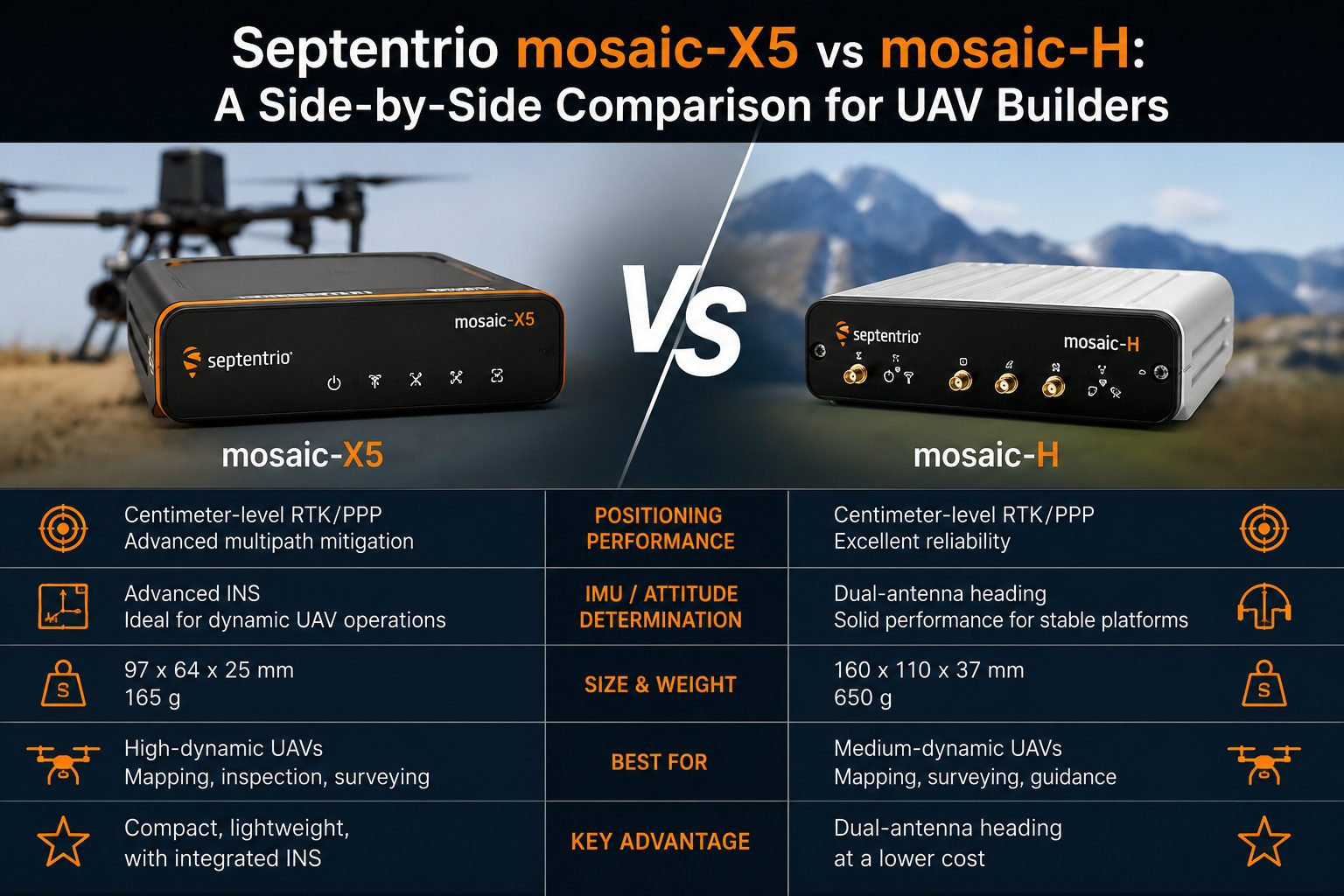
The mosaic-X5 is Septentrio’s flagship multi-frequency, multi-constellation GNSS receiver module, designed for maximum performance and flexibility. It supports GPS, GLONASS, Galileo, BeiDou, QZSS, and NAVIC, with full L-Band correction support for PPP services. The mosaic-H, by contrast, is a compact, integration-focused module that trades some GNSS bands for a smaller footprint and lower power consumption, making it ideal for space-constrained UAV designs.
Both modules share the same core Septentrio GNSS+ expertise, including advanced interference mitigation technologies and centimeter-level accuracy, but they target different segments of the UAV market. For a deeper look at what makes Septentrio modules stand out, check out our comparison of Septentrio vs u-blox performance.
Key Specifications Comparison
Constellations and Frequency Bands
The mosaic-X5 supports all major GNSS constellations across more frequency bands than the mosaic-H. Here is a breakdown:
- mosaic-X5: GPS L1/L2/L5, GLONASS L1/L2/L3, Galileo E1/E5a/E5b/E6, BeiDou B1I/B2I/B3I/B1C/B2a, QZSS L1/L2/L5/L6, NAVIC L5. Full L-Band (1525–1560 MHz) for PPP corrections.
- mosaic-H: GPS L1/L2, GLONASS L1/L2, Galileo E1/E5b, BeiDou B1I/B2I, QZSS L1/L2. L-Band subset for basic correction services.
The mosaic-X5’s broader frequency support means better signal tracking in challenging environments and faster convergence times for RTK and PPP solutions.
Form Factor and Power
Physical size and power draw are often deciding factors for UAV integrators. At gnss-solutions.com, we offer both modules in various integration levels, but it helps to understand the raw specifications:
- mosaic-X5: 46 x 60 x 13 mm, ~12 g, typical power 1.5 W
- mosaic-H: 31 x 31 x 4 mm, ~5 g, typical power 0.8 W
If you are building a small inspection drone or a micro-UAV, the mosaic-H’s smaller footprint and lower power draw are significant advantages. For larger platforms like mapping drones or eVTOL aircraft, the mosaic-X5’s additional capabilities may justify the extra size and power.
RTK and Correction Services
Both modules support RTK (Real-Time Kinematic) for centimeter-level positioning, but they differ in how they handle correction data. The mosaic-X5 includes support for advanced correction streams including AIM+ anti-jamming and anti-spoofing technology, which is critical for UAV operations in contested or interference-prone environments. For premium and critical applications, these features are non-negotiable.
For a deep dive on interference protection, read our article on GNSS anti-jamming for UAVs.
Integration and Ecosystem
Septentrio provides comprehensive SDKs and API documentation for both modules, but there are differences worth noting:
- mosaic-X5: Rich ecosystem with native support for PX4 and ArduPilot autopilots. Extensive ROS integration for research platforms.
- mosaic-H: Limited but growing ecosystem. Well-supported in major autopilot systems, with dedicated breakout boards for rapid prototyping.
For custom INS/IMU integrations, the mosaic-X5 provides additional synchronization options that pair well with our INS receiver product line, enabling tightly coupled GNSS/INS solutions for the most demanding applications.
Pricing and Value Proposition
The mosaic-H is priced lower than the mosaic-X5, making it an excellent entry point for UAV startups and small-volume integrators. The mosaic-X5 commands a premium but delivers professional-grade performance suitable for survey-grade mapping, mission-critical, and high-value asset applications. For bulk pricing and module variants, please contact our sales team.
When to Choose Each Module
Choose the mosaic-X5 if:
- You need the highest possible accuracy and availability
- Your UAV operates in challenging RF environments
- You require L-Band PPP support for remote operations
- You are building a survey-grade or premium platform
- Maximum multi-constellation redundancy is critical
Choose the mosaic-H if:
- Size and weight are primary constraints
- Power budget is limited (small battery UAVs)
- Your application does not require L5/E5a bands
- You are prototyping or in early-stage development
- Cost sensitivity is a key factor
Frequently Asked Questions
1. Can the mosaic-H achieve the same RTK accuracy as the mosaic-X5?
Yes, under good conditions both modules achieve centimeter-level RTK accuracy. However, the mosaic-X5 maintains lock better in challenging environments (tree cover, urban canyons) thanks to more frequency bands and AIM+ interference mitigation.
2. Is the mosaic-X5 compatible with existing mosaic-H firmware tools?
Both modules share the same Septentrio command interface and can be configured using the same RxTools software suite. Firmware formats differ, so always use the correct firmware for your module variant.
3. Which module supports PPP-RTK?
The mosaic-X5 supports PPP-RTK and full L-Band correction services. The mosaic-H supports standard RTK but has limited L-Band capabilities for PPP.
4. Are both modules pin-compatible?
No. The modules have different pinouts and form factors. If you are migrating from mosaic-H to mosaic-X5, a new PCB design will be required. However, Septentrio provides reference designs for both modules.