The UAV industry is growing fast. Whether you’re surveying land, inspecting power lines, or mapping mines, your drone’s positioning accuracy can make or break the mission. A standard consumer-grade GPS gives you 2–5 meter accuracy. For professional drone operations, that’s not nearly good enough.
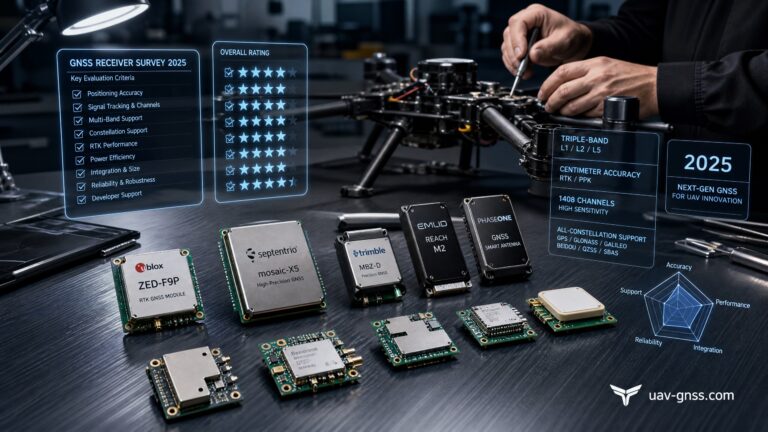
That’s where a high-precision GNSS receiver for UAV comes in. These receivers deliver centimeter-level accuracy using multiple satellite constellations and correction technologies like RTK. But with so many options on the market, how do you choose the right one?
This guide covers everything you need to know — from understanding the technology to selecting the best receiver for your specific drone application. If you’re looking to buy GNSS receiver online, this buyer’s guide will help you make an informed decision.
1. What Is a High-Precision GNSS Receiver and Why Does Your UAV Need One?
A high-precision GNSS receiver for UAV is a device that receives signals from multiple global navigation satellite systems (GNSS) — such as GPS (USA), GLONASS (Russia), BeiDou (China), and Galileo (Europe) — and uses them to calculate extremely accurate position data. Unlike standard GPS modules that cost a few dollars, high-precision receivers use advanced algorithms, multi-frequency bands, and correction data to achieve accuracy down to 1–2 centimeters.
Why does your UAV need one?
- Survey-grade accuracy: For mapping, bathymetry, and land surveying, meter-level accuracy produces unusable results. Centimeter-level positioning is essential.
- Safe autonomous flight: Precision landing, obstacle avoidance, and follow-me modes all depend on knowing exactly where the drone is.
- Regulatory compliance: Some countries require certified positioning accuracy for commercial drone operations.
- Data quality: Better position data means better orthomosaics, point clouds, and 3D models.
If your drone work involves any kind of measurement, inspection, or precise navigation, a high-precision GNSS receiver for UAV is not optional — it’s essential.
2. Key Factors to Consider When Choosing a GNSS Receiver for Your Drone
Choosing the best GNSS receiver for drone applications requires careful evaluation. Here are the most important factors:
2.1 Accuracy and Precision
Look for receivers that advertise horizontal accuracy of ≤2.5 cm with RTK correction. Without correction, the receiver should still deliver <1 meter using built-in SBAS (Satellite-Based Augmentation System).
2.2 Weight and Size
For UAVs, every gram matters. A heavy receiver reduces flight time and payload capacity. Compact receivers like the EV322 GNSS receiver are designed specifically for drone integration — lightweight yet powerful.
2.3 Update Rate
For fast-moving drones, a higher update rate means smoother positioning. Look for 10 Hz or higher. Professional receivers often support 20 Hz or even 100 Hz for demanding applications.
2.4 Interface Compatibility
Your receiver must work with your flight controller. Common interfaces include UART, I²C, SPI, and USB. If you’re using ArduPilot or PX4, ensure the receiver supports these protocols.
2.5 Correction Support
RTK (Real-Time Kinematic) and PPK (Post-Processed Kinematic) are the two main correction methods. We’ll cover both in detail below.
2.6 Brand and Support
Receivers powered by Septentrio modules — like those available from UAV GNSS — are known for reliability, anti-jamming technology, and long-term support. A well-supported receiver saves headaches down the road.
3. RTK vs PPK: Which Correction Method Fits Your UAV Operation?
Both RTK and PPK use correction data to remove errors from GNSS signals. But they work differently.
RTK (Real-Time Kinematic)
RTK provides real-time corrections via a communication link (radio, 4G, or NTRIP). The base station sends correction data to the rover (your drone), which calculates its position in real time.
- Pros: Instant centimeter-level accuracy, no post-processing needed.
- Cons: Requires a continuous data link; range limited by radio or cellular coverage.
- Best for: Real-time mapping, live inspection, autonomous navigation.
The HB21 GNSS Box Receiver is an excellent RTK receiver for UAV applications, featuring built-in 4G LTE for reliable correction links and heading capabilities.
PPK (Post-Processed Kinematic)
PPK records raw GNSS data during flight, then processes it with base station data after landing. No real-time link is needed.
- Pros: No communication link required; works in remote areas; can be more accurate.
- Cons: Results available only after processing; more complex workflow.
- Best for: Remote area mapping, areas with poor cellular coverage.
Which should you choose? If your drone operates within range of a base station or has cellular coverage, RTK is more convenient. For remote operations or when real-time positioning isn’t critical, PPK is reliable and often more practical.
4. Multi-Constellation vs Single-Constellation: Why More Satellites Matter
Standard GPS receivers only track the US GPS constellation — roughly 31 satellites. A multi-constellation GNSS receiver for UAV can track GPS + GLONASS + BeiDou + Galileo simultaneously, often seeing 40–60 satellites at once.
Why this matters:
- Better accuracy: More satellites mean better geometry and more precise position calculations.
- Faster fix: In urban canyons, forests, or near buildings, multi-constellation receivers lock onto signals faster.
- Redundancy: If one constellation has issues (interference, selective availability), others keep working.
- Global coverage: Different constellations have better coverage in different regions. BeiDou excels in Asia, Galileo in Europe, GPS globally.
All professional-grade receivers today support multi-constellation. Single-constellation receivers are obsolete for serious UAV work. When you buy GNSS receiver online, always choose multi-constellation.
5. Do You Need Anti-Jamming Protection for Your Drone GNSS?
GNSS jamming and spoofing are real threats. Consumer drones are particularly vulnerable because their standard GPS modules lack protection. For professional operations, anti-jamming technology is becoming increasingly important.
Common sources of interference:
- Radio towers and broadcast antennas
- Power lines and high-voltage infrastructure
- Other electronic equipment on the drone itself
- Deliberate jamming near sensitive sites
Septentrio-powered receivers feature built-in AIM+ (Advanced Interference Mitigation) technology, which actively detects and filters out interference. This is a standout feature for the best GNSS receiver for drone applications in challenging RF environments.
If you fly in urban areas, near industrial sites, or anywhere with heavy radio traffic, anti-jamming protection is worth the investment.
6. Budget: How Much Should You Spend on a UAV GNSS Receiver?
Prices for high-precision GNSS receivers vary widely based on features:
For most professional drone operators, the mid-to-professional range offers the best value. A Septentrio GNSS receiver from the mid-range provides enterprise-grade positioning without the enterprise price tag.
Remember: your GNSS receiver is the foundation of your positioning data. Cutting corners here means cutting accuracy on every mission.
7. Top GNSS Receiver Recommendations for Professional Drone Operations
Based on the factors above, here are our top recommendations for professional UAV operators:
Best All-Rounder: HB21 GNSS Box Receiver
The HB21 is an all-in-one RTK receiver powered by Septentrio Mosaic X5. It offers quad-constellation support, AIM+ anti-jamming, 4G LTE, heading, and data logging — everything a professional drone operator needs in a single package.
Best Compact Option: EV322 GNSS Receiver
The EV322 GNSS receiver is lightweight and compact, designed specifically for drone integration. Powered by the Septentrio mosaic-G5 module, it delivers centimeter-level RTK accuracy in a small form factor.
Budget-Friendly Professional: HB6 GNSS Box Receiver
The HB6 offers excellent value with quad-constellation RTK support, powered by Septentrio Mosaic X5 in a compact enclosure. It’s a great entry point for professional-grade positioning.
Browse the full range of high-precision UAV GNSS receivers to find the perfect fit for your drone.
8. Where to Buy High-Precision GNSS Receivers for UAVs
When you’re ready to buy GNSS receiver online, here’s what to look for in a supplier:
- Authorized distributors: Ensure the supplier sells genuine Septentrio-powered products.
- Technical support: A good supplier helps with integration and troubleshooting.
- Documentation: Look for datasheets, wiring guides, and integration manuals.
- Warranty: Professional receivers should come with at least a 1-year warranty.
UAV GNSS is a trusted supplier of high-precision UAV GNSS receivers powered by Septentrio technology. With comprehensive documentation, responsive support, and a full range of products from compact receivers to enterprise-grade units, it’s the go-to source for professional drone operators.
Visit the UAV GNSS shop to browse the full catalog, or check the FAQ for answers to common questions about installation, compatibility, and setup.
Choosing the right high-precision GNSS receiver for UAV is an investment in your drone operations. With the right receiver, every mission delivers better data, safer flights, and more professional results.