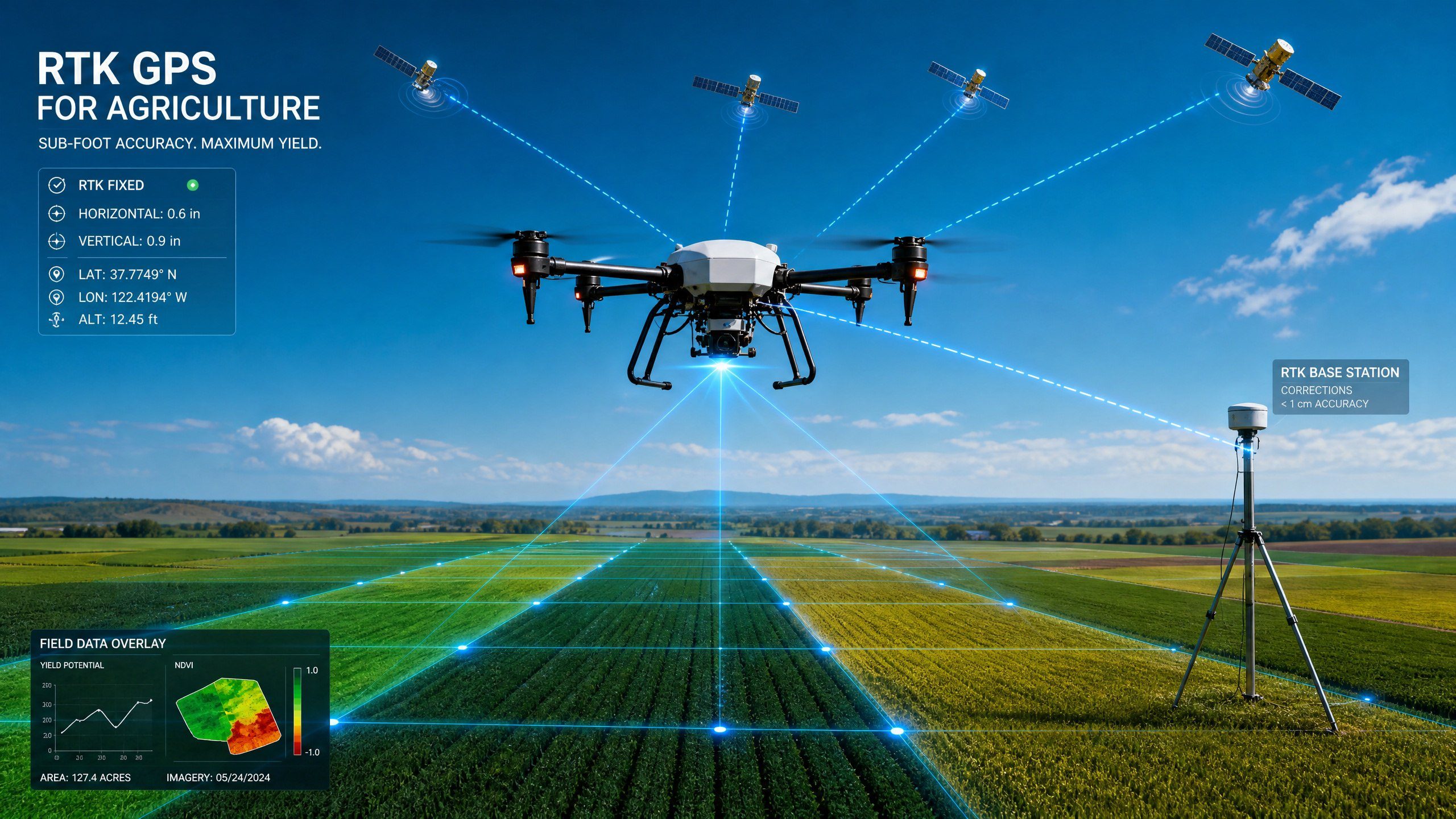
Precision agriculture has moved from a niche specialty to a core practice for modern farming operations. At the heart of this transformation is RTK (Real-Time Kinematic) GNSS technology — the only positioning method that delivers the repeatable sub-foot accuracy needed for tasks like variable-rate seeding, autonomous tractor guidance, and precise chemical application. This guide explores how RTK GNSS receivers — particularly those powered by Septentrio modules — are helping agronomists, OEMs, and farm operators achieve centimeter-level performance in demanding field conditions.
Why RTK GNSS Matters in Agriculture
Standard GNSS receivers, even those with differential correction (SBAS), typically deliver 1–3 meter accuracy. That’s fine for general navigation but insufficient for precision farming. RTK corrects satellite signal errors in real time using a fixed base station or NTRIP network, bringing accuracy down to 2–5 centimeters — the difference between overlapping fertilizer strips and efficient, gap-free coverage.
Key agricultural applications that depend on RTK accuracy include:
- Auto-steer and guidance — Keeping tractors, sprayers, and harvesters on sub-inch rows pass after pass, even in low-visibility dust or fog
- Variable-rate application (VRT) — Adjusting seed, fertilizer, and chemical rates in real time based on GPS-positioned soil maps
- Strip-till and controlled traffic farming (CTF) — Confining wheel traffic to permanent lanes to reduce soil compaction
- Yield mapping — Attributing harvest data to precise field coordinates for next-season planning
- Autonomous equipment — Enabling fully unmanned tractors and implements to navigate field boundaries safely
What to Look for in an Agricultural GNSS Receiver
Not all RTK receivers are built for the farm. Agricultural environments present unique challenges: dust, vibration, extreme temperatures, power fluctuations from vehicle electrical systems, and long hours of continuous operation. Here are the key specifications to evaluate when selecting a GNSS receiver for precision agriculture:
Multi-Frequency, Multi-Constellation Support
A receiver that tracks GPS, GLONASS, Galileo, and BeiDou across L1, L2, and L5 bands provides more satellites in view, faster RTK fix convergence, and better performance under tree canopy or near buildings. Industrial-grade GNSS solutions from Septentrio offer full multi-constellation, multi-frequency tracking with fast Time-To-Fix-RTK — often under 10 seconds in open sky conditions.
Anti-Jamming and Interference Mitigation
Farm environments are full of RF interference sources: nearby power lines, electric fences, inverter drives on irrigation pumps, and even other radios on the same vehicle. Septentrio’s AIM+ (Advanced Interference Mitigation) technology actively detects and blanks up to 80 interfering signals simultaneously without losing lock on satellite signals. This is a critical feature often overlooked by integrators until a receiver loses RTK fix mid-application and wastes input across overlapping passes.
Communication and Correction Delivery
RTK corrections must reach the receiver reliably. Modern agricultural receivers support multiple correction delivery methods:
- NTRIP via cellular modem — Ideal for regions with reliable 4G/5G coverage; corrections stream from a VRS (Virtual Reference Station) network
- Radio UHF link — Preferred where cellular coverage is spotty; a local base station broadcasts corrections over licensed or license-free bands
- L-band satellite correction — No base station or cellular needed; correction data arrives via geostationary satellite (services like TerraStar, RTX)
- On-device logging + post-processing — Useful for yield mapping and field surveys where real-time corrections aren’t required
Septentrio-Powered Receivers: A Closer Look
Several manufacturers integrate Septentrio’s mosaic™ and AsteRx-family GNSS modules into purpose-built agricultural receivers. These modules are known for their low power consumption (ideal for battery-operated field devices), rugged signal tracking in high-vibration environments, and LOCK+ technology that maintains RTK fix even under heavy canopy or roll-over conditions.
For OEMs and system integrators building the next generation of smart farming equipment, choosing a high-precision GNSS receiver module that balances performance, power, and cost is essential. Septentrio modules offer raw measurement output for custom fusion with inertial sensors (IMU), enabling RTK-level accuracy in GNSS-denied periods — such as when a combine enters a grain silo or passes through a narrow treeline.
Integration with ISOBUS and Precision Ag Platforms
A GNSS receiver is only as useful as the systems it talks to. Modern receivers should support:
- ISOBUS (ISO 11783) — The universal communication protocol for agricultural tractors and implements, enabling plug-and-play compatibility across brands
- NMEA 0183 and NMEA 2000 — Standard marine and mobile navigation protocols widely used in ag displays and guidance controllers
- CAN bus output — Direct integration with vehicle CAN networks to deliver position and heading data to ECUs
- Native APIs (SDK/ROS) — For custom autonomy stacks in autonomous tractor and robotic implement projects
Septentrio receivers ship with free SDK access and ROS driver support, making them a strong choice for research teams and startups developing autonomous agricultural platforms.
Common Mistakes When Deploying RTK on the Farm
A few pitfalls we see repeatedly in the field:
- Ignoring base station placement. A temporary base station mounted on a tripod in the yard won’t provide the repeatable accuracy needed for CTF season after season. Install a permanent monument mark with known coordinates.
- Choosing the wrong correction source. Cellular NTRIP is convenient, but if your farm has dead zones, invest in a UHF radio link or L-band service before you lose fix during a critical operation.
- Neglecting antenna quality. A premium receiver paired with a cheap antenna is wasted performance. Multi-frequency survey-grade antennas with ground-plane filters make a measurable difference under canopy.
- Skipping interference surveys. Before deploying RTK across a large operation, scan the property for interference sources. An afternoon with a spectrum analyzer can save weeks of frustration.
The Bottom Line
RTK GNSS is no longer optional for competitive precision agriculture. Whether you’re an OEM designing the next generation of autonomous sprayers, an integrator building guidance systems for large row-crop operations, or a farm operator looking to upgrade from WAAS-level guidance, the choice of GNSS receiver determines the ceiling of your system’s performance.
Septentrio-powered receivers deliver the accuracy, reliability, and environmental resilience that modern agriculture demands — from the dusty wheat fields of the Great Plains to the humid rice paddies of Southeast Asia. When evaluating your next precision ag platform, demand a receiver that offers true RTK, multi-constellation tracking, and serious interference protection. Your crop yields — and your bottom line — will thank you.
Looking for a GNSS receiver for your precision agriculture application? Browse our range of RTK GNSS receivers with Septentrio modules or contact our team for a technical consultation.
Need a rugged, multi-frequency GNSS module for your ag OEM project? Explore GNSS Solutions’ industrial receiver options and INS-receiver.com’s integrated GNSS+IMU platforms for autonomous farming.