Two of the fastest-growing outdoor robotics categories — autonomous lawn mowers and professional UAVs — are converging on the same engineering problem: centimeter-level positioning that keeps working in the real world, not just in a clear-sky field. Interference from Wi-Fi and wireless charging in backyards, RF noise on job sites, tree cover, and the need for trustworthy heading all stress-test a GNSS receiver in ways spec sheets do not capture. This guide is written from the operator and systems-integrator perspective: what Septentrio receivers actually deliver when you put them on a mower or a UAV running ROS, where the official ROSaic driver removes work, and how the pieces fit together.
1. What a Mower and a UAV Ask of GNSS
A boundary-free RTK mower needs to mow within centimeters of edges it cannot see, map the yard without guide wires, pause and resume after an interruption, and drive itself back to the dock — all on continuous positioning. A UAV doing survey, inspection or delivery work asks for the same reliability at higher dynamics, with the added requirement that the receiver must not lose lock under prop wash, vibration or RF interference. In both cases the receiver is not an accessory; it is the primary reference the whole autonomy stack trusts.
Market momentum is real: the smart-mowing-robot market is projected to rise from USD 1.29B (2020) to USD 4.04B (2028), about 15.5% CAGR [Fortune Business Insights via industry reporting]. Public leaderboard references include Segway Navimow’s ±2 cm RTK + vision claim and ECOVACS GOAT A’s 45-satellite tracking and 2-inch edge mowing. Those numbers only hold if the receiver keeps RTK fixed when the environment turns hostile.
2. Interference Is the Silent Failure Mode
Yards are full of electromagnetic noise: Wi-Fi routers, Bluetooth speakers, wireless charging pads, power tools, neighboring radio gear. A GNSS receiver without serious mitigation will drop from fixed to float or lose lock entirely — and the mower, which has no boundary wire to fall back on, simply stops being safe. Septentrio’s AIM+ anti-jamming and anti-spoofing is the differentiator here. AIM+ monitors and suppresses interference and authenticates signals with OSNMA; at Jammertest 2025 the receivers held centimeter accuracy through roughly 100 interference scenarios and raised correct spoofing alarms. For a UAV operator, that is the difference between a mission that completes and one that returns with no usable data — or worse.
3. Heading Without the Magnetometer Problem
Edge mowing demands accurate heading. Many designs use a magnetometer, which is cheap but easily disturbed by motor currents, metal decking, or the charging station. Septentrio’s mosaic-H takes a different route: dual-antenna heading computed from RTK carrier phase. Heading, pitch and roll are available at power-up, immune to magnetic interference, and stable even when the vehicle is stationary — the same capability UAV GNSS operators use for moving-base attitude and dual-antenna alignment on aircraft.
4. ROS Integration: Where ROSaic Earns Its Keep
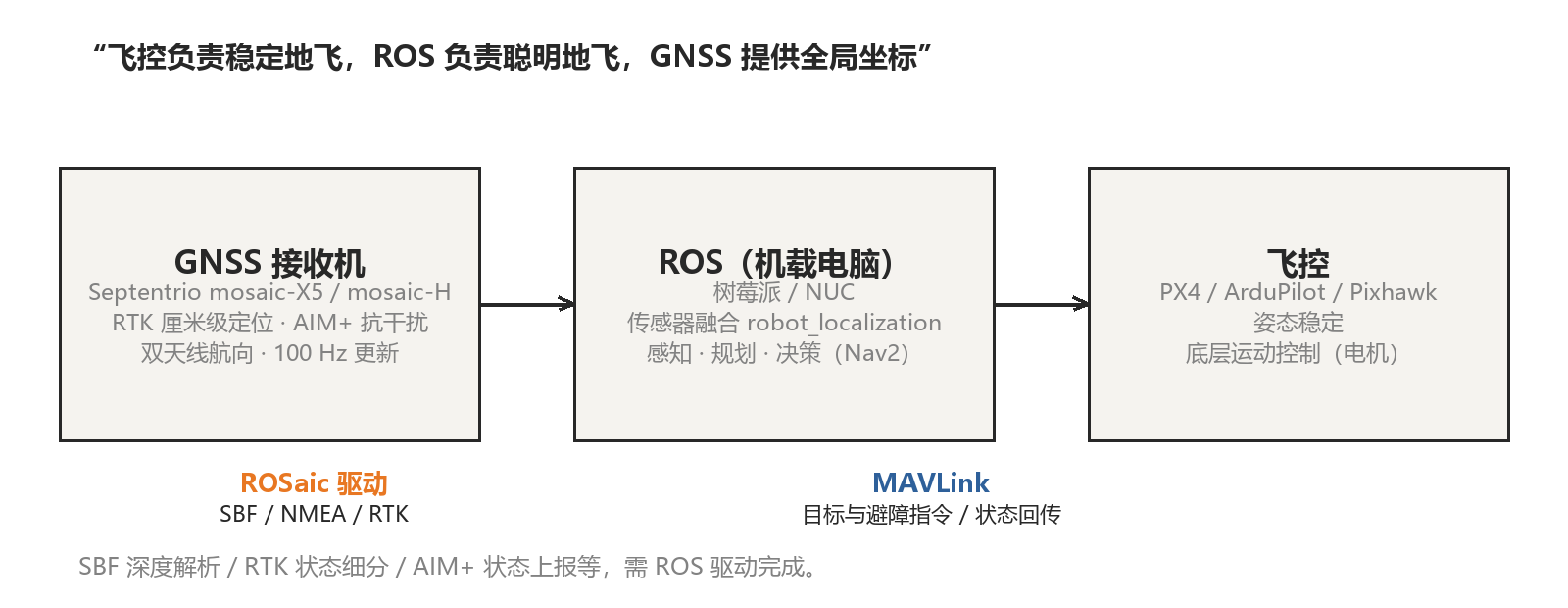
A flight controller (PX4 / ArduPilot / Pixhawk) reads basic NMEA/UBX sentences and keeps the platform stable. The autonomy layer — obstacle avoidance, path planning, task decisions — runs on a companion computer under ROS, and that is where receiver depth matters. Binary SBF blocks, RTK fix quality, AIM+ interference state and multiple differential sources are invisible to the flight controller; they are exactly what Septentrio’s open-source ROSaic driver (septentrio_gnss_driver, C++, ROS 1 Melodic/Noetic + ROS 2 Foxy through Rolling) exposes on the ROS side.
4.1 Straight into the fusion stack
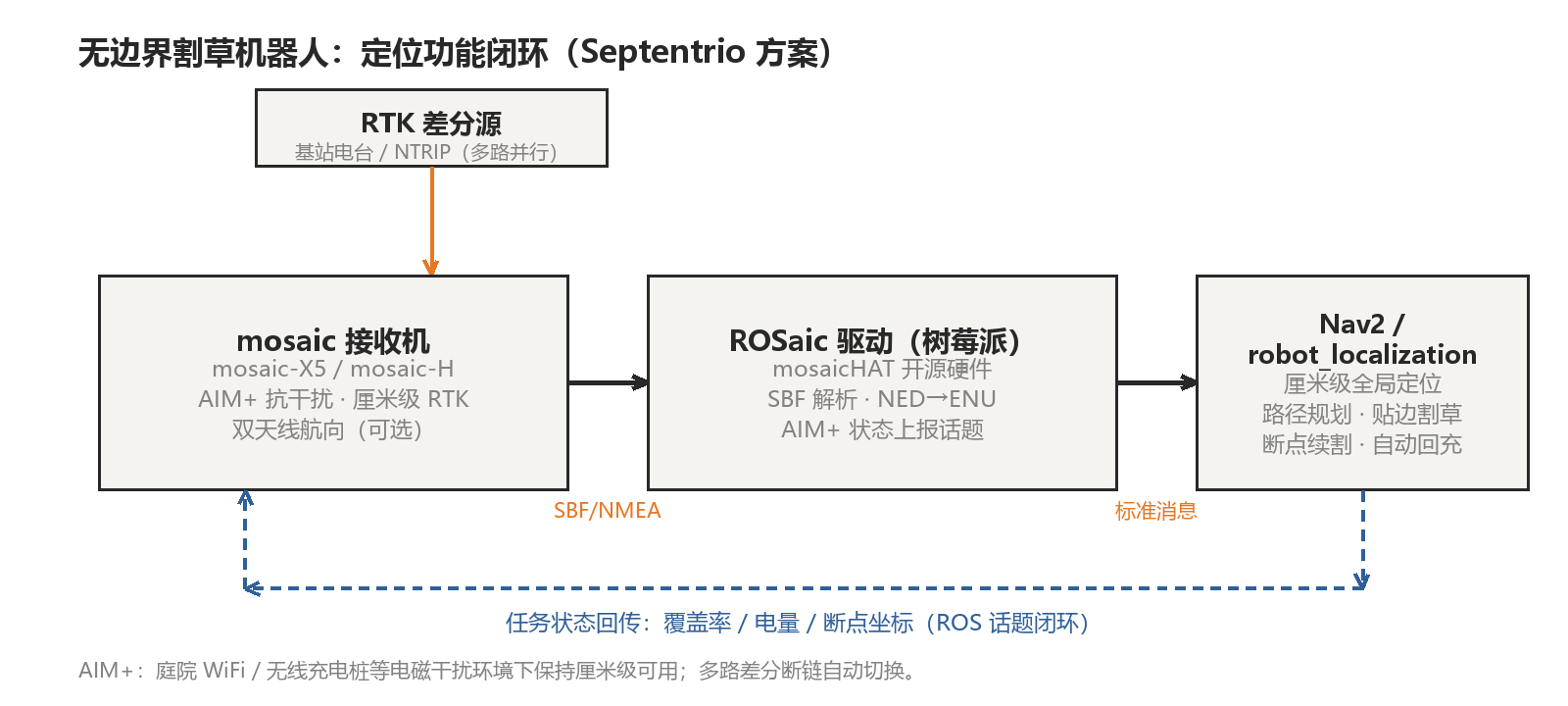
ROSaic publishes sensor_msgs/NavSatFix, gps_common/GPSFix and — on INS models — nav_msgs/Odometry with full attitude. That plugs directly into robot_localization and Nav2, the standard ROS 2 fusion/navigation stack for mowers and ground robots. The driver also converts Septentrio’s NED axis convention to ROS’s ENU internally, so fused pose is correct without custom math.
4.2 Multi-source RTK that fails over by itself
Real deployments lose correction links: an NTRIP stream drops, a base station goes offline, a radio link fades at the far end of the yard. ROSaic lets you configure several differential sources at once — NTRIP, TCP/IP streams, serial — and switches to the next available source automatically. For the dock-return leg of a mowing cycle, that continuity is what keeps the robot arriving at the charger instead of stopping in the middle of the lawn.
4.3 INS models: the YAML settings that matter
On GNSS/INS receivers (AsteRx-i3 D Pro(+), AsteRx SBi3 Pro(+), AsteRx RBi3 Pro(+)), the ROSaic YAML config controls fusion quality directly. Key fields: receiver_type: ins; use_ros_axis_orientation to choose NED or ENU; ins_spatial_config with IMU orientation (theta X/Y/Z) and lever arms — poi_lever_arm, antenna-to-IMU ant_lever_arm, velocity-sensor-to-IMU vsm_lever_arm; ins_initial_heading (auto or stored); ins_std_dev_mask as the quality gate; ins_use_poi for TF publishing; and ins_vsm to feed wheel/body speed into the solution. These physical offsets and uncertainty ceilings are where centimeter claims are won or lost in integration.
4.4 Verify without a bench
SBF and PCAP replay means you can exercise the whole ROS pipeline with a recorded log — topic structure, message contents, fusion behavior — before the receiver is even mounted. On a real unit, ros2 topic list / ros2 topic echo confirm INS topics (INSNavGeod, INSNavCart, ExtSensorMeas, IMUSetup, VelSensorSetup), and PlotJuggler renders acceleration and trajectory live.
5. The Full Loop on a Mower
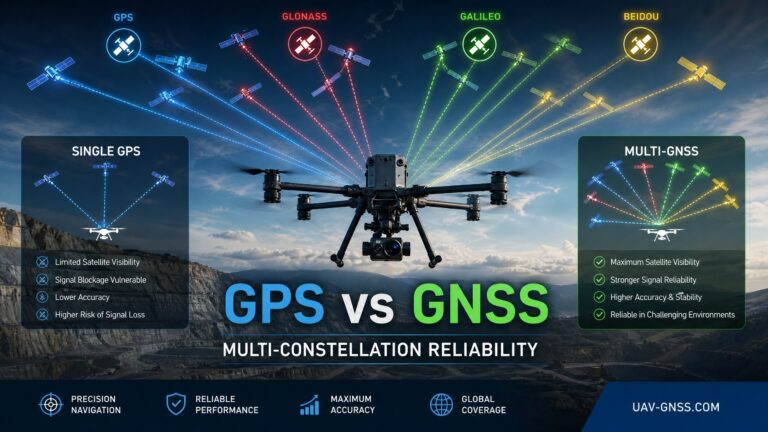
Putting it together on a boundary-free mower: RTK corrections arrive from base station and NTRIP in parallel; a mosaic-class receiver runs AIM+ while tracking all constellations (GPS / Galileo / GLONASS / BeiDou / QZSS); mosaicHAT (mosaic-X5 + Raspberry Pi) carries the ROSaic driver; Nav2 / robot_localization fuses GNSS and IMU; and the mower mows edges, resumes after interrupts, and returns to dock — with task state looped back over ROS topics for supervision.
| Mowing / UAV need | Septentrio capability that answers it |
|---|---|
| Shade, walls, tree cover | Full-constellation multi-band (GPS / Galileo / GLONASS / BeiDou / QZSS) and GNSS+ algorithms hold position with fewer visible satellites |
| Yard EMI (Wi-Fi, chargers, Bluetooth) | AIM+ interference monitoring & suppression with OSNMA authentication; Jammertest 2025: cm accuracy through ~100 scenarios, correct spoofing alarms |
| Precise heading | mosaic-H dual-antenna heading: RTK-derived heading/pitch/roll at power-up, no magnetometer, no magnetic-field sensitivity |
| Motion-control update rate | mosaic-H RTK at 100 Hz output |
| Tight power budgets | mosaic surface-mount ultra-low-power modules; mosaicHAT reference design for Pi prototyping |
| ROS 2 autonomy stack | ROSaic outputs NavSatFix / IMU / Odometry directly to Nav2 / robot_localization; NED→ENU built in; AIM+ state on topics; UDP low-latency path |
| Dock-return reliability | Parallel RTK sources (NTRIP / TCP / serial) with automatic failover; time sync + latency compensation |
6. Honest Fit Assessment
Septentrio is not the cheapest option on a mower BOM — consumer products are extremely cost-sensitive, and volume designs often pick budget chipsets. The value case is reliability-first products: premium mowers that advertise accuracy as a feature, commercial mowing fleets where downtime costs money, and UAV operators who need jamming-resistant positioning on critical missions. ROSaic is also aimed at professional integration, so teams planning fully proprietary receiver firmware may not need it; teams building on ROS or PX4 will feel the difference immediately. [Assessment in this guide.]
Takeaway: for mowers and UAVs alike, the Septentrio package that wins is AIM+ anti-jamming for hostile RF, mosaic-H dual-antenna heading for edge precision, and the mosaicHAT / ROSaic open-source stack for development speed — one receiver family that spans the ROS and flight-controller worlds.
7. FAQ
Can a Septentrio receiver feed both a Pixhawk flight controller and a ROS companion computer? Yes. The mosaic family connects to Pixhawk / ArduPilot / PX4 for flight control while ROSaic simultaneously publishes full-depth data (SBF status, AIM+ state, RTK quality) to the ROS computer.
Will AIM+ stop a mower losing RTK near a Wi-Fi router or wireless charger? AIM+ is designed exactly for that: it detects and suppresses interference and authenticates signals with OSNMA, and held centimeter accuracy through ~100 jamming scenarios at Jammertest 2025. No receiver is immune to a jammer placed directly on the antenna, but household RF is well within AIM+’s intended envelope.
Do I need a GNSS/INS receiver for a mowing robot, or is GNSS-only enough? GNSS-only (e.g. mosaic-X5 / mosaic-G5) is the common starting point and works with ROSaic’s NavSatFix output. Add INS (AsteRx SBi3 Pro etc.) when you need continuous attitude, robust pose under brief GNSS outages, or integrated heading without a second antenna.
Which UAV GNSS receivers work with ROSaic? Any UAV GNSS receiver built on the Septentrio mosaic-X5, mosaic-G5 or AsteRx engines — including our EV322, HB6 and HB10 series — inherits full ROSaic support with no custom driver work.
How fast can a team integrate? With the official driver, teams typically reach a validated GNSS+IMU fusion on ROS 2 in days — versus weeks to months to write and maintain protocol parsing, coordinate conversion and differential plumbing yourself.
8. References
| Item | Source |
|---|---|
| septentrio_gnss_driver (ROSaic) repository | github.com/septentrio-gnss/septentrio_gnss_driver |
| mosaicHAT open-source reference design | github.com/septentrio-gnss/mosaicHAT |
| Septentrio Jammertest 2025 results | septentrio.com — Jammertest 2025 insights |
| Septentrio mosaic / AsteRx product pages | web.septentrio.com — GNSS modules · INS receivers |
| ROSaic integration knowledge-base articles | customersupport.septentrio.com |
| ROS docs / robot_localization | wiki.ros.org · github.com/cra-ros-pkg/robot_localization |
| Mowing market analysis | Fortune Business Insights via industry reporting |
Author: UAV GNSS technical team · Published: 2026-09-03 · Source document: 《Septentrio GNSS 接入 ROS 技术指南》终稿 v1.2 (2026-09-02) · External references as listed above.
9. Related Reading
- Septentrio GNSS 接收机如何无缝接入 ROS:官方驱动、兼容性与技术优势详解(中文版) — Chinese version on gnss-imu.com
- Septentrio GNSS + ROS Integration Guide: Compatibility & Mowing-Robot Case Study (gnss-solutions.com) — Eview selection-guide version
- Septentrio GNSS + ROS Integration: Official ROSaic Driver Guide — technical report on this site
- ROSaic Deep Dive (gnss-solutions.com) — systems-engineering deep dive
- Septentrio ROS 驱动(ROSaic)技术报告(中文版) (gnss-imu.com)
- RTK GNSS for Autonomous Lawn Mowers (uav-gnss.com) — product overview
10. More on AIM+ Anti-Jamming
- Jammertest 2025: AIM+ Anti-Jamming Keeps UAVs on Mission (uav-gnss.com)
- Jammertest 2025 Results (gnss-solutions.com)
- Jammertest 2025 抗干扰实测结果(中文版) (gnss-imu.com)
Building a ROS mower or a GNSS-guided UAV? UAV GNSS supplies mosaic-X5 and AsteRx-based receivers with AIM+ anti-jamming, and our engineers can advise on ROSaic integration. Email sales@uav-gnss.com for a quote.