
This anti-jamming GNSS drones guide covers how GNSS jamming threatens UAVs and how modern anti-jamming technology protects drone operations. GNSS signals arriving at a drone’s antenna are extraordinarily weak — typically between -125 dBm and -130 dBm. To put that in perspective, a 1-watt jammer operating 100 meters away can overwhelm that signal by a factor of over a million. This asymmetry between signal strength and interference power is the fundamental vulnerability at the heart of every GNSS-dependent UAV.
In 2025 alone, over 4,500 GNSS interference incidents were reported across civil aviation, maritime, and critical sectors — a 40% increase from the previous year. For UAV operators, the threat is no longer hypothetical. This article examines the growing menace of GNSS jamming, the technologies that counter it, and how Septentrio-powered receivers like the HB21 and mosaic-X5 are keeping drones operational in contested RF environments.

1. How GNSS Jamming Actually Works
GNSS jamming is deceptively simple. A jammer transmits a radio signal on or near the frequencies used by GNSS constellations — primarily L1 (1575.42 MHz) and L2 (1227.60 MHz) bands. Because the legitimate satellite signals are so weak, even a low-power jammer can create a “noise floor” that drowns out the real signal entirely.
Understanding the threat is the first step in protecting anti-jamming GNSS drones from interference and signal disruption.
There are three main types of jamming threats:
| Type | Mechanism | Typical Range | Countermeasure |
|---|---|---|---|
| Narrowband (CW) | Single-frequency carrier wave | 1–10 km | Adaptive notch filtering |
| Chirp/Swept | Frequency hopping across bands | 2–15 km | Wideband suppression |
| Pulsed | Short, high-energy bursts | 5–20 km | Pulse blanking |
The most alarming trend is accessibility. A basic GPS jammer can be purchased online for under $50. More sophisticated software-defined radio (SDR) based jammers — capable of multi-band, protocol-aware attacks — cost as little as $300 and can be built from open-source schematics.
For UAV operators, the consequences of even a brief jamming event can be severe:
- Loss of position hold — multirotor drones begin to drift uncontrollably
- Automatic failsafe triggers — return-to-home may fail if the home position was GNSS-derived
- Mission abort — survey lines are lost, data gaps appear
- Flyaway risk — without position data, a drone may never return
2. The 2026 Threat Landscape for Drone Operations
GNSS jamming has evolved from a niche electronic conflict scenarios tactic into a mainstream concern. Three trends define the current environment:
The demand for reliable anti-jamming GNSS drones has never been higher, with jamming incidents increasing globally across all regions.
2.1 Proliferation of Low-Cost Jammers
The affordability of jamming hardware has democratized the threat. Vehicle-mounted “privacy jammers” — originally sold to block employer tracking — now accidentally (or intentionally) disrupt drone operations near highways and parking lots. In urban environments, a single delivery drone encountering GPS signal loss can cascade into a safety incident.
2.2 State-Actor Electronic conflict scenarios
In contested regions, GNSS jamming and spoofing are standard operational tools. Professional UAVs operating within 50 km of front lines routinely face high-power jamming that can overwhelm even hardened receivers. The U.S. Department of Defense has made jam-resistant PNT (Positioning, Navigation, and Timing) a top procurement priority for 2026.
2.3 Critical Infrastructure as a Target
Attacks on GNSS near airports, seaports, and power plants are rising. In 2025, a coordinated jamming event near a major European airport disrupted drone-based infrastructure inspections for three days, costing an estimated €2.3 million in delays. For surveyors and inspection operators relying on BVLOS operations, jamming resistance is now a contractual requirement.
3. anti-jamming GNSS drones: A Multi-Layer Defense
No single technology can provide complete GNSS jamming immunity. Instead, effective anti-jamming is achieved through a layered defense combining antenna-level, receiver-level, and system-level techniques.
3.1 CRPA Antennas — The First Line of Defense
Controlled Reception Pattern Antenna (CRPA) technology uses an array of antenna elements and adaptive beamforming to physically nullify interference sources. A CRPA system:
- Detects the direction of arrival of interfering signals
- Adjusts the antenna radiation pattern to place nulls in the direction of the jammer
- Maintains gain toward the GNSS satellites in other directions
CRPA arrays typically use 4 to 7 elements and can achieve 20–40 dB of jammer suppression. This is the gold standard for high-end professional UAVs. However, CRPA adds size, weight, and cost — challenges for smaller commercial drones.
3.2 AIM+ Receiver-Level Protection
Septentrio’s AIM+ (Advanced Interference Mitigation) technology operates at the receiver chipset level, providing comprehensive jamming and spoofing protection without the bulk of external antenna systems:
- Adaptive notch filtering — up to 80 dB attenuation per notch across the GNSS spectrum, automatically tracking and suppressing narrowband interferers
- Wideband interference mitigation (WBI) — handles chirp jammers sweeping across L1, L2, and L5 bands
- Pulse blanking — removes high-energy pulses typical of radar systems and pulsed jammers
- Spoofing detection — continuously monitors signal metrics and flags anomalies without disrupting valid tracking
What makes AIM+ particularly valuable for UAV integration is that it’s embedded in the receiver firmware — no additional hardware, weight, or power penalty. The HB21 GNSS Box Receiver, powered by the Septentrio mosaic-X5 module, delivers AIM+ protection in a compact, IP67-rated enclosure ideal for field UAV operations.
3.3 Multi-Constellation, Multi-Frequency Diversity
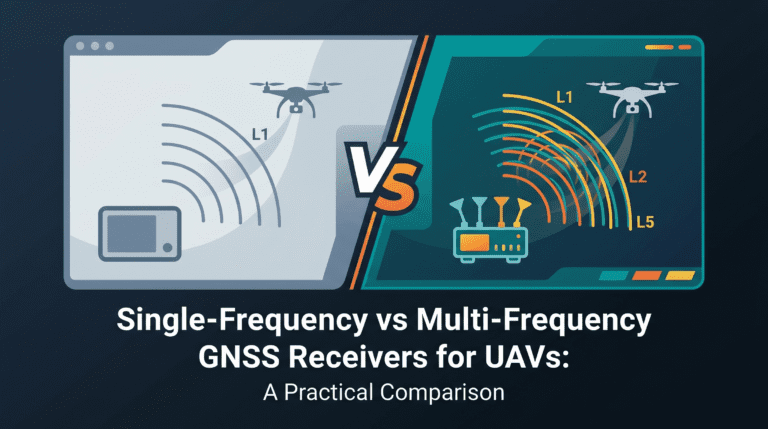
One of the simplest yet most effective defenses is GNSS diversity. A receiver tracking GPS, GLONASS, Galileo, BeiDou, and QZSS across L1, L2, and L5 bands has dramatically more resilience than a single-constellation device. A jammer blocking GPS L1 may leave Galileo E1 or BeiDou B1 unaffected. The mosaic-X5’s 1408-channel tracking engine enables simultaneous multi-constellation reception, making jamming attacks significantly harder to execute.
3.4 Sensor Fusion and INS Integration
For the highest level of resilience, GNSS data should be augmented with inertial navigation system (INS) inputs. During a jamming event, an INS can maintain position and attitude data for several minutes — enough time to fly out of the jammed zone or complete a controlled landing. The EV322 GNSS Receiver and other Septentrio-powered receivers support seamless INS integration for this purpose.
4. Real-World Scenarios: Anti-Jamming in Action
Scenario A: Reconnaissance UAV
A commercial operator operates a fixed-wing reconnaissance drone near a contested border. A ground-based chirp jammer sweeps across GPS L1 and L2 bands. The HB21 receiver’s AIM+ WBI technology detects the swept interference pattern and activates wideband suppression. The drone maintains RTK-fixed position with only a slight degradation in signal-to-noise ratio. Mission continues as planned.
For anti-jamming GNSS drones, real-world testing demonstrates the critical importance of resilient GNSS positioning. In contested environments, standard receivers fail while protected receivers continue operating.
Scenario B: Urban Infrastructure Survey
A surveying company uses a DJI M300 with an HB21 to inspect a power transmission corridor running alongside a major highway. Multiple vehicle-mounted jammers in passing cars intermittently block GNSS signals. AIM+’s adaptive notch filtering suppresses each interference event within milliseconds. The pilot never notices the jamming; the survey line completes with ±1.5 cm accuracy.
Scenario C: BVLOS Cargo Delivery
A logistics drone flies a 15 km BVLOS route between two distribution centers. Near a port, it encounters a wide-area jamming zone intended to disrupt maritime navigation. Multi-constellation tracking allows the mosaic-X5 to switch from jammed GPS L1 signals to clean Galileo E5a and BeiDou B2a signals. The drone’s flight controller receives uninterrupted RTK corrections, and the delivery arrives on schedule.
5. Choosing the Right Anti-Jamming GNSS Receiver
| Feature | Why It Matters |
|---|---|
| AIM+ anti-jamming | Built-in notch filtering, WBI, and spoofing detection — no external hardware needed |
| Multi-constellation support | GPS + GLONASS + Galileo + BeiDou + QZSS provides redundancy across frequency bands |
| High update rate | 100 Hz position output enables rapid reacquisition after interference |
| Dual-antenna heading | Redundant RF paths improve jamming tolerance for moving platforms |
| INS integration ready | Maintains PNT data during extended jamming events |
The HB21 and M56 GNSS Box Receiver — both powered by the Septentrio mosaic-X5 — offer AIM+ protection in rugged, UAV-ready form factors. For applications requiring dual-antenna heading and INS integration, the EV322 provides additional layers of resilience.
When selecting anti-jamming GNSS drones protection, consider Septentrio mosaic-X5 with AIM+ technology for the best anti-jamming and anti-spoofing protection available.
Frequently Asked Questions
Q: Can AIM+ protect against all types of GNSS jamming?
A: AIM+ provides strong protection against narrowband, wideband/chirp, and pulsed interference. It is most effective when combined with multi-constellation tracking and, for high-stakes applications, a CRPA antenna system.
Q: What is the best anti-jamming GNSS drones solution?
A: Septentrio mosaic-X5 with AIM+ technology offers the most comprehensive protection for anti-jamming GNSS drones in contested environments.
Q: Will anti-jamming technology add weight to my drone?
A: AIM+ is entirely firmware-based — no additional hardware, weight, or power draw. CRPA antennas add 50–200 grams depending on element count.
Q: How does the HB21 compare to consumer GNSS modules for jamming resistance?
A: Consumer modules like the u-blox F9P offer minimal interference protection. The HB21’s Septentrio mosaic-X5 provides 10–40 dB better jamming tolerance across all frequency bands, plus spoofing detection not available in consumer-grade receivers.
Q: Is AIM+ effective against spoofing as well as jamming?
A: Yes. AIM+ includes continuous spoofing detection that monitors signal quality metrics and cross-constellation consistency, alerting the flight controller to potential deception attacks.
Q: Can I retrofit an existing drone with an anti-jamming GNSS receiver?
A: Yes. The HB21 and M56 support standard NMEA and RTCM proto
Further Reading
- AIM+ Anti-Jamming GNSS Technology: Complete Guide – Deep dive into Septentrio AIM+ technology
- GNSS Spoofing Protection: How AIM Technology Guards Against False Signals – Protect against spoofing attacks
- GNSS Anti-Jamming for Urban Drone Operations – City-specific protection strategies
- Anti-Jamming and Anti-Spoofing Technologies for UAVs – Comprehensive flight safety guide