
HB52H / HB52 Ultralight RTK GNSS Module — Septentrio mosaic-G5
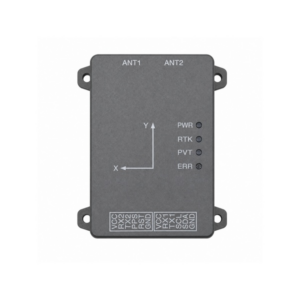
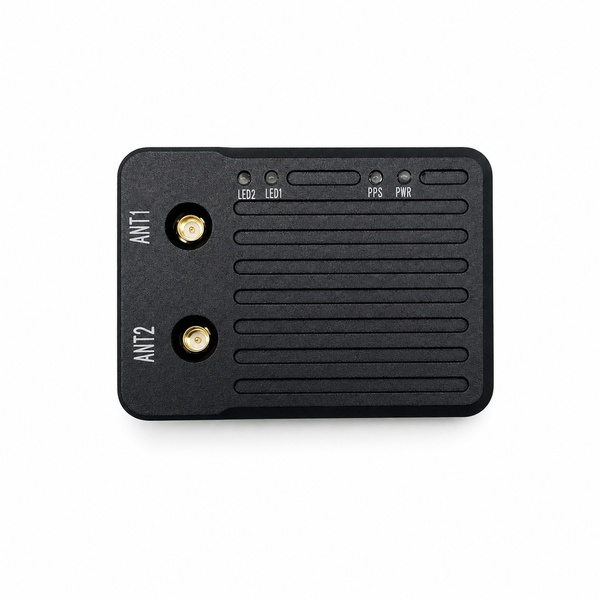
The HB52H / HB52 is a featherweight, ultra-compact all-constellation RTK GNSS module built on the Septentrio mosaic-G5. Measuring just 43.8 × 34.0 × 11.5 mm, it packs 789 hardware channels, centimetre-level RTK accuracy, and onboard TF card logging — making it a natural fit for weight-critical UAV, robotics, and autonomous vehicle builds. The HB52H variant adds dual-antenna heading, pitch, and roll for full 6-DOF orientation.
Description
Sub-45 mm RTK GNSS Module with Full Septentrio Signal Protection
The HB52H / HB52 is an ultralight, fully encapsulated RTK GNSS module powered by the Septentrio mosaic-G5. It tracks every current constellation and frequency band across 789 hardware channels, delivering 0.6 cm + 0.5 ppm RTK horizontal accuracy at up to 20 Hz with sub-10 ms latency. The HB52H variant supports dual-antenna heading, pitch, and roll for platforms requiring full orientation data. An integrated TCXO and LNA, onboard TF card slot (up to 32 GB), and the complete Septentrio signal resilience suite make this module drop-in ready for constrained, vibration-heavy platforms.
Key Features
- Septentrio mosaic-G5 engine — 789 hardware channels, all-in-view multi-GNSS
- Full signal support: GPS · GLONASS · BDS · Galileo · QZSS · NavIC · SBAS
- RTK accuracy: 0.6 cm + 0.5 ppm horizontal; 1.0 cm + 1 ppm vertical
- 20 Hz update rate · <10 ms output latency (99.9%)
- HB52H dual-antenna heading: 0.15° @ 1 m · 0.03° @ 5 m baseline
- Ultra-short baseline heading output supported
- Timing: xPPS 1.4 ns · Event <3 ns
- Cold TTFF <35 s · Warm <10 s · Reacquisition 1 s
- AIM+ anti-jamming/spoofing · APME+ multipath · IONO+ scintillation · LOCK+ tracking · RAIM+ integrity
- OSNMA Galileo authentication supported
- Integrated TCXO · LNA · TF card slot (up to 32 GB)
- Compact form factor: 43.8 × 34.0 × 11.5 mm
GNSS & Positioning Performance
| Parameter | Value |
|---|---|
| GNSS Engine | Septentrio mosaic-G5 |
| Hardware Channels | 789 |
| Constellations | GPS · BDS · GLONASS · Galileo · QZSS · NavIC · SBAS |
| GPS Signals | L1C/A, L1C, L2C, L2P(Y), L5 |
| BDS Signals | B1I, B1C, B2a, B2I, B2b, B3I |
| GLONASS Signals | L1CA, L2CA, L2P, L3 CDMA |
| Galileo Signals | E1, E5a, E5b, E6 |
| RTK Accuracy (H) | 0.6 cm + 0.5 ppm (RMS) |
| RTK Accuracy (V) | 1.0 cm + 1 ppm (RMS) |
| Standalone (H/V) | 1.2 m / 1.9 m |
| DGNSS (H/V) | 0.4 m / 0.7 m |
| Cold TTFF | <35 s |
| Warm TTFF | <10 s |
| Reacquisition | 1 s |
| Update Rate | 20 Hz |
| Latency | <10 ms (99.9%) |
| Velocity Accuracy | 0.03 m/s (RMS) |
Heading & Timing
| Parameter | Value |
|---|---|
| Heading Accuracy @ 1 m | 0.15° heading · 0.25° pitch/roll |
| Heading Accuracy @ 5 m | 0.03° heading · 0.05° pitch/roll |
| xPPS Timing | 1.4 ns (RMS) |
| Event Timing | <3 ns |
| Baud Rate | 4800–4M bps (default 115200) |
Interface & Mechanical
| Parameter | Value |
|---|---|
| UART Ports | 2× UART (RX1/TX1, RX2/TX2) |
| Additional Interfaces | I²C (SCL/SDA) · SPI/SDIO · PPS · PWR |
| Storage | TF card slot, up to 32 GB |
| Protocols | NMEA 0183 v2.3/v3.03/v4.0 · Septentrio SBF · RTCM v3.x (MSM) |
| Dimensions | 43.8 × 34.0 × 11.5 mm (±0.2 mm) |
Target Applications
At under 45 mm in length and with full mosaic-G5 resilience, the HB52H / HB52 suits weight-sensitive fixed-wing and multirotor UAVs, fully autonomous ground robots, autonomous driving development platforms, and systems that need compatibility with open-source autopilots such as ArduPilot and PX4. The HB52H variant is particularly effective in multi-rotor applications where magnetic heading is unreliable, providing interference-free heading from the GNSS baseline alone.