

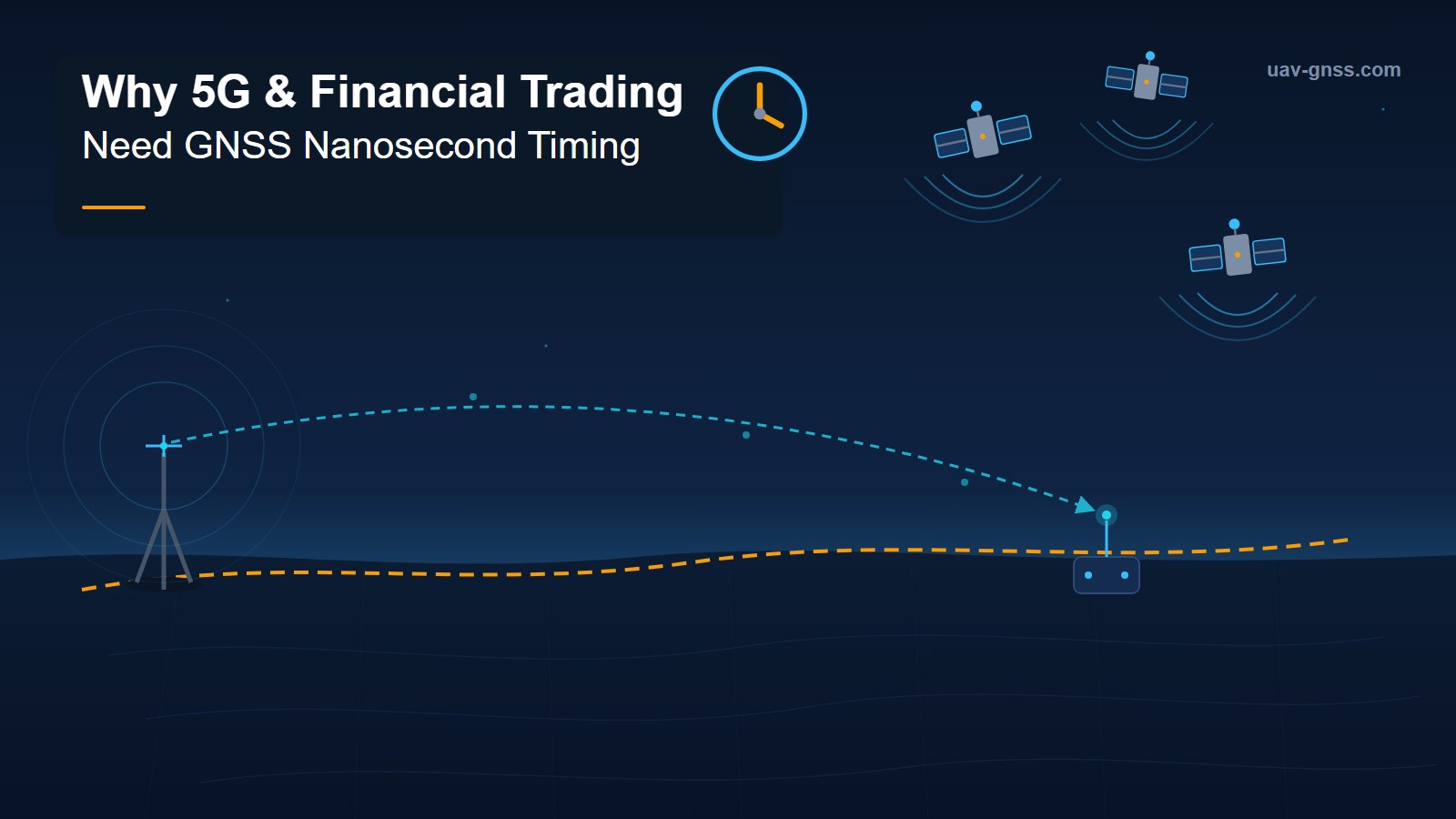
When most people think of GNSS (Global Navigation Satellite Systems), they think of navigation—getting from point A to point B. But there’s a second, equally transformative capability that GNSS provides: precise timing. Every GPS, Galileo, and BeiDou satellite carries multiple atomic clocks, broadcasting time signals accurate to within billionths of a second. This timing signal has become the invisible backbone of two of the most demanding industries on earth: 5G telecommunications and high-frequency financial trading.
In this post, we explore why nanosecond-level GNSS timing matters, how 5G networks depend on it for proper operation, why financial regulators mandate sub-microsecond timestamp accuracy, and how high-performance GNSS receivers like Septentrio’s mosaic-X5 enable this critical infrastructure.
The Hidden Role of GNSS Timing in Modern Infrastructure
Every GNSS satellite broadcasts not just positioning data, but an extremely accurate time signal referenced to Coordinated Universal Time (UTC). A GNSS receiver decodes these signals and outputs a precise 1 Pulse Per Second (1PPS) signal, along with Time of Day (ToD) data. Modern multi-constellation receivers can achieve timing accuracy of 5 nanoseconds or better—fast enough to distinguish events separated by the time it takes light to travel just 1.5 meters.
This capability is what makes GNSS the primary reference time source for virtually all critical infrastructure. From mobile network base stations to stock exchange matching engines, the world’s most time-sensitive systems rely on GNSS-disciplined oscillators (GNSSDOs) to stay synchronized to UTC.
Why 5G Networks Require Nanosecond-Level Timing
The leap from 4G to 5G represents a fundamental shift in how mobile networks use time. 4G networks primarily required frequency synchronization—ensuring that all base station oscillators tick at the same rate. 5G, however, demands absolute phase and time alignment across the entire network.
Time-Division Duplex (TDD) and Slot Alignment
5G networks operating in mid-band and millimeter-wave spectrum use Time-Division Duplex (TDD), where uplink and downlink share the same frequency channel but transmit at different times. Every base station in the network must agree on the exact moment to switch between transmit and receive modes. Even a timing discrepancy of a few hundred nanoseconds causes uplink and downlink slots to overlap, creating interference that degrades throughput, drops connections, and in safety-critical scenarios, creates dangerous conditions.
The 5G air interface tolerance is just ±130 nanoseconds. Within this window, advanced features like massive MIMO, carrier aggregation, and beamforming operate correctly. Outside it, network performance degrades rapidly.
O-RAN and Fronthaul Synchronization
The shift toward Open RAN (O-RAN) architecture disaggregates traditional base stations into Centralized Units (CU), Distributed Units (DU), and Radio Units (RU). This creates a new critical synchronization segment—the fronthaul network connecting DU to RU. The O-RAN specification requires time error (TE) of just ±65 nanoseconds between ports for enhanced Common Public Radio Interface (eCPRI) over Ethernet.
Meeting this requirement demands a multi-layered timing architecture: GNSS-disciplined grandmaster clocks at the root, Precision Time Protocol (IEEE 1588 PTP) for packet-based distribution, Boundary Clocks to regenerate timing at network switches, and high-stability oscillators for holdover when GNSS signals are temporarily unavailable.
5G Timing Standards and Compliance
Telecom timing is governed by a layered set of international standards:
- ITU-T G.8272 defines Primary Reference Time Clock (PRTC) requirements, including MTIE and TDEV masks
- ITU-T G.8275.1 specifies the PTP profile for phase/time synchronization with full timing support
- ITU-T G.8262 defines Ethernet Equipment Clock (EEC) requirements for Synchronous Ethernet (SyncE)
- 3GPP TS 38.104 sets base station radio requirements for TDD time alignment
- O-RAN.WG4.CUS.0 mandates the stringent ±65 ns TE for eCPRI fronthaul
All of these standards ultimately trace their timing reference back to GNSS-disciplined clocks.
GNSS Timing in High-Frequency Financial Trading
If 5G needs nanosecond timing for technical reasons, financial markets need it for fairness, compliance, and competitive advantage.
Why Timestamps Matter in Electronic Trading
Modern stock exchanges operate entirely electronically. Algorithms process market data, make trading decisions, and execute orders in microseconds. When thousands of orders arrive at a matching engine within the same microsecond, the sequence in which they are processed determines which trade gets filled and which does not. Without accurate time synchronization, it becomes impossible to determine the true order of events—creating disputes, regulatory risk, and potential market manipulation.
The financial industry has therefore invested heavily in precision timing infrastructure. Exchanges deploy GNSS-disciplined grandmaster clocks in their data centers, distribute time via PTP over dedicated low-latency networks, and require co-located trading firms to maintain clock synchronization within tight tolerances.
Regulatory Requirements: MiFID II and Beyond
Europe’s MiFID II regulation (specifically RTS 25) requires trading venues and market participants to maintain business clocks synchronized to UTC with specific accuracy levels:
- ±1 millisecond for trading venues and their members
- ±100 microseconds for high-frequency trading (HFT) firms
- Timestamps must be granular to at least 100 microseconds (with 1 microsecond recommended)
In practice, leading exchanges and HFT firms achieve far tighter synchronization. At Gemini, engineers implementing PTP with hardware timestamping on Solarflare NICs achieved ±30 nanosecond offset from the exchange’s grandmaster clock, with worst-case drift under ±85 ns over 24 hours. This represents a 20x margin over MiFID II’s most stringent requirement.
The EU’s Digital Operational Resilience Act (DORA), effective since January 2025, adds additional requirements for timing resilience. Financial entities must now demonstrate they can maintain accurate time even when GNSS signals are degraded or unavailable, using disciplined holdover oscillators and multiple reference sources.
From NTP to PTP to Hardware Timestamping
Financial trading firms typically use a layered timing approach:
- NTP (Network Time Protocol) — Millisecond accuracy, suitable for audit logs and non-critical systems
- PTP (IEEE 1588 Precision Time Protocol) — Sub-microsecond accuracy with hardware timestamping
- White Rabbit — Sub-nanosecond accuracy over fiber, used in the most demanding environments
- GNSS-Disciplined Oscillators (GNSSDOs) — The foundation, providing 5-100 ns accuracy directly traceable to UTC
Hardware timestamping is the critical enabler. When a PTP packet arrives at a network interface card (NIC), software-based timestamps introduce 50-500 µs of jitter due to kernel stack processing. Hardware timestamping records the arrival time at the physical layer with ~5 ns precision—three orders of magnitude better.
The GNSS Vulnerability Challenge
Both 5G networks and financial exchanges face a common challenge: GNSS signals are weak, easily jammed, and vulnerable to spoofing. A successful spoofing attack that shifts the time reference by just a few microseconds could disrupt an entire mobile network or cause catastrophic trading losses.
Key vulnerabilities include:
- Jamming: Low-power transmitters can overwhelm the weak GNSS signal (-125 dBm or weaker)
- Spoofing: Fake GNSS signals can trick receivers into reporting incorrect time
- Signal blockage: Indoor deployments, urban canyons, and underground sites lack sky visibility
- Solar weather: Space weather events can degrade GNSS signal quality
Modern timing infrastructure addresses these vulnerabilities through:
- Multi-constellation reception (GPS + Galileo + GLONASS + BeiDou) for redundancy
- Holdover oscillators (OCXO, Rubidium) that maintain accuracy during GNSS outages
- Terrestrial backup sources like 5G PRS-based timing for GPS-denied environments
- AIM+ interference mitigation technology built into receivers like the mosaic-X5 to filter out jamming signals
Recent tests by NextNav and Oscilloquartz demonstrated that 5G Positioning Reference Signals (PRS) can serve as a backup timing source when GPS is unavailable, achieving MTIE within 10-20 ns even in indoor, GPS-denied environments.
How mosaic-X5 Enables Precision Timing Applications
At the heart of many precision timing deployments is Septentrio’s mosaic-X5 GNSS receiver module. This compact module (31 × 31 × 4 mm, just 7 grams) delivers timing performance that rivals much larger, more expensive equipment:
- 1PPS output accuracy: 5 ns (typical)
- Event input accuracy: < 20 ns for time-tagging external events
- Multi-constellation support: GPS, GLONASS, Galileo, BeiDou
- L-Band corrections: TerraStar, Trimble RTX, and other PPP services
- AIM+ anti-jamming: Built-in interference mitigation for reliable operation in RF-challenged environments
- High update rate: Up to 100 Hz position output
- Low latency: < 10 ms from signal reception to output
For applications requiring even tighter timing, Septentrio offers the mosaic-T, a variant specifically optimized for timing and synchronization applications with enhanced holdover performance and additional timing-specific features.
Both modules support external frequency input (10 MHz reference) and can synchronize their internal time base to an external 1PPS signal via the TimeSync feature—critical for integration into existing timing architectures with Rubidium or Cesium holdover oscillators.
Emerging Trends: 6G, AI, and Beyond
The timing requirements will only grow more demanding. As 6G research progresses, target frequencies above 100 GHz will shrink cell sizes and demand even tighter synchronization—potentially sub-nanosecond time error. Network operators are exploring AI/ML-based timing management to predict GNSS outages, optimize PTP servo loops, and perform predictive oscillator maintenance.
In financial markets, regulators globally are moving toward stricter timestamp requirements. The SEC’s proposed Rule 613 (Consolidated Audit Trail) and ongoing ESMA reviews point toward sub-microsecond timestamping becoming the global standard rather than the exception.
Frequently Asked Questions
How accurate is GNSS timing?
Modern multi-constellation GNSS receivers like the mosaic-X5 achieve 1PPS output accuracy of 5 nanoseconds. Under good sky visibility, a properly installed GNSS-disciplined oscillator can maintain 10-100 ns accuracy to UTC.
What is the difference between NTP and PTP?
NTP (Network Time Protocol) typically delivers millisecond-level accuracy and is suitable for most IT systems. PTP (Precision Time Protocol, IEEE 1588) can achieve sub-microsecond accuracy with hardware timestamping, making it essential for 5G networks and financial trading where deterministic timing is critical.
Why do 5G networks need such precise timing?
5G’s Time-Division Duplex (TDD) operation requires all base stations to agree on exact transmission/reception timing. Even 130 ns of error causes interference between uplink and downlink slots. Advanced features like massive MIMO and carrier aggregation require even tighter synchronization.
What happens if GNSS timing is lost in a trading environment?
Without GNSS timing, trading systems rely on holdover oscillators (OCXO or Rubidium) that gradually drift. A clock with 1 ppm drift accumulates 3.6 ms of error in one hour—enough to reorder events across multiple markets. This is why financial firms deploy redundant GNSS receivers, multiple PTP grandmasters, and high-quality holdover oscillators.
Can GNSS timing be spoofed?
Yes, GNSS signals are vulnerable to spoofing. However, modern receivers include anti-spoofing features like signal authentication, multi-frequency monitoring, and AIM+ interference detection. Infrastructure deployments also use multi-constellation reception and cross-checking against backup time sources to detect and reject spoofed signals.
What is the mosaic-X5’s timing accuracy?
The Septentrio mosaic-X5 delivers 5 ns typical 1PPS output accuracy and <20 ns event input accuracy, making it suitable for the most demanding 5G and financial trading timing applications.
Conclusion
GNSS precision timing has become the invisible backbone of modern critical infrastructure. From enabling 5G’s next-generation mobile networks to ensuring fairness in global financial markets, nanosecond-level time synchronization is no longer a luxury—it’s a fundamental requirement. As 6G, AI, and increasingly stringent financial regulations push timing demands even further, the quality and resilience of GNSS timing infrastructure will only grow in importance.
Whether you’re building 5G base station synchronization equipment or designing high-frequency trading systems, the choice of GNSS receiver directly impacts your timing accuracy. Septentrio’s mosaic-X5 and mosaic-T modules offer the nanosecond-level precision, multi-constellation reliability, and anti-jamming resilience that these demanding applications require.