In the world of unmanned aerial vehicles (UAVs), precise navigation depends on more than just positional accuracy. While standard GNSS receivers can tell you where your drone is, they often fall short when it comes to determining its orientation — specifically, which direction it’s facing. That’s where GNSS heading receivers come into play, and for professional drone operations, understanding heading accuracy is critical.
What Is GNSS Heading Accuracy?
GNSS heading is the measurement of a vehicle’s orientation (yaw angle) relative to true north, determined by comparing carrier phase measurements from two or more GNSS antennas. Unlike a compass, which can be affected by magnetic interference from motors, batteries, and metal structures on a UAV, GNSS-based heading provides a true, drift-free orientation reference.
Heading accuracy is typically measured in degrees and depends on the baseline distance between the two antennas. A longer baseline (the distance between antennas) generally produces more accurate heading readings. For example, a 0.5-meter baseline on the Septentrio Mosaic-G5 P3H can deliver heading accuracy of approximately 0.3 degrees RMS.
Why Standard GNSS Isn’t Enough for UAV Heading
A single-antenna GNSS receiver can only provide position (latitude, longitude, altitude) and velocity. It cannot determine the yaw angle of the vehicle because there’s no reference point for rotation. This is why many drones rely on magnetometers (electronic compasses) for heading — but magnetometers have significant drawbacks:
- Magnetic interference: UAV motors, speed controllers, and power cables generate strong magnetic fields that distort compass readings.
- Calibration drift: Magnetometers require periodic calibration, and environmental changes can affect accuracy.
- Latitude-dependent: Near the Earth’s poles, magnetic compasses become unreliable due to magnetic declination.
A dual-antenna GNSS heading receiver overcomes all these limitations by using carrier phase differential GPS (CDGPS) techniques to compute heading directly from satellite signals.
How Dual-Antenna GNSS Heading Receivers Work
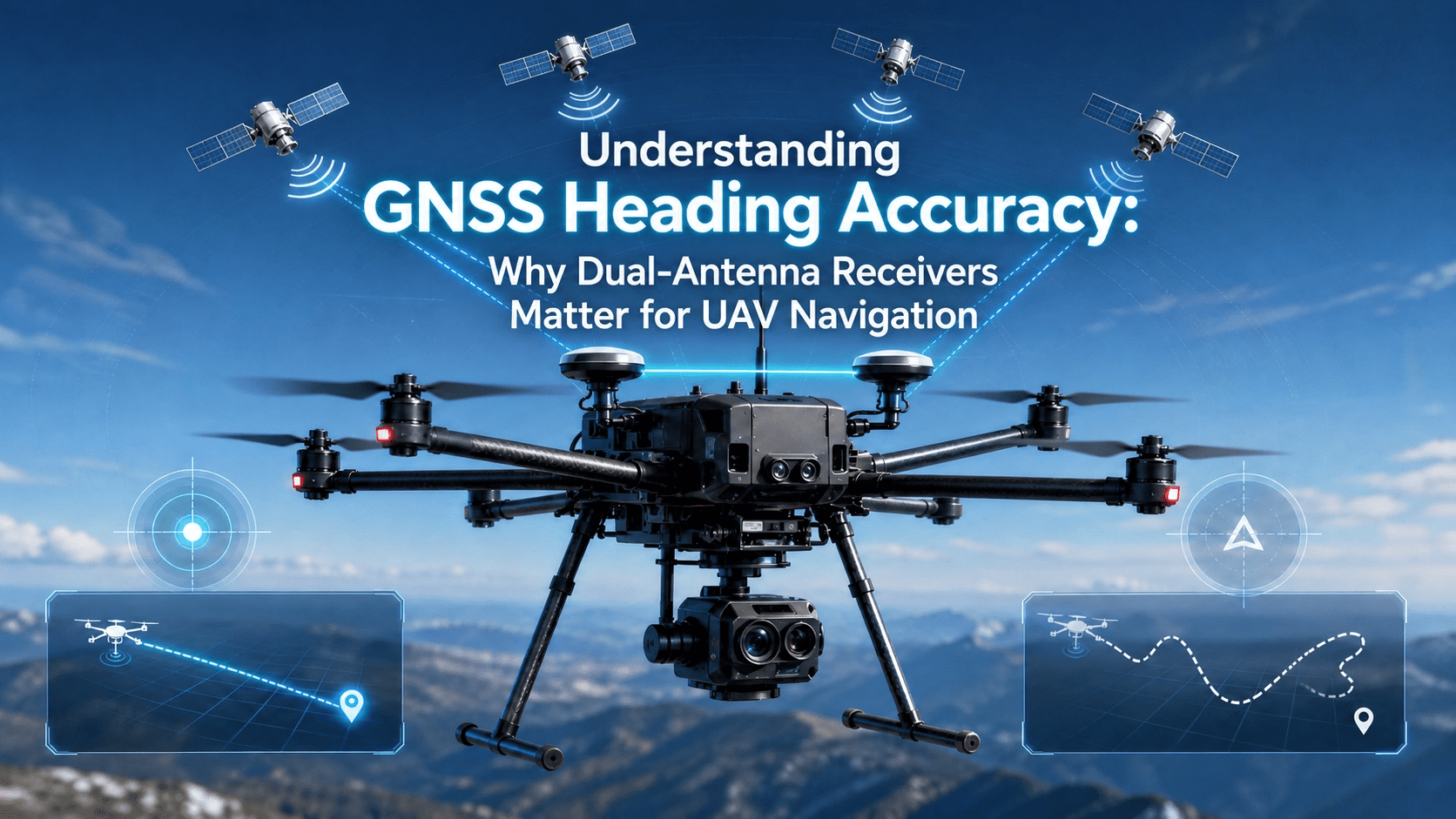
A dual-antenna heading receiver like the Septentrio Mosaic-G5 P3H uses two antennas mounted at a fixed distance (baseline) along the vehicle’s longitudinal axis. The receiver continuously tracks the same satellite signals on both antennas and measures the carrier phase difference between them.
This phase difference, combined with knowledge of the baseline length, allows the receiver to calculate the precise orientation of the vehicle. The process works as follows:
- Both antennas receive signals from the same satellites simultaneously.
- The receiver computes the carrier phase difference for each satellite pair.
- Using RTK-level algorithms, the system resolves the integer ambiguity and determines the baseline vector.
- The baseline vector is converted to heading (yaw) and optionally pitch angles.
Key Benefits for Drone Operations
| Benefit | Impact on UAV Operations |
|---|---|
| No magnetic interference | Reliable heading even near high-current motors and power systems |
| Instantaneous heading | Heading available immediately upon startup — no compass calibration needed |
| High precision | Sub-degree accuracy (<0.5° RMS) for precision navigation and mapping |
| RTK-ready | Integrates seamlessly with RTK corrections for centimeter-level position + heading |
| Anti-jamming built-in | AIM+ technology protects against GNSS interference and spoofing |
Real-World Applications
Dual-antenna GNSS heading receivers are transforming several UAV applications:
Precision Agriculture: Spray drones require accurate heading to maintain consistent spray patterns and avoid overlaps. A heading receiver ensures the autopilot knows the drone’s orientation during turns and straight-line passes.
Surveying and Mapping: For corridor mapping (power lines, pipelines, roads), accurate heading is essential for aligning imagery and LiDAR data. Combined with RTK positioning, a heading receiver delivers survey-grade results without ground control points.
Search and Rescue: UAVs operating in GPS-challenged environments (dense forests, urban canyons) benefit from the redundancy of dual-antenna heading. The system provides orientation data even when satellite visibility is limited.
Marine and Coastal Inspection: Over-water operations where magnetic compasses are unreliable due to hull interference see dramatic improvements with GNSS heading.
Septentrio Mosaic-G5 P3H: A Case Study in Heading Performance
The Septentrio Mosaic-G5 P3H is a dual-frequency, dual-antenna GNSS receiver module designed specifically for UAV applications. With support for GPS L1/L5, GLONASS, Galileo, and BeiDou, it maintains heading lock even in challenging environments. Its compact form factor (31 x 31 mm) and low power consumption make it ideal for integration into drone flight controllers.
When paired with ArduPilot or PX4 autopilots, the Mosaic-G5 P3H provides real-time heading data over a standard UART or CAN interface, reducing integration complexity for drone manufacturers.
Heading vs. Compass: When to Choose GNSS Heading
For many commercial drone operations, a magnetic compass suffices. But for professional applications requiring reliable, sub-degree heading accuracy, a dual-antenna GNSS receiver is the superior choice. Consider GNSS heading if your operation involves:
- RTK-level surveying without ground control points
- Operations near power lines, substations, or metal structures
- Heavy-lift drones with high current draw affecting compasses
- Autonomous or BVLOS (Beyond Visual Line of Sight) operations
- Marine or coastal environments
FAQ: GNSS Heading for UAVs
What heading accuracy can I expect from a dual-antenna GNSS receiver?
Do I need two separate GNSS antennas for heading?
Is GNSS heading better than a magnetometer for drones?
Can I use a heading receiver with Pixhawk or ArduPilot?
Understanding GNSS heading accuracy is key to selecting the right receiver for your UAV platform. Whether you’re building a surveying drone, an agricultural sprayer, or a marine inspection UAV, a dual-antenna heading receiver offers reliability and precision that a magnetic compass simply cannot match.
For more information on integrating high-precision GNSS into your drone platform, check out our guide on GNSS receiver selection for UAVs and explore how dual-antenna heading can elevate your next project.