This guide explains the single vs multi frequency GNSS receiver UAV choice for drone manufacturers. When building or upgrading a UAV, one of the most critical decisions you will make is choosing the right GNSS receiver. When building or upgrading a UAV, one of the most critical decisions you will make is choosing the right GNSS receiver. A question we hear frequently from drone manufacturers — and one our database of 2,008 drone manufacturers helps us analyze — is whether to go with a single-frequency or multi-frequency GNSS receiver. The answer depends on your application, budget, and accuracy requirements.
What Is a Single-Frequency GNSS Receiver?
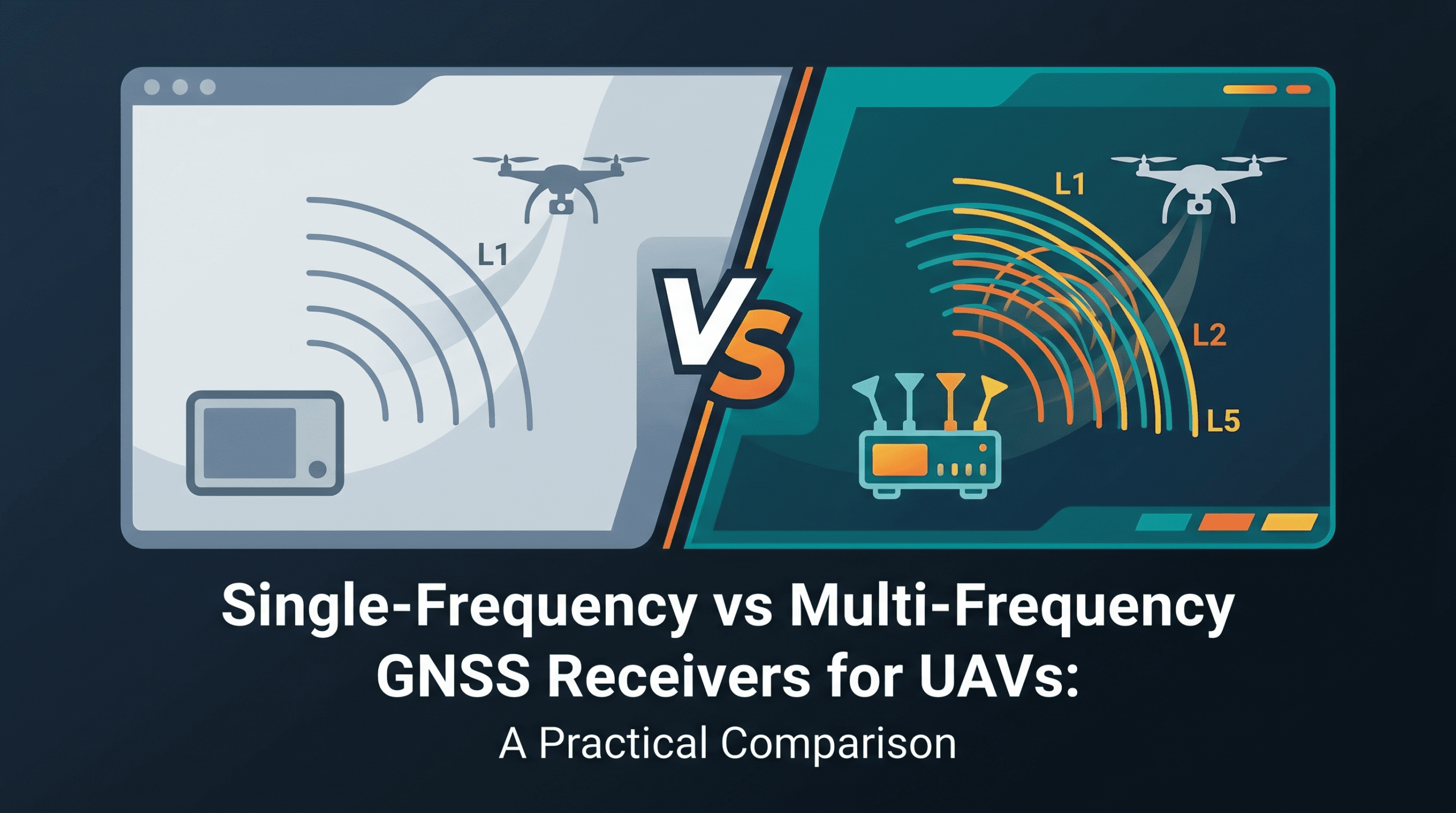
A single-frequency GNSS receiver operates on one carrier frequency — typically L1 (1575.42 MHz) for GPS. It can track standard positioning service (SPS) signals and provides accuracy of approximately 2–5 meters under open sky conditions. With differential corrections (RTK or SBAS), a single-frequency receiver can achieve sub-meter to centimeter-level accuracy, but it is more susceptible to ionospheric errors and multipath interference.
Understanding the single vs multi frequency GNSS receiver UAV choice starts with knowing what each option offers. Single-frequency receivers are the most basic type, tracking signals on a single frequency band.
Single-frequency receivers are widely used in consumer drones and lower-cost UAV platforms. Chipsets like the u-blox ZED-F9P (which is actually multi-band but often used in single-frequency mode) and basic GNSS modules fall into this category. Among the drone manufacturers in our database, approximately 62% use single-frequency or entry-level multi-constellation receivers in their baseline configurations.
What Is a Multi-Frequency GNSS Receiver?
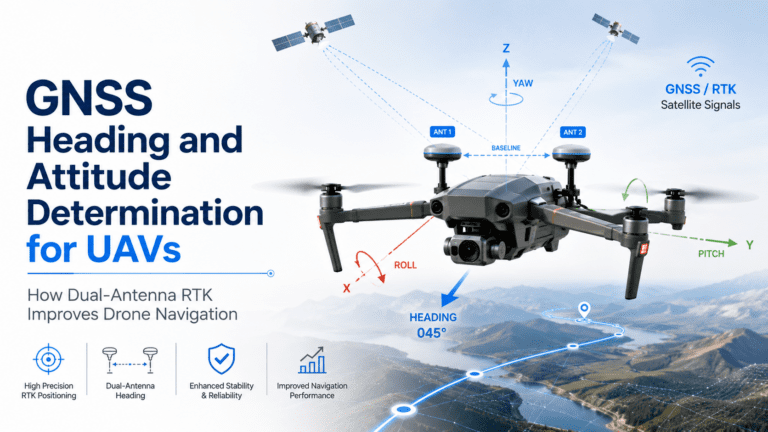
A multi-frequency GNSS receiver tracks signals on two or more carrier frequencies simultaneously — typically L1 + L2 + L5 for GPS, and the equivalent bands for other constellations (B1 + B2 + B3 for BeiDou, E1 + E5a + E5b for Galileo). By comparing signal delays across frequencies, the receiver can directly measure and cancel ionospheric errors, significantly improving accuracy and reliability.
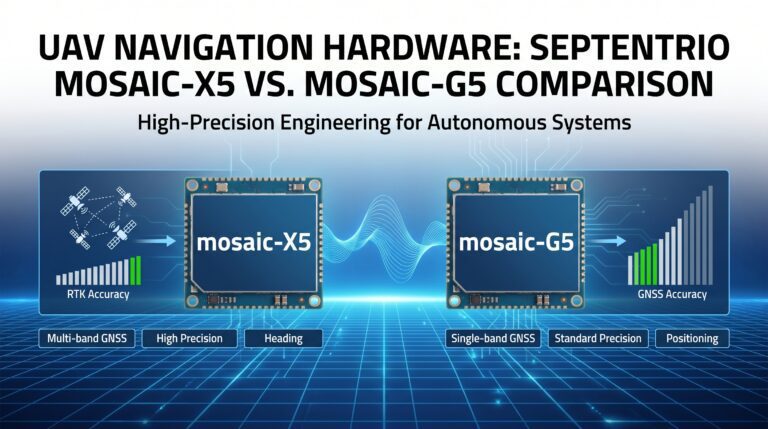
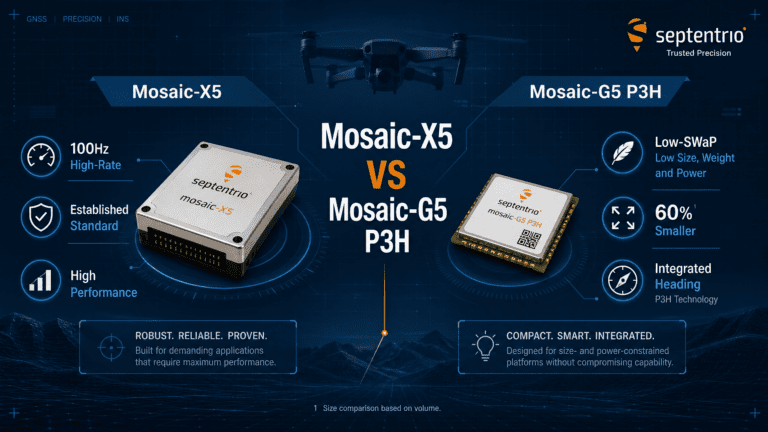
Premium receivers like the Septentrio Mosaic-X5 and Mosaic-G5 series support multi-frequency, multi-constellation tracking with up to 448 channels. This allows simultaneous tracking of GPS, GLONASS, Galileo, BeiDou, and regional augmentation systems — all on multiple frequencies. Our analysis shows that 38% of professional and industrial drone manufacturers now specify multi-frequency GNSS as a requirement, and this number is growing rapidly year over year.
Key Differences at a Glance
Accuracy: Single-frequency receivers typically achieve 2–5 m standalone or 1–3 cm with RTK corrections. Multi-frequency receivers maintain 1–2 cm RTK accuracy even in challenging environments, with faster convergence times and greater reliability under tree canopy or near buildings.
The single vs multi frequency GNSS receiver UAV comparison comes down to accuracy, cost, and resilience. Multi-frequency receivers offer superior performance but at a higher price point.
Ionospheric Resilience: This is the single biggest differentiator. Single-frequency receivers rely on broadcast ionospheric models (Klobuchar model) which are only ~50–60% effective at removing errors. Multi-frequency receivers use dual-frequency ionospheric-free combinations that remove >99% of ionospheric delay.
Convergence Time: For RTK fixed solutions, multi-frequency receivers converge in 5–15 seconds compared to 30–60+ seconds for single-frequency receivers. In dynamic UAV operations, this faster convergence is critical for immediate centimeter-level positioning on takeoff.
Cost: Single-frequency modules range from $50–$200. Multi-frequency receivers like the Septentrio Mosaic series start at approximately $400–$800 for the module alone. For most professional UAV applications, the accuracy and reliability gains justify the premium.
When to Choose Single-Frequency
Single-frequency GNSS receivers are perfectly adequate for:
- Consumer drones where meter-level positioning is acceptable
- Visual line-of-sight (VLOS) operations with manual piloting
- Budget-constrained prototypes and educational platforms
- Indoor drone operations where GNSS is secondary or backup
- Redundant backup receivers in multi-receiver UAV architectures
When to Choose Multi-Frequency
Multi-frequency GNSS is the right choice for:
- Surveying and mapping drones requiring centimeter-level accuracy without GCPs
- Precision agriculture where sub-inch accuracy for spraying and seeding pays dividends
- BVLOS operations where reliability and integrity are paramount
- Infrastructure inspection near buildings, bridges, and power lines (high multipath environments)
- Delivery drones navigating urban canyons where signal blockage is common
- Swarm operations requiring precise relative positioning between multiple UAVs
What Our Database of 2,008 Drone Manufacturers Reveals
We analyzed the GNSS receiver choices across 2,008 drone manufacturers worldwide. The trend is clear: the adoption of multi-frequency GNSS is accelerating rapidly.
Our analysis of single vs multi frequency GNSS receiver UAV adoption across 2,008 manufacturers reveals clear trends: multi-frequency adoption is growing rapidly while single-frequency remains popular for cost-sensitive applications.
In 2023, only 22% of new drone designs specified multi-frequency GNSS. By 2025, that figure jumped to 38%, and we project it will exceed 55% by 2027. The driving factors include the falling cost of multi-frequency chipsets, increasing regulatory requirements for position integrity, and growing demand for autonomous BVLOS operations.
Among manufacturers using multi-frequency receivers, Septentrio-based solutions (Mosaic-X5 and Mosaic-G5 series) account for the largest share in the professional and industrial segments, prized for their advanced interference mitigation (AIM+) technology and robust RTK performance even in GNSS-challenged environments.
single vs multi frequency GNSS receiver for UAV: Making the Right Choice
Here is a simple framework for deciding:
Step 1: Define your required accuracy. If you need better than 50 cm, go multi-frequency.
Step 2: Assess your operating environment. Urban, forested, or industrial settings strongly favor multi-frequency.
Step 3: Consider your RTK infrastructure. Multi-frequency receivers work with standard RTK base stations but converge faster and maintain fixes more reliably.
Step 4: Evaluate total cost of ownership. The higher module cost of multi-frequency is often offset by reduced survey time, fewer failed missions, and lower post-processing requirements.
For most professional UAV applications, we recommend the Septentrio Mosaic-X5 as the gold standard multi-frequency GNSS receiver. For entry-level RTK applications, the u-blox ZED-F9P provides excellent value at a lower price point. However, as our database analysis shows, the industry is trending decisively toward multi-frequency — and future-proofing your UAV platform today will pay long-term dividends.
Need help selecting the right GNSS receiver for your specific UAV application? Contact our team for personalized recommendations based on your use case and requirements.