Abstract
The Septentrio mosaic-G5 P1 provides centimeter-level RTK positioning for power inspection drones, with advanced multi-frequency GNSS performance and robust anti-electromagnetic interference capabilities. Its 789-channel design, GNSS+ technology suite (AIM+ Basic, APME+, LOCK+, RAIM+), and ultra-low power consumption make it ideal for reliable operation in high-voltage electromagnetic environments and long-distance transmission line inspections.
High-Precision GNSS Technology Empowering Modern Power Inspection
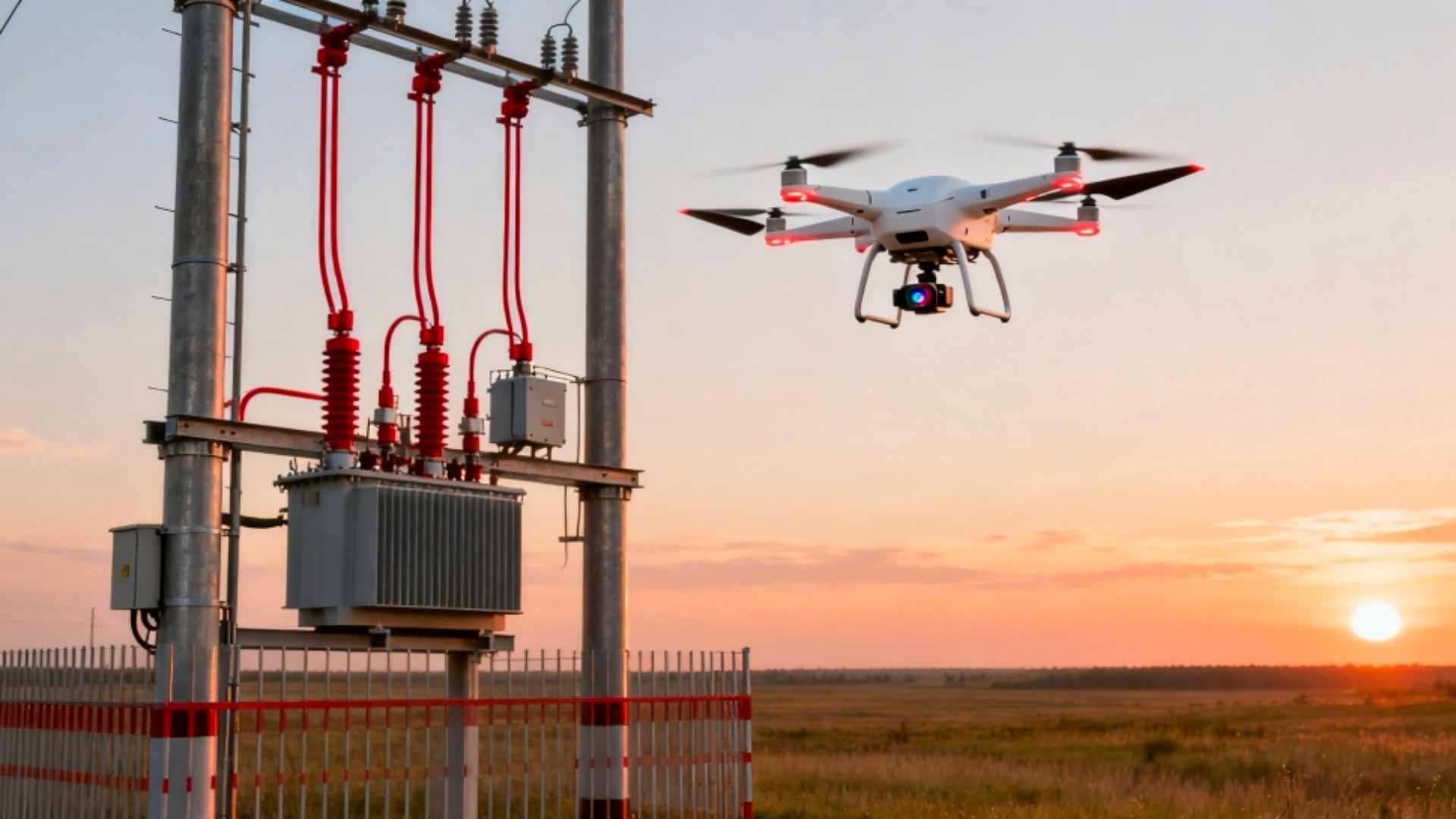
In modern power inspection operations, drones have evolved from auxiliary tools into efficient and precise platforms for inspection and data collection. Key tasks such as detailed mapping of transmission lines, defect localization, 3D modeling, and autonomous inspections place extremely high demands on positioning accuracy. Traditional meter-level or decimeter-level precision can no longer meet the three core requirements of power inspection: data accuracy, operational efficiency, and safety management.
Why Is Centimeter-Level GNSS Accuracy Crucial for Power Inspection?
Quad-constellation GNSS receivers achieve centimeter-level accuracy by simultaneously tracking GPS, GLONASS, Galileo, and BeiDou satellites with RTK corrections. Accurate GNSS positioning is the key technological foundation for ensuring reliable data, efficient operations, and scientific analysis in drone-based power inspection.
Core Advantages of the Septentrio mosaic-G5 P1 GNSS Receiver
The mosaic-G5 P1 is not just a navigation module but a high-precision spatiotemporal positioning system specifically designed for power inspection drones. Its design philosophy delivers reliable centimeter-level positioning capabilities within an extremely compact form factor, making it particularly suitable for stable operation in high-voltage electromagnetic environments, complex terrains, and long-distance transmission line inspections.
Full-Constellation Multi-Frequency GNSS Performance for Complex Inspection Environments
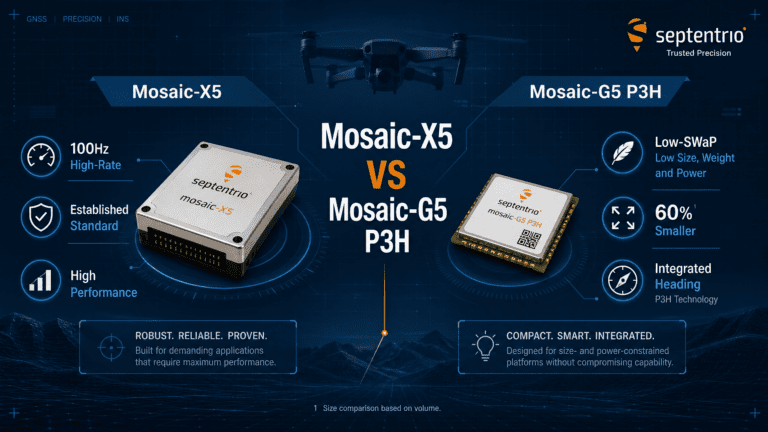
Despite its compact size of 22.8 x 16.4 x 2.4 mm, the mosaic-G5 P1 features:
- 789 hardware channels for simultaneous tracking of all visible satellite signals
- Support for GPS, GLONASS, BeiDou, Galileo, and QZSS full constellations
- Triple-frequency tracking (L1/L2/L5 bands) to enhance signal lock robustness
- Stable positioning in complex electromagnetic and terrain environments such as mountains, forests, urban canyons, and high-voltage corridors
GNSS+ Technology Ensures Reliable Operation in Interference-Prone Environments
Septentrio’s proprietary GNSS+ technology suite ensures signal integrity under actual inspection conditions, including high-voltage electromagnetic interference and multipath reflections:
- AIM+ Basic: Interference and spoofing signal detection and manual suppression, effectively countering strong electromagnetic interference from high-voltage transmission lines
- APME+: Multipath mitigation to reduce interference from reflected signals from towers, buildings, and the ground
- LOCK+: Maintains stable tracking under high vibration and mechanical shocks, meeting the demands of drone operations in strong winds or during rapid maneuvers
- RAIM+: Receiver Autonomous Integrity Monitoring provides positioning reliability indicators, ensuring the trustworthiness of critical data
These technologies collectively enable sustained and reliable centimeter-level RTK positioning accuracy:
- Horizontal accuracy: 0.6 cm + 0.5 ppm
- Vertical accuracy: 1.0 cm + 1 ppm
Integration Advantages of mosaic-G5 P1 in Power Inspection Drone Platforms
High-Precision Autonomous Inspection and Detailed Mapping
The mosaic-G5 P1 supports an update rate of up to 5 Hz and a latency of less than 10 ms, ensuring centimeter-level trajectory control for drones during autonomous flights and data collection. This provides a reliable spatial reference for detailed tower modeling, conductor measurements, and precise defect localization.
Low Power Consumption and Extended Flight Time
With a typical power consumption of only 0.44 W and a maximum of 0.57 W, it significantly extends the drone’s flight time per inspection mission, making it suitable for continuous inspection tasks over long-distance and large-scale transmission lines.
Strong Electromagnetic Environment Adaptability and High Reliability
Operating temperature range of -40°C to +85°C and compliance with ENV-STD-810H vibration and shock standards enable adaptability to outdoor environments such as high heat, extreme cold, humidity, and dust. It also maintains stable positioning near high-voltage transmission lines under strong electromagnetic interference.
Fast Startup and Efficient Operations
Cold start time under 35 seconds, hot start under 10 seconds, and reacquisition time of just 1 second enhance field response speed and inspection efficiency.
The mosaic-G5 P1: The Precision Positioning Foundation for Power Inspection Drones
Improved Data Accuracy and Inspection Efficiency
Centimeter-level positioning accuracy ensures high credibility of inspection data (e.g., tower coordinates, conductor sag, defect locations), providing precise spatial information support for digital grids and intelligent maintenance.
Easy Integration and Rapid Deployment
Complete interface documentation, SDK, and API support, along with compatibility with protocols such as SBF, NMEA, and RTCM, facilitate quick integration into various inspection drone platforms, reducing development cycles and integration costs.
Positioning Solutions for Intelligent Inspection
Choosing the mosaic-G5 P1 provides long-term stability and high-precision GNSS performance for power inspection drones, meeting the evolving needs of grid digitalization and intelligent inspection.
Related GNSS Products
- HB21 GNSS Box Receiver — All-in-one RTK receiver with integrated 4G LTE, heading, and data logging
- HB6 GNSS Box Receiver — Compact quad-constellation RTK receiver powered by Septentrio Mosaic X5
- EV322 GNSS Receiver — Lightweight RTK receiver for UAVs and autonomous systems
- AIM+ Anti-Jamming Technology — Advanced interference and spoofing protection
Browse our full GNSS receiver collection for professional UAV applications.
Frequently Asked Questions
Why is precise GNSS critical for power line inspection drones?
Power line inspection requires the drone to fly within 3-5 meters of live high-voltage lines to capture detailed thermal and visual data. Centimeter-level RTK accuracy ensures the drone maintains safe clearance from conductors while staying close enough for effective inspection, even in GPS-challenged environments near metal towers and electromagnetic fields.
How does the mosaic-G5 P1 handle EMI from high-voltage power lines?
The mosaic-G5 P1 features Septentrio’s AIM+ interference mitigation technology, which detects and filters out narrowband and pulsed interference common near high-voltage transmission lines. The receiver’s robust RF front-end maintains lock and RTK fix even with elevated noise floors from corona discharge and electrical fields.
Can the mosaic-G5 P1 log inspection data for post-flight analysis?
Yes. The mosaic-G5 P1 supports raw data logging at configurable rates, including carrier-phase observations, ephemeris, and correction data. This allows full PPK post-processing after the inspection flight, providing an additional source of high-accuracy trajectory data for asset management systems.