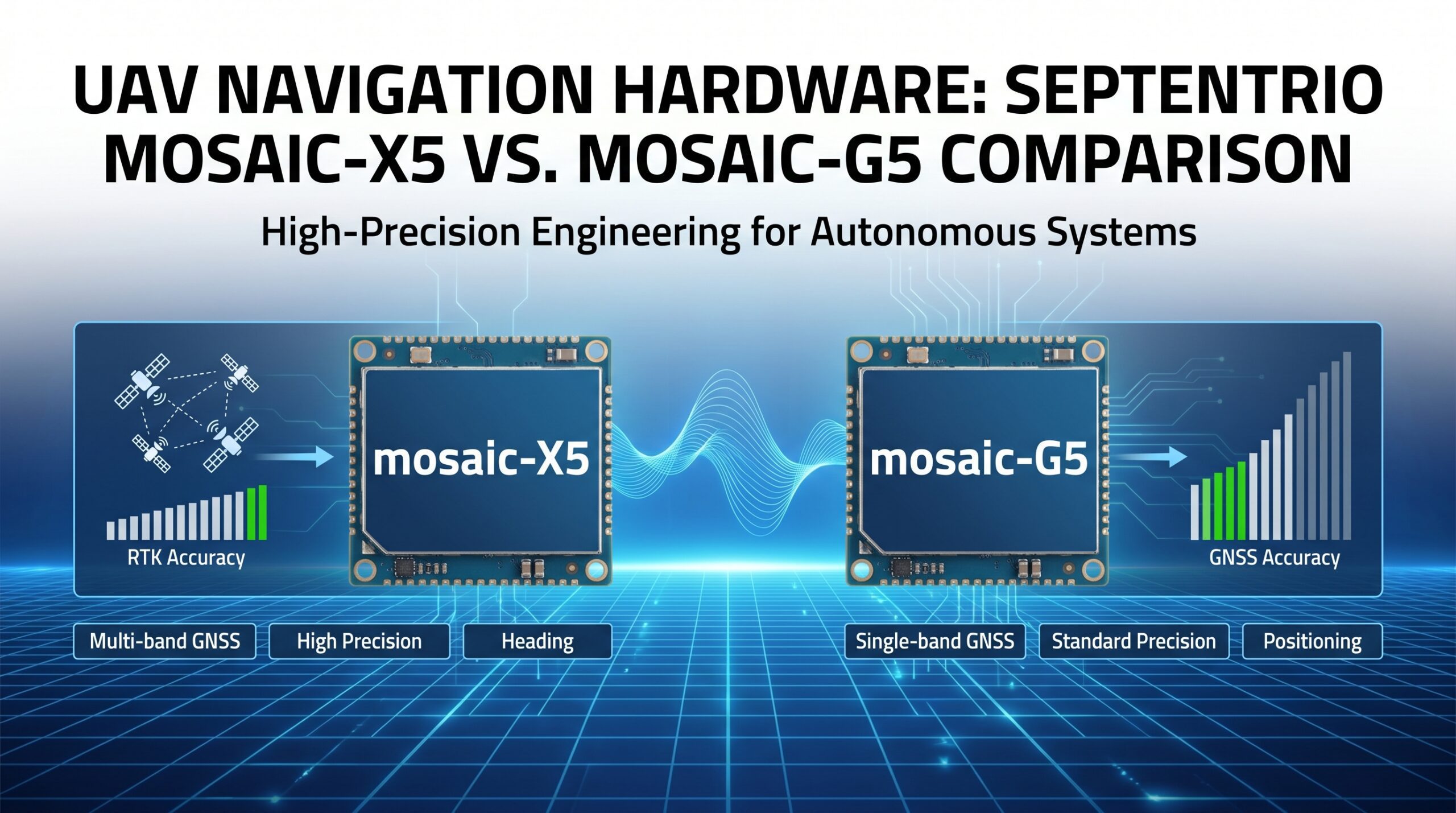
Septentrio mosaic-X5 vs mosaic-G5: GNSS Receiver Comparison for UAV Applications
When choosing a high-precision GNSS receiver for a UAV platform, two of the most compelling options from Septentrio are the mosaic-X5 and the mosaic-G5. Both modules offer centimeter-level RTK accuracy, multi-constellation tracking, and built-in AIM+ anti-jamming technology, but they differ in key specifications that matter for specific UAV applications.
This comparison breaks down the differences between the mosaic-X5 and mosaic-G5 across the dimensions that matter most for drone manufacturers, integrators, and survey professionals: signal tracking, heading capabilities, power consumption, and overall value.
Core Specifications at a Glance
| Feature | mosaic-X5 | mosaic-G5 |
|---|---|---|
| Constellations | GPS, GLONASS, BeiDou, Galileo | GPS, GLONASS, BeiDou, Galileo |
| Frequency Bands | L1, L2, L5 | L1, L2, E5b |
| RTK Accuracy | 0.6 cm + 0.5 ppm horizontal | 0.6 cm + 0.5 ppm horizontal |
| Heading Accuracy | 0.15° (with dual antenna) | 0.3° (with dual antenna) |
| Max Update Rate | 100 Hz | 100 Hz |
| Anti-Jamming | AIM+ (advanced) | AIM+ (standard) |
| Power Consumption | ~1.1 W | ~0.9 W |
Both modules share the same form factor, software interface, and communication protocols, making them drop-in compatible for most UAV designs. The differences lie in the finer details of signal processing and feature support.
1. Multi-Frequency Tracking: L5 vs E5b
The most significant technical difference between the two modules is frequency band support. The mosaic-X5 tracks L1, L2, and L5 signals, while the mosaic-G5 tracks L1, L2, and E5b (Galileo).
L5 (1176.45 MHz) is the modern GPS civil signal designed for aviation safety-of-life applications. It offers higher power, wider bandwidth, and better multipath rejection than L2. Combined with Galileo E5a (which shares the same frequency), L5 capability gives the mosaic-X5 access to the strongest civilian GNSS signal available today.
E5b (1207.14 MHz) is another Galileo band used primarily for the Galileo Commercial Service and public regulated navigation. The mosaic-G5 uses E5b as its third frequency instead of GPS L5.
For UAV applications: If your drones operate in challenging environments — near buildings, power lines, or in GPS-denied zones — the mosaic-X5’s L5 tracking provides measurably better signal lock and multipath rejection. For open-sky survey operations, the mosaic-G5’s E5b capability is more than adequate. For a full range of compatible receivers, visit uav-gnss.com.
2. Heading Accuracy: Dual-Antenna Performance
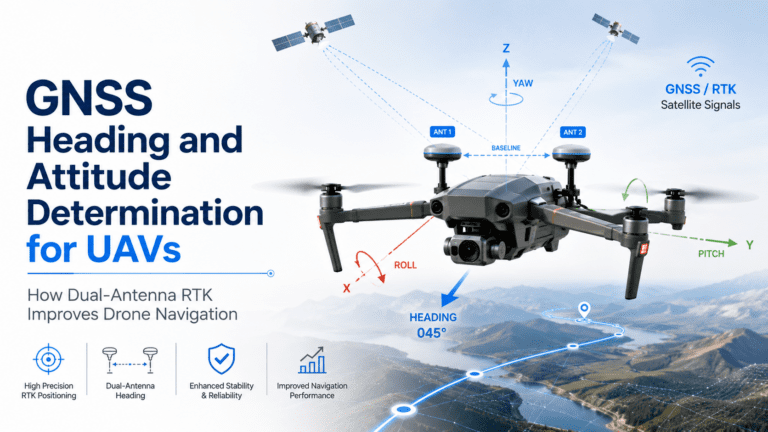
Both modules support dual-antenna heading, but the mosaic-X5 achieves 0.15° heading accuracy while the mosaic-G5 provides 0.3°. This difference comes from the X5’s superior L5 signal processing, which reduces carrier-phase noise on the secondary antenna.
For most UAV applications — mapping, agriculture, and inspection — 0.3° heading accuracy is sufficient. But for precision survey, dual-antenna VTOL transition phases, and marine operations, the 0.15° capability of the mosaic-X5 can be the difference between a clean flight and a drifted path.
Both modules provide heading output via SBF (Septentrio Binary Format) messages or NMEA HDT sentences, compatible with PX4 and ArduPilot flight controllers. For more guidance on dual-antenna integration, see gnss-solutions.com for compatible antenna and receiver bundles.
3. AIM+ Anti-Jamming Performance
Septentrio’s AIM+ (Advanced Interference Mitigation) technology is a key differentiator in both modules, but the implementation differs:
- mosaic-X5: Full AIM+ with wideband and pulsed jamming rejection across L1, L2, and L5 bands simultaneously
- mosaic-G5: AIM+ with jamming rejection on L1, L2, and E5b bands
The practical difference is minimal in most scenarios. Both modules can reject continuous-wave and pulsed interference up to 80 dB relative to the noise floor. However, if your UAV operates near urban infrastructure, professional sites, or known jamming sources, the mosaic-X5’s full L5-band protection adds an extra layer of resilience.
For detailed anti-jamming performance data and real-world test results, refer to ins-receiver.com for integrated GNSS+IMU solutions designed for jam-prone environments.
4. Power Consumption and Thermal Design
The mosaic-G5 draws approximately 0.9 W during typical operation, while the mosaic-X5 draws 1.1 W — a difference of 0.2 W. For small UAVs with limited battery capacity (e.g., 2-3 hour flight endurance), this 18% increase in GNSS power draw is negligible in absolute terms but worth factoring into overall power budgeting.
Both modules handle thermal dissipation through their metal housing and PCB copper planes. Neither requires active cooling in standard UAV configurations. For high-altitude or enclosed payload bays, the mosaic-X5’s slightly higher thermal output should be considered.
5. Price vs Performance: Which Should You Choose?
Choose the mosaic-G5 when:
- Your UAV operates primarily in open-sky conditions
- Budget is a primary concern
- Power efficiency is critical (smaller drones, longer flights)
- Standard 0.3° heading accuracy meets your requirements
Choose the mosaic-X5 when:
- You need maximum signal resilience (urban, near-infrastructure)
- Sub-0.2° heading is required for precision survey
- L5-band availability and safety-of-life features matter
- You’re building a premium, future-proof platform
6. Software and Ecosystem Compatibility
Both modules use the same Septentrio RxTools software suite for configuration, firmware updates, and log processing. They share the same command set, SBF message format, and NMEA output protocols. This means that integration work done for one module transfers directly to the other — a major advantage for product lines that span price tiers.
All common UAV autopilots including PX4, ArduPilot, and DJI’s onboard SDK accept NMEA and UBX-formatted GNSS data from both modules without modification. For RTK workflows, both modules accept standard RTCM 3.x corrections over UART, USB, or Bluetooth.
FAQ
Q: Can I upgrade from mosaic-G5 to mosaic-X5 without changing my UAV design?
A: Yes. Both modules share the same 71-pin Hirose U.FL connector layout, physical dimensions, and pin assignments. It’s a drop-in replacement. You may need to update firmware and retune the antenna matching for L5-band operation.
Q: Does the mosaic-X5 work with existing L1/L2 antennas, or do I need an L5-rated antenna?
A: The mosaic-X5 works with standard L1/L2 antennas — it will track L1 and L2 signals normally. To take full advantage of L5, you need a tri-band antenna rated for L1/L2/L5 or L1/L5/E5a. Many modern survey-grade antennas already support L5.
Q: Is the mosaic-G5 being phased out in favor of the X5?
A: No. Septentrio continues to support and manufacture the mosaic-G5 as a value-option alongside the X5. The G5 is well-suited to applications that don’t require L5 tracking, and its lower power consumption makes it ideal for battery-constrained platforms.
Q: Which module is better for RTK base station vs rover use?
A: Both modules work equally well as base stations or rovers. For a base station, the mosaic-G5 offers excellent value since the base station doesn’t need L5 rover-specific features. For the rover, the mosaic-X5 provides better signal tracking in dynamic environments with multipath.