Interference is the silent failure mode of drone operations. A jammed or spoofed GNSS receiver does not always announce itself — the aircraft simply ends up somewhere it should not be. At Jammertest 2025, the annual Norwegian government test of anti-jamming and anti-spoofing hardware, Septentrio receivers with AIM+ technology held centimeter-level positioning through roughly 100 jamming and spoofing scenarios, while rival receivers drifted meters — sometimes more than ten — off their true position. Here is what those results mean for UAV and robotics teams, and which receivers bring that protection to a flight stack.
The Test Behind the Numbers
Jammertest is run by the Norwegian government on a remote island, and it is one of the few interference exercises in the world that publishes its results. For five days each year, receivers sit in a controlled environment while real jammers and spoofers — not simulations — are pointed at them. That makes it a genuine worst-case laboratory for the GNSS technology drones depend on.
AIM+: the Anti-Jamming Technology Inside the Receivers
Septentrio’s AIM+ (Advanced Interference Mitigation) is the engine behind the results. AIM+ detects incoming interference, characterizes it, and filters it out of the signal chain, while separate anti-spoofing logic watches for counterfeit signals. It is the same technology built into every UAV GNSS receiver sold on this site — no optional module, no upgrade tier.
2025: the Hardest Jammertest Yet
Each edition of Jammertest raises the bar. In 2025 the receivers faced roughly 100 jamming scenarios, spanning more frequencies, power levels, and interference types than any previous year — including patterns representative of modern electronic-warfare environments. After five days, the AIM+ receivers came out with a clear edge over the competition. Two findings stood out: spoofing defense works best when several anti-spoofing mechanisms act together, and Septentrio’s spoofing alerts gave operators the clearest situational awareness of any hardware in the test.

Jammertest 2025 Results: Jamming
Five days, multiple receivers, and a steady diet of interference produced the charts below.
Static test under a commercial jammer
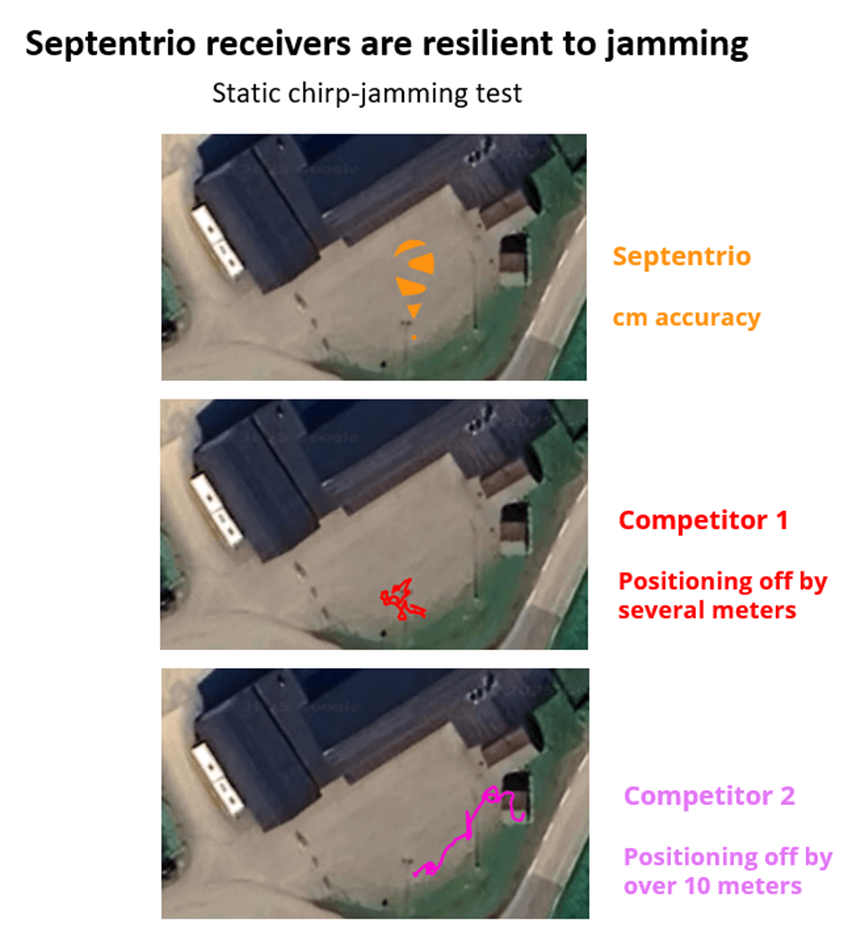
One chart tells the story. Beneath a powerful, commercially available jammer, the Septentrio receiver kept solving its position to the centimeter — the interference was detected and excised in real time. A rival receiver (red) wandered meters off, and another (purple) was more than ten meters wrong for the duration of the jamming.
What losing GNSS does to a drone
Translate those errors into flight. A drone that loses position lock does not politely pause — it can crash, and even disciplined autopilots resort to hover, land, or orbit fallbacks, or lean on inertial navigation. INS is a stopgap at best: error compounds with every second the true position is missing, and it can never supply absolute location. Attackers exploit exactly this. A typical spoofing attempt opens with heavy jamming to shatter the receiver’s lock on genuine signals, then feeds counterfeit signals as the receiver scans the sky to re-acquire.
Jammertest 2025 Results: Spoofing
Spoofing is the nastier attack: rather than denying position, it fabricates it. In the circular spoofing test, a stationary receiver sat inside a spoofed coverage area while two rival brands — purple and red — accepted the fake signals and traced the path the spoofer had scripted. The Septentrio receiver never bit: it held its true position and raised spoofing flags.
Spoofing test results
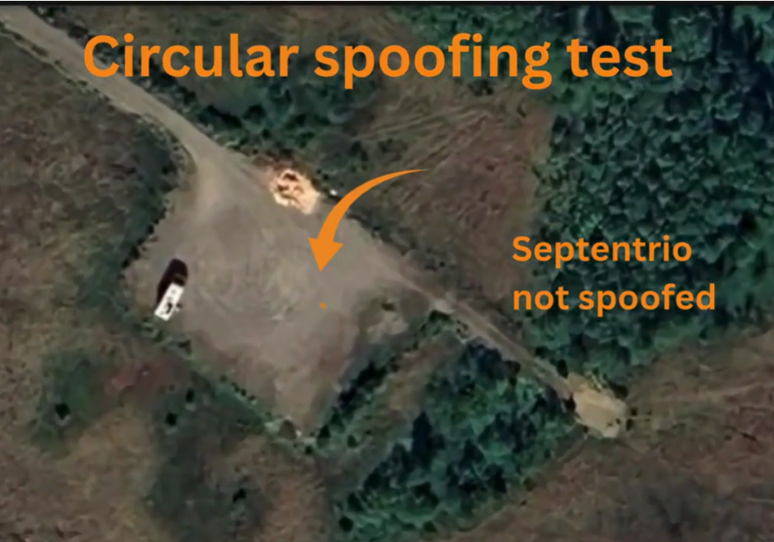
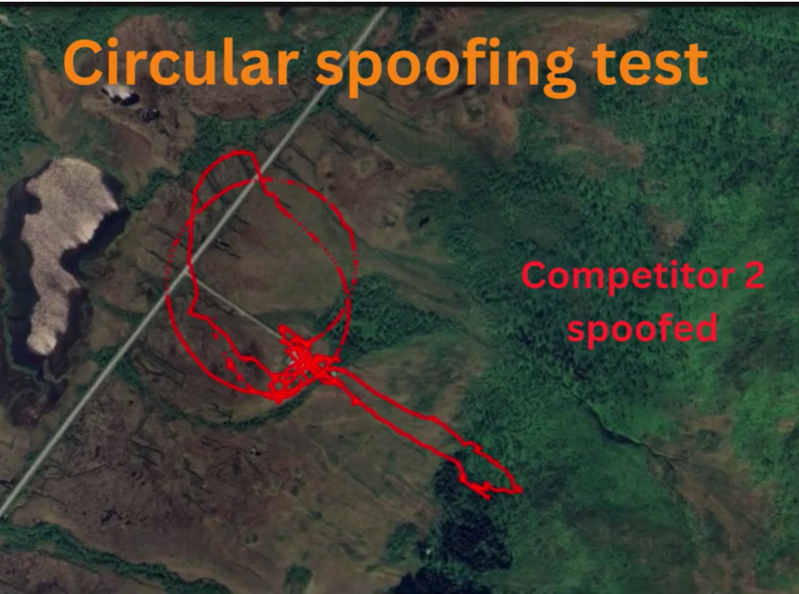
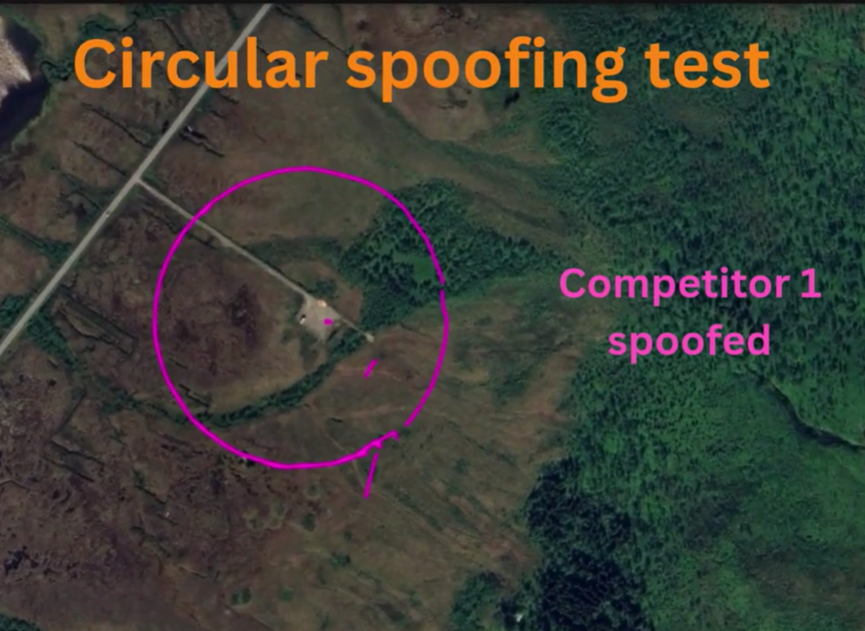
Static receiver, scripted spoofing: the Septentrio unit stayed put while competitors followed the phantom path.
The danger of a spoofed position with no warning
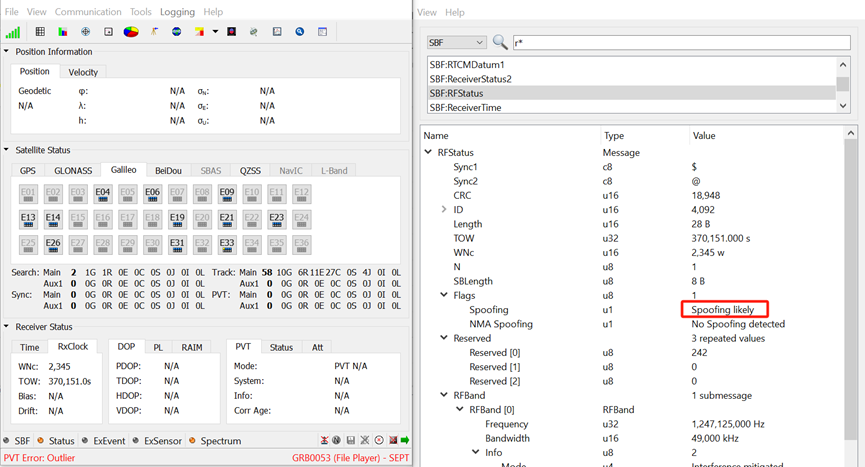
Across the whole exercise, the Septentrio receiver flagged spoofing continuously — catching malicious attacks the others missed and usually shaking the attack off entirely. Rivals detected spoofing only rarely. The red warning flags in the figure mark the truly dangerous moments: spoofing that is neither detected nor mitigated. In the field, that means the system keeps trusting a position that is quietly wrong, and a vehicle can be steered wherever the attacker intends.
Galileo OSNMA: Authentication That Closes the Door
Jammertest 2025 also put Galileo OSNMA (Open Service Navigation Message Authentication) through its paces on Septentrio receivers. OSNMA is a free Galileo service that authenticates the navigation data broadcast by the satellites, end to end, so a receiver can verify every message it decodes. Because that data carries satellite positions, authenticating it blocks Galileo spoofing at the source. In one scenario, an OSNMA-enabled Septentrio receiver flagged the attack inside its built-in web interface — the screenshot below shows the spoofed Galileo signals being called out.
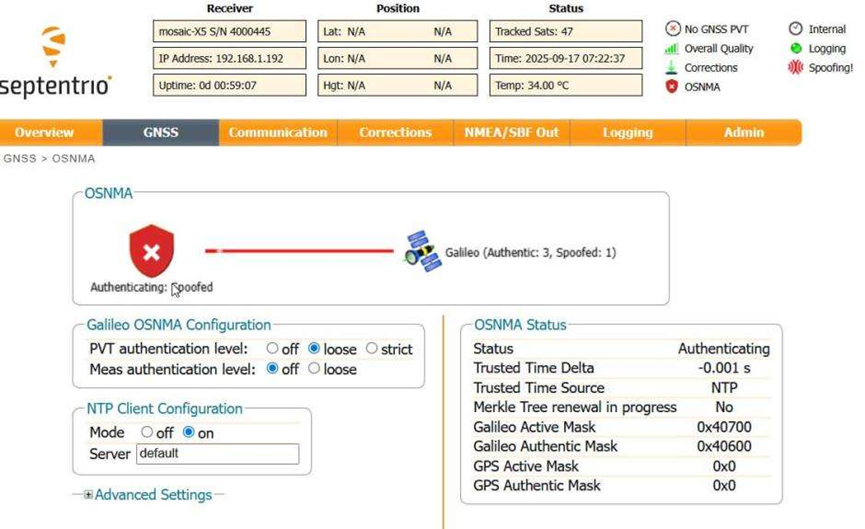
Septentrio Galileo OSNMA.
Time Is Part of the Mission Too
Precision timing was on the test list as well. When GNSS time was spoofed, the Septentrio receiver kept its clock accurate while a competitor displayed a time three minutes in the past. Telecom networks, power grids, and financial systems all synchronize on GNSS — for them, a forged clock is an outage waiting to happen, with losses that can reach millions.

Forged GNSS time: the Septentrio receiver kept correct timing, while a rival receiver showed a time three minutes old.
A Layered Defense, Not a Single Trick
The 2025 results do not rest on one algorithm. AIM+ is a layered defense refined over more than 25 years of Septentrio GNSS development:
- Multi-band reception — jam or spoof one frequency, the others keep the solution alive.
- OSNMA signal authentication — verify the source of every navigation message.
- Anomaly detection — trained on years of field data and updated continuously.
Signal simulators have become cheap and widespread, and spoofing is climbing accordingly. It outranks jamming in danger because it does not merely disrupt — it can hijack navigation and drive hardware to failure. The most effective defense sits at the receiver core, where the position itself is computed.
Proven Outside the Test Range
Reliable PNT — positioning, navigation, and timing that stays accurate and available — is what keeps complex industrial and mission-critical operations running. Live exercises such as Jammertest keep the technology sharp against the newest attack methods, and field users operating in persistently jammed areas report the same resilience.
What This Means for Your UAV
For an integrator, the Jammertest results come down to three practical points:
- RTK survives jamming — AIM+ holds centimeter-level fixes through interference that blinds consumer modules; the mission ends in the intended landing zone, not in hover mode.
- Spoofing gets caught — detection plus OSNMA authentication defend against navigation takeover, where the drone is quietly steered somewhere it should not go.
- Drop-in for Pixhawk, ArduPilot, and PX4 — Septentrio receivers are supported as GPS_TYPE 9, so the anti-jamming capability joins an existing flight stack without extra integration work.
The HB6 box (mosaic-X5), the EV322 (mosaic-G5), the HB51 dual-antenna heading module, and the HB10 (AsteRx-m3 Pro) are all built on the modules tested at Jammertest, with AIM+ as standard — see the full receiver lineup.
FAQ: Anti-Jamming GNSS for UAVs
What is Jammertest?
Jammertest is the Norwegian government’s annual jamming and spoofing exercise on a remote island. For five days, GNSS receivers are tested against live interference in a controlled environment; it is one of the few such events that publishes its results.
How much interference can AIM+ reject?
AIM+ (Advanced Interference Mitigation) handles jamming-to-signal ratios of roughly 40–60 dB — versus about 25 dB for typical consumer-grade modules. That is the difference between holding centimeter-level RTK and losing the fix entirely.
Can jamming really crash a drone?
Yes. A jammed receiver can lose position lock entirely — the drone may enter hover, land, or orbit fallback modes, or drift under INS. At Jammertest, competitor receivers were off by more than 10 meters; in a real mission that can mean flying into obstacles or losing the payload.
Do UAV GNSS receivers include AIM+?
Yes. All UAV GNSS receivers are built on Septentrio modules (mosaic-X5, mosaic-G5, AsteRx-m3 Pro) with AIM+ anti-jamming and anti-spoofing as standard, plus OSNMA support where available.
Do these receivers work with Pixhawk, ArduPilot, and PX4?
Yes. Septentrio receivers are fully supported as GPS_TYPE 9 (Septentrio) in ArduPilot and PX4. The HB51 also provides dual-antenna heading over the same serial port, so no separate magnetometer is required.
What is Galileo OSNMA?
OSNMA (Open Service Navigation Message Authentication) is a free Galileo service that cryptographically authenticates the navigation data broadcast by Galileo satellites. Receivers that support it can verify signals are genuine and flag spoofed ones.
Related Reading
- Jammertest 2025 Results: AIM+ Anti-Jamming GNSS Holds Centimeter Accuracy Through 100+ Interference Scenarios (gnss-solutions.com)
- ROSaic Deep Dive: Integrating Septentrio GNSS/INS Receivers with ROS 1 & ROS 2 (gnss-solutions.com)
- Septentrio GNSS + ROS Integration: Official ROSaic Driver, Compatibility & Technical Advantages (uav-gnss.com)
Sources & References
Author: UAV GNSS (uav-gnss.com)
Published: August 25, 2026
External reference: https://www.septentrio.com/en/learn-more/insights/results-jammertest-2025-withstanding-gps-jamming-and-spoofing
Images: Original Septentrio Jammertest 2025 figures, used with source credit. Photo credit where noted: David Jensen.
Related: UAV GNSS Technical Papers & Research