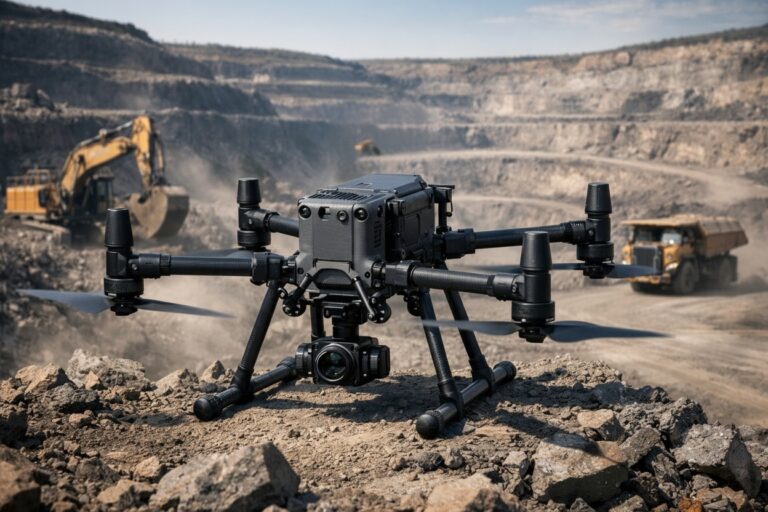


Why Construction Machinery Needs Precision GNSS Positioning
On a construction site, every centimeter matters. For excavators, bulldozers, graders, and mining trucks operating in complex environments — deep excavations, mining canyons, urban construction corridors — precise positioning is the difference between finishing on schedule and costly rework. Even a single centimeter of error can waste tons of concrete, necessitate reworking dozens of meters of pipeline, or disrupt an entire project’s cash flow.
Standard GNSS receivers perform adequately in open fields, but they falter in the environments where construction machinery actually operates. Urban deep excavations, mining canyons, and port yards create signal reflections, multipath interference, and sky occlusion that cause standard receivers to drift by tens of centimeters or lose lock entirely. Construction machinery demands a GNSS receiver engineered for extreme environments.
For a complete overview of solutions, explore Septentrio-powered GNSS receivers at uav-gnss.com.
The Septentrio Mosaic-X5: Built for Construction Machinery Environments
AIM+ Interference Immunity for Reliable Operation on Active Sites
Construction sites are RF-hostile environments. Walkie-talkies, truck jammers, welding equipment, and nearby communication infrastructure all generate interference that degrades GNSS performance. The mosaic-X5’s AIM+ engine continuously scans and identifies threats — from narrowband continuous waves to broadband chirp jammers — and automatically generates counter-signals that cancel interference at the baseband level within milliseconds.
Field tests demonstrate that while standard receivers lose lock entirely under -90 dB interference, the mosaic-X5 maintains a fixed solution with positioning accuracy within 0.6 cm. This reliability means construction equipment keeps working when others stop.
Learn more about AIM+ resilient GNSS technology for interference-free construction operations.
APME+ Multipath Suppression for Canyon-Like Construction Sites
Deep excavations, mine pits, and urban construction corridors create canyon-like environments where GNSS signals reflect off walls, steel structures, and vehicle cabins. The mosaic-X5’s APME+ multipath suppression algorithm precisely identifies and removes delayed signals from these reflections, retaining only direct line-of-sight signals. This ensures stable centimeter-level positioning even in the most challenging site conditions.
High-Speed 100 Hz Update Rate for Real-Time Machine Control
Traditional GNSS boards output at 5 to 20 Hz, leaving a noticeable lag in machine control response. At a 20 km/h bulldozer speed, this creates a “jagged edge” in the blade path. The mosaic-X5 pushes position, heading, and speed to 100 Hz with latency under 10 ms — equivalent to accelerating the control loop tenfold. This allows the bucket to glide over the design surface with visible flatness, enabling two extra trips per day, 20% fuel savings, and project schedule reductions of up to a full week.
Key Capabilities for Construction Machinery
- Centimeter-level RTK accuracy: 0.6 cm + 0.5 ppm horizontal, 1 cm + 1 ppm vertical for precise bucket and blade control
- AIM+ anti-interference: industrial-grade spectrum monitoring that cancels interference at the baseband level
- APME+ multipath suppression: Removes signal reflections from walls, vehicle cabins, and terrain features
- 100 Hz update rate: Real-time positioning for responsive machine control with sub-10 ms latency
- Dual-antenna heading: 0.2° heading and pitch accuracy via dual antennas, eliminating costly IMUs
- IONO+ ionospheric compensation: Reliable performance across day-night transitions and seasonal variations
- Ultra-low 0.6 W power consumption: Lower than a single LED vehicle light, for continuous operation
- -40°C to +85°C operating range: Built for the toughest construction environments
For excavators requiring real-time attitude data, the mosaic-X5 outputs heading and pitch with 0.2° accuracy via dual antennas — replacing expensive IMUs and complex wiring. For autonomous mining trucks, it supports mobile base station RTK, enabling vehicles to maintain centimeter-level trajectories in a dynamic reference frame.
Like the mosaic-X5 used in vehicle-mounted drone applications, this receiver shares the same compact footprint and robust GNSS+ technology suite for demanding operational environments.
Key Applications for Construction and Mining Machinery
Excavator 3D Machine Control
For excavator operations, the mosaic-X5’s centimeter accuracy enables real-time bucket position tracking against design surfaces. The 100 Hz update rate with sub-10 ms latency ensures the bucket follows the design surface without oscillation, reducing the need for manual grade checking and stake-out. Industry solutions like CHCNAV’s TX63 excavator control system demonstrate the precision that dual-GNSS receivers with survey-grade accuracy (< ±3 cm) bring to modern construction.
Bulldozer and Grader Guidance
For dozers and graders, the dual-antenna heading capability provides accurate blade orientation relative to the design surface. This eliminates the need for manual survey stakes and enables operators to achieve specified grade in fewer passes, reducing fuel consumption and project timelines.
Autonomous Mining Truck Navigation
For autonomous mining operations, the mosaic-X5 supports mobile base station RTK within a dynamic reference frame. Trucks “build the network as they go” — eliminating wait times for traditional total station setup and prism relocation. The AIM+ interference protection is particularly critical in mining environments where heavy equipment generates significant electromagnetic interference.
The HB21 GNSS Box Receiver offers a rugged RTK solution with dual-antenna heading and AIM+ anti-jamming for construction machinery integration.
Ultra-Compact Design for Seamless Integration
All this capability is packed into a surface-mount receiver measuring just 31 × 31 × 4 mm and weighing 7 grams — one-quarter the size of a business card. With typical power consumption of just 0.6 W — lower than a single LED vehicle light — it operates continuously across the -40°C to +85°C range, achieving truly compact size, low power, and high performance in a single package.
For further reading, refer to GNSS Solutions’ construction and mining applications page for an overview of how high-precision GNSS positioning transforms heavy equipment operations.
Why the Mosaic-X5 Is the Right GNSS Receiver for Construction Machinery
- Centimeter-level RTK accuracy for precise bucket, blade, and drill positioning
- AIM+ anti-interference for active construction sites with heavy RF equipment
- APME+ multipath suppression for deep excavations and mining canyons
- 100 Hz update rate with sub-10 ms latency for responsive machine control
- Dual-antenna heading eliminating the need for separate IMU hardware
- Ultra-compact 31 × 31 × 4 mm, 7 g for easy integration into existing machinery
- Ultra-low 0.6 W power consumption for continuous equipment operation
- -40°C to +85°C operating range for extreme construction environments
For construction and mining professionals seeking to eliminate rework, reduce downtime, and improve productivity, the Septentrio mosaic-X5 delivers the precision and reliability that modern construction machinery demands.
Frequently Asked Questions
Q: What GNSS accuracy do excavators and bulldozers need for machine control?
A: Construction machine control requires survey-grade accuracy of 2-3 cm. The mosaic-X5 delivers 0.6 cm + 0.5 ppm horizontal RTK accuracy, exceeding requirements for excavator bucket positioning, dozer blade control, and grader guidance.
Q: How does the mosaic-X5 handle interference from construction site equipment?
A: AIM+ advanced interference mitigation continuously scans the RF spectrum and cancels interference from walkie-talkies, truck jammers, welding equipment, and other site transmitters — maintaining centimeter-level positioning even in high-RF environments.
Q: Can the receiver maintain accuracy in deep excavations and mining pits?
A: Yes. APME+ multipath suppression technology removes signal reflections from excavation walls, vehicle cabins, and terrain features. Multi-constellation tracking (GPS, GLONASS, Galileo, BeiDou) ensures strong satellite geometry even with restricted sky visibility.
Q: What is the update rate needed for responsive machine control?
A: The mosaic-X5 outputs position, heading, and speed at 100 Hz with latency under 10 ms — ten times faster than standard GNSS boards — enabling responsive control that prevents bucket oscillation and blade lag.
Related GNSS Products
- HB21 GNSS Box Receiver — All-in-one RTK receiver with integrated 4G LTE, heading, and data logging for construction machinery
- HB6 GNSS Box Receiver — Compact quad-constellation RTK receiver powered by Septentrio Mosaic X5
- EV322 GNSS Receiver — Lightweight RTK receiver for UAVs and construction survey drones
- AIM+ Anti-Jamming Technology — Advanced interference and spoofing protection
Browse our full GNSS receiver collection for professional construction applications.