RTK GNSS for Drone Swarms: Synchronization and Multi-UAV Positioning
RTK GNSS for drone swarms is the backbone technology enabling coordinated multi-UAV operations with centimeter-level positioning. Whether you’re building a drone light show, deploying autonomous inspection swarms, or developing logistics fleets, every UAV in the formation needs to know exactly where it is — and exactly where every other UAV is.
This article covers how RTK GNSS delivers the precision, timing, and reliability required for drone swarm applications, with a focus on Septentrio-based receivers and their unique advantages for multi-UAV synchronization.
Why RTK GNSS Matters for Drone Swarms
A drone swarm is more than multiple UAVs flying in the same airspace. It’s a coordinated system where position, timing, and communication must work within tight tolerances. Without RTK-grade positioning, swarms face three critical problems:
Collision Risk at High Density
Standard GNSS (2–5 meter accuracy) creates a minimum safe separation distance of several meters. For a drone show with 1,000+ UAVs, this wastes airspace and limits choreography. With RTK (1–3 cm accuracy), you can safely fly drones within 1–2 meters of each other without collision risk.
Position Drift Over Time
Standalone GNSS receivers accumulate position error as satellite geometry changes and atmospheric conditions shift. Over a 10-minute flight, a single-point GNSS position can drift by 5–10 meters. RTK corrections eliminate this drift entirely, keeping every UAV locked to its intended trajectory.
Synchronized Waypoint Execution
Swarm choreography requires every UAV to hit its waypoint at the exact same time. RTK GNSS provides not just positional accuracy but precise timing — essential for coordinated maneuvers.
How RTK GNSS Enables Multi-UAV Synchronization
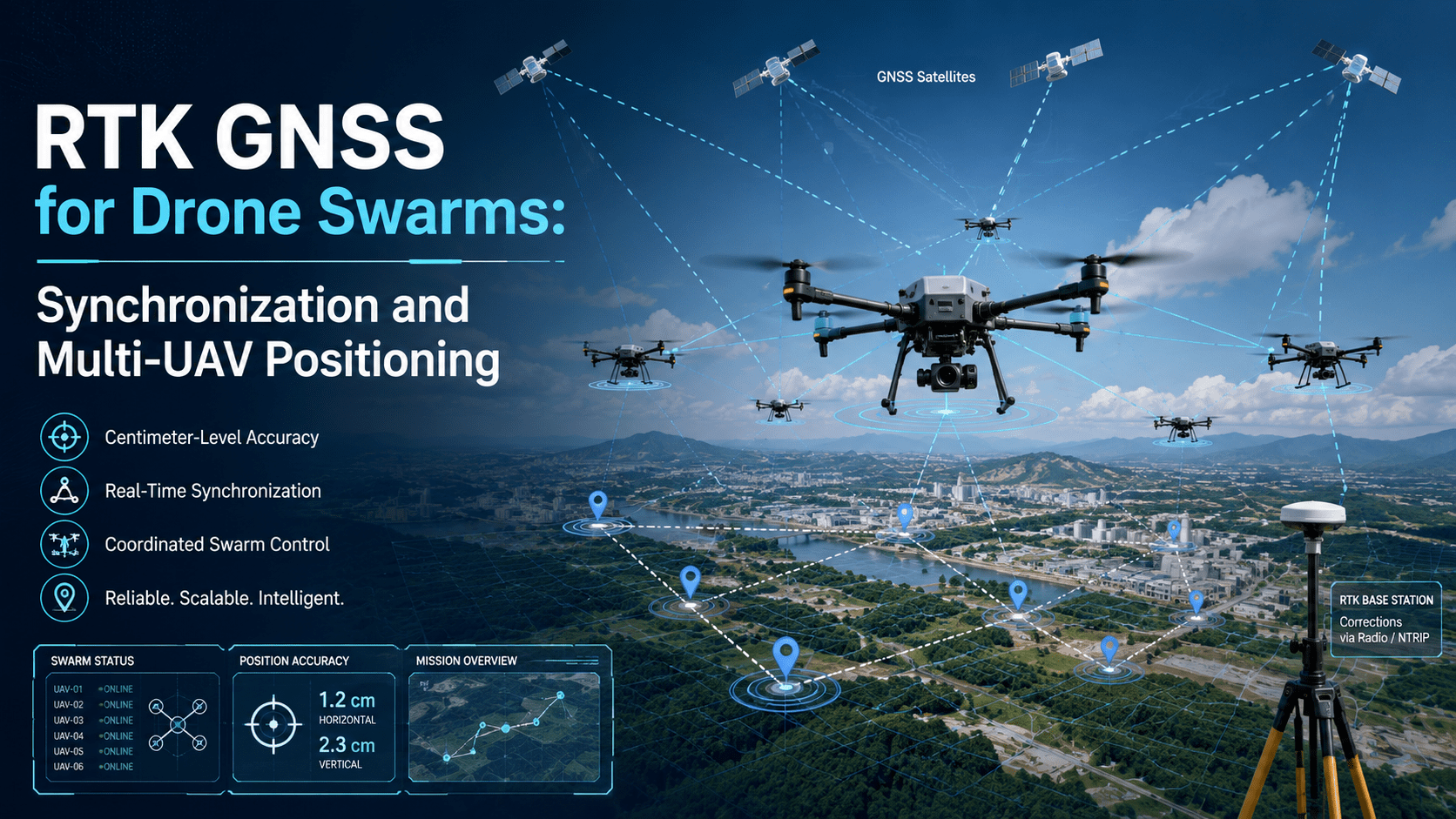
RTK (Real-Time Kinematic) positioning works by sending correction data from a base station to each rover. In a drone swarm context, this architecture takes several forms:
Single Base Station Architecture
The simplest setup uses one ground-based base station that broadcasts RTCM correction messages to all drones in the swarm. The base station sits on a known surveyed point and calculates the difference between its known position and the GNSS satellite measurements. It then transmits these corrections — typically over 4G/LTE, 900 MHz radio, or WiFi — to every UAV in the swarm.
| Parameter | Standalone GNSS | Single-Base RTK | Network RTK |
|---|---|---|---|
| Horizontal Accuracy | 1.5–3.0 m | 1–3 cm | 2–5 cm |
| Convergence Time | Instant | 10–45 seconds | 20–60 seconds |
| Swarm Size Limit | Unlimited | Depends on link | Unlimited |
| Base Station Required | No | Yes | No (uses network) |
| Drift Over 10 Minutes | 5–10 m | <1 cm | <3 cm |
| Relative Accuracy Within Swarm | 3–8 m | 1–2 cm | 3–5 cm |
| Suitable for Dense Swarms | ❌ | ✅ Excellent | ✅ Good |
The single-base RTK approach offers the best relative accuracy between drones because all rovers share the same correction source. This is critical for drone shows and tight formations.
Network RTK (NTRIP) for Large-Area Swarms
For swarms operating over larger areas — beyond 10–20 km from a base station — Network RTK (NTRIP) becomes the practical choice. The drones receive corrections from a regional CORS (Continuously Operating Reference Station) network via cellular data links. This eliminates the need for a physical base station but introduces slightly lower relative accuracy because each drone’s corrections come from a different reference point.
Onboard RTK Processing with Septentrio Chips
Receivers powered by the Septentrio mosaic-X5 or mosaic-G5 process RTK corrections directly on the chip. This means:
– Sub-second RTK convergence after signal reacquisition
– Full L1/L2/L5 multi-band tracking for maximum integrity
– IMU-aided RTK that maintains centimeter accuracy during brief GNSS outages (under bridges, through trees)
– Dual-antenna heading for precise yaw estimation without a compass
This onboard processing is a major advantage for drone swarms because it offloads computation from the flight controller and reduces latency between position fix and control action.
Timing Synchronization Across the Swarm
Position accuracy is only half the equation. For a drone swarm executing synchronized maneuvers, timing matters just as much.
GNSS Time as the Swarm Clock
Every GNSS receiver outputs precise UTC time synchronized to GPS time. When all drones in a swarm use GNSS time as their reference, they share a common clock within microsecond accuracy. This allows:
– Simultaneous waypoint transitions — All drones switch formation patterns at the exact same moment
– Synchronized sensor data — LIDAR, camera, or payload data from multiple drones can be merged accurately
– Coordinated landing and takeoff — Especially important for narrow launch platforms on ships or moving vehicles
PPS (Pulse Per Second) Output
Most RTK GNSS receivers including Septentrio-based modules provide a PPS signal accurate to 20–50 nanoseconds. Flight controllers can use this to discipline their internal clock, maintaining tight synchronization even during GNSS outages of several seconds.
Handling RTK Fix Loss in Individual Drones
In a swarm environment, some drones may temporarily lose RTK fix due to:
– RF interference from other drones in close proximity
– Obstructed sky view (flying under a bridge or near buildings)
– Data link dropout for correction messages
Septentrio receivers handle this gracefully through their AIM+ anti-jamming technology and rapid re-convergence — typically recovering RTK fix within 5–15 seconds after the obstruction passes.
Real-World Swarm Applications for RTK GNSS
Drone Light Shows
The most visible application of drone swarms has been entertainment. Companies like Geoscan, Drone Show Software, and CEATEC rely on RTK GNSS for shows with thousands of aircraft:
– Each drone follows a pre-planned 3D trajectory
– RTK ensures every UAV stays within 3 cm of its assigned position
– PPS synchronization keeps LED light transitions coordinated across the entire fleet
– Post-show return-to-home uses RTK for precision landing on a marked LZ
For drone show operators, Septentrio mosaic-based receivers offer the reliability advantage: they maintain a higher RTK fix rate in RF-congested environments compared to consumer-grade GNSS chips.
Autonomous Inspection Swarms
Industrial inspection of bridges, power lines, wind turbines, and pipelines benefits enormously from multi-UAV coverage. A swarm of 3–5 drones can cover an entire bridge deck in a single flight, each drone flying a defined corridor while maintaining relative positioning.
Requirements for inspection swarms:
– 1–2 cm relative accuracy between drones for collision-free corridor flying
– RTK fix reliability >99.5% during the mission
– Rapid re-convergence after flying near structures
Search and Rescue (SAR) Swarms
SAR operations require covering large areas quickly. A grid-search swarm with RTK GNSS ensures complete coverage without gaps or overlaps:
– Each drone flies a precise grid line at 5–10 cm accuracy
– Real-time position sharing via 4G telemetry
– Geotagged imagery with centimeter accuracy for ground teams
– Coordinated handoff between battery-limited drones
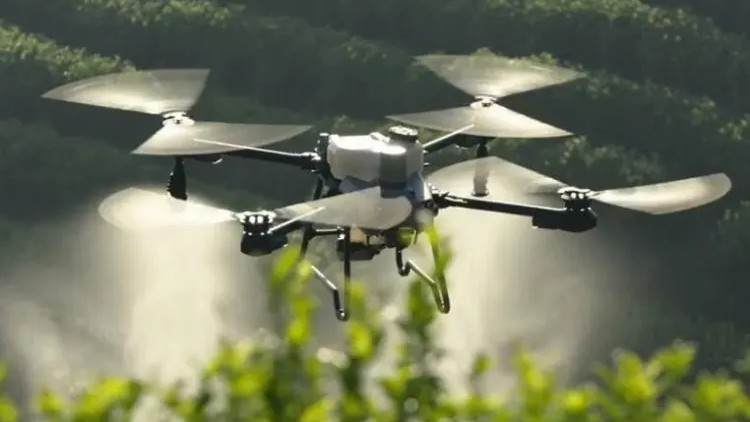
Agricultural Multi-UAV Operations
In precision agriculture, multiple drones may operate simultaneously — one spraying, one mapping, one scouting. RTK GNSS ensures:
– No overlap or gaps in spray patterns (1–2 cm lane accuracy)
– Precise correlation between scouting imagery and treatment zones
– Safe automated landing on moving platforms
Key Technical Requirements for Swarm-Grade RTK Receivers
Not all RTK GNSS receivers are suitable for multi-UAV operations. Here’s what to look for:
Multi-Constellation, Multi-Frequency Support
A swarm-grade receiver should track:
– GPS L1/L2/L5
– GLONASS L1/L2
– Galileo E1/E5a/E5b/E6 (E6 unlocks HAS)
– BeiDou B1I/B2I/B1C/B2a
– QZSS L1/L2/L5
– NavIC L5
Septentrio mosaic-X5 tracks all of these across 448 channels, giving exceptional lock stability even in urban canyons and high-interference environments.
High Update Rate
For dynamic drone operations, the receiver should output position data at 10–100 Hz. The Septentrio mosaic-X5 supports configurable update rates up to 100 Hz, while most consumer GNSS chips cap at 5–10 Hz.
Low Latency
From signal reception to position output, latency should be under 20 milliseconds. Higher latency introduces control lag that compounds in a swarm where multiple drones must react simultaneously.
IMU Integration (GNSS+INS)
A GNSS+INS receiver fuses RTK positioning with inertial measurement data. This provides:
– Continuous positioning during GNSS dropouts (1–2 cm drift per second of outage)
– Reliable attitude estimation for flight control
– Smooth trajectory output even with momentary RTK fix loss
Protocol Support for Swarm Communication
The receiver must output standard protocols:
– SBF (Septentrio Binary Format) — for native integration with ArduPilot and PX4
– NMEA 0183 — for generic flight controller compatibility
– RTCM 3.3 — for sending correction data between drones
Related GNSS Products
- HB21 GNSS Box Receiver — All-in-one RTK receiver with 4G LTE, heading, and data logging
- HB6 GNSS Box Receiver — Compact RTK receiver powered by Septentrio Mosaic X5
- EV322 GNSS Receiver — Lightweight RTK receiver for UAVs and autonomous systems
- AIM+ Anti-Jamming Technology — Advanced interference and spoofing protection
Browse our full GNSS receiver collection for professional UAV applications.
Frequently Asked Questions
Can multiple drones share one RTK base station?
Yes. A single RTK base station can serve an unlimited number of drone rovers within radio range (typically 5–15 km with UHF, or nationwide with NTRIP over 4G). Each drone maintains its own RTK fix independently.
What RTK accuracy is achievable for drone swarm formations?
With Septentrio’s mosaic-X5 or mosaic-G5 P3H receivers, each drone achieves 0.6 cm + 0.5 ppm RTK accuracy. For relative positioning between drones in a swarm, dual-antenna heading (P3H) adds 0.2° heading accuracy.
How does GNSS timing synchronization work between swarm drones?
Septentrio receivers output a PPS (pulse-per-second) signal with <20 ns jitter. In swarm applications, each drone's GNSS time can sync to UTC via the same satellite constellation, enabling coordinated flight actions.
What happens to swarm positioning if RTK corrections drop out?
Receivers fall back to standalone GPS (~2 m accuracy) or SBAS. Septentrio’s HPGNSS firmware maintains sub-meter accuracy during brief RTK outages (<60 s) using internal INS fusion. For critical swarms, pair with a second correction source.
Does drone swarm size limit RTK performance?
Not directly. Each drone computes its own RTK fix independently. However, the base station or NTRIP caster must handle the traffic. For 50+ drone swarms, use a dedicated NTRIP caster and 4G/LTE modems on each drone.
Further Reading
- Drone Swarm Navigation: Multi-UAV Collaborative Operations – Practical swarm navigation techniques
- Septentrio Mosaic-T Timing Receiver for Drone Swarms – Precision timing for drone coordination
- How Multi-Constellation GNSS Improves UAV Accuracy – Multi-constellation benefits for swarms
- Dual-Antenna RTK Heading for UAV Navigation – Advanced heading solutions
Can multiple drones share one RTK base station?
Yes. A single RTK base station can serve an unlimited number of drone rovers within radio range (typically 5–15 km with UHF, or nationwide with NTRIP over 4G). Each drone maintains its own RTK fix independently.
What RTK accuracy is achievable for drone swarm formations?
With Septentrio’s mosaic-X5 or mosaic-G5 P3H receivers, each drone achieves 0.6 cm + 0.5 ppm RTK accuracy. For relative positioning between drones in a swarm, dual-antenna heading (P3H) adds 0.2° heading accuracy.
How does GNSS timing synchronization work between swarm drones?
Septentrio receivers output a PPS (pulse-per-second) signal with <20 ns jitter. In swarm applications, each drone's GNSS time can sync to UTC via the same satellite constellation, enabling coordinated flight actions.
What happens to swarm positioning if RTK corrections drop out?
Receivers fall back to standalone GPS (~2 m accuracy) or SBAS. Septentrio’s HPGNSS firmware maintains sub-meter accuracy during brief RTK outages (<60 s) using internal INS fusion. For critical swarms, pair with a second correction source.
Does drone swarm size limit RTK performance?
Not directly. Each drone computes its own RTK fix independently. However, the base station or NTRIP caster must handle the traffic. For 50+ drone swarms, use a dedicated NTRIP caster and 4G/LTE modems on each drone.