GPS jamming and spoofing are no longer a niche military concern. In 2025, airlines reported 55,000 GNSS interference incidents — a 193% increase over 2023 — and more than 430,000 jamming and spoofing events were recorded in 2024 alone, affecting between 700 and 1,350 flights every day. The problem has spread far beyond conflict zones: maritime traffic in the Strait of Hormuz, telecom networks in the Baltics, and drone operations worldwide are all being hit.
For operators of critical infrastructure — aviation, maritime, utilities, autonomous systems, and precision timing networks — understanding GNSS anti-jamming and anti-spoofing protection is no longer optional. It is a compliance and business-continuity requirement. This guide explains how jamming and spoofing work, why GNSS is so vulnerable, and the receiver-level technologies — including Septentrio’s AIM+ interference mitigation — that keep position, navigation, and timing (PNT) trustworthy.
The Threat Is Real: GNSS Interference by the Numbers
The scale of GNSS interference has grown so fast that regulators now describe it as crisis-level:
- Aviation: IATA recorded 55,000 GPS interference incidents reported by airlines in 2025, up 193% from 2023. Spoofing reports increased 193% and jamming reports 67% between 2024 and 2025.
- Global incidents: More than 1.4 million documented GNSS interference events occurred during 2025–2026 — a 62% increase over the 2023–2024 baseline, according to industry incident reporting.
- Telecom: A single 2024 European jamming event disrupted 4G/5G synchronization at roughly 11,000 cell sites across Poland and the Baltic states for 14–18 hours.
- Maritime: Over 1,100 vessels reported GPS interference within a single 24-hour period near the Strait of Hormuz in March 2026, with ships displaying false positions — some plotted on land.
- Low barrier to entry: A working GPS spoofing setup now costs under $350 using software-defined radios like the HackRF One, making spoofing accessible to non-state actors and criminals.
Regulators have responded: the FAA published its updated GNSS Interference Resource Guide v1.1, EASA issued revised Safety Information Bulletin guidance in July 2026 and new airworthiness requirements (CS-SC241) mandating interference detection in certified avionics, and ICAO has elevated GNSS interference to a standing safety agenda item. The GNSS resilience market is projected to grow from $5.9 billion in 2024 to $9.7 billion by the end of 2026.
Jamming vs. Spoofing: What’s the Difference?
| Threat | How It Works | Effect on Receiver | Detection Difficulty |
|---|---|---|---|
| Jamming | Transmits high-power RF noise on GNSS frequencies (L1/L2/L5), overwhelming the very weak satellite signals | Receiver loses lock; position/timing service is denied entirely | Easy — signal loss is obvious and alerts trigger |
| Spoofing | Broadcasts counterfeit GNSS-like signals that the receiver tracks as authentic | Receiver computes a false position or time while appearing fully healthy | Hard — the receiver looks normal while delivering wrong data |
| Meaconing | Rebroadcasts delayed authentic GNSS signals | Position is shifted by the delay; gradual drift | Moderate |
Jamming is a blunt instrument — it denies service and is easy to detect. Spoofing is far more insidious: it feeds false data into systems that trust GNSS implicitly, and the effects can linger for hours after the aircraft, vessel, or vehicle leaves the affected area. A spoofed position can corrupt an inertial navigation system (INS) that keeps computing from the bad input, and multi-sensor systems may even select the spoofed GNSS source as the highest-integrity input.
Why GNSS Receivers Are So Vulnerable
GNSS signals arrive at Earth’s surface at power levels around -125 to -130 dBm — roughly a billion times weaker than a Wi-Fi signal. Any transmitter broadcasting noise on the same frequencies can drown them out, and any transmitter broadcasting a well-formed fake signal can replace them. This is a fundamental property of the system, not a defect in any particular receiver. That is why resilience cannot rely on the signal itself — it must be built into the receiver, the antenna, and the wider navigation architecture.
What’s at Stake: Critical Infrastructure Under Threat
Aviation
Modern aircraft feed GPS into flight management, terrain awareness (TAWS/EGPWS), ADS-B surveillance, timing, and RNP/PBN approaches. Spoofing can cause false terrain alerts, wrong ADS-B positions, and map shifts — and crews may not see any cockpit indication that anything is wrong. EASA reports that roughly 25% of spoofing events occur during approach, where traffic is densest.
Maritime
Vessels in the Black Sea, Eastern Mediterranean, and Persian Gulf routinely lose or receive false positions. This affects collision avoidance, AIS integrity, and compliance in congested shipping lanes — and has pushed 13 European coastal states plus Iceland to jointly flag growing GNSS interference in the Baltic and North Seas.
Telecom & Precision Timing
5G networks, power grids, and financial exchanges depend on GNSS-disciplined clocks for microsecond-level synchronization. When GNSS timing is jammed or spoofed, network synchronization fails — the 2024 Baltic event proved an entire region’s mobile service can go dark.
Drones, UAVs & Autonomous Systems
Delivery drones, eVTOL, robotaxis, AGVs, and robot swarms navigate with GNSS at their core. A jammer forces them into failsafe landing or lost-link procedures; a spoofer can drag them off course or break geofences — which is precisely why counter-drone systems use jamming and spoofing as their primary weapons.
How GNSS Anti-Jamming and Anti-Spoofing Protection Works
No single technology defeats every attack. Resilient PNT is layered, and each layer addresses a different part of the problem:
1. Multi-Constellation, Multi-Frequency Tracking
Tracking GPS, Galileo, GLONASS, and BeiDou across L1/L2/L5 (and E1/E5/E6) gives the receiver geometric diversity and redundancy. Interference usually hits one band or one constellation at a time; a multi-frequency receiver switches to clean signals and keeps computing. It also lets the receiver cross-check ranges across frequencies — inconsistencies become an early integrity warning.
2. AIM+ Advanced Interference Mitigation
Septentrio’s AIM+ technology is the industry’s most mature receiver-level defense. It continuously monitors the RF environment, detects and characterizes interference in real time, and applies adaptive filtering that notches out jamming while preserving satellite signals. AIM+ also detects spoofing by analyzing signal consistency across bands, and it flags corrupted channels so they never contaminate the position solution. Every Septentrio-powered receiver from uav-gnss.com — from the compact EV322 to the HB21 box receiver — ships with AIM+ built in, providing professional-grade resilience in an affordable, civilian package.
3. RAIM & Integrity Monitoring
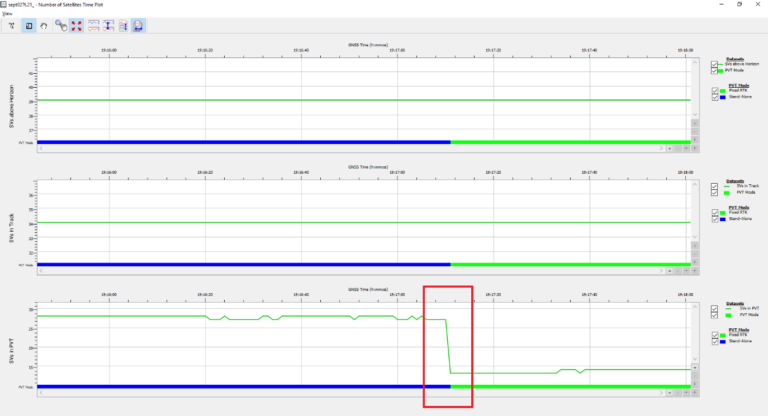
Receiver Autonomous Integrity Monitoring checks the consistency of the satellite measurement set. Fault Detection and Exclusion (FDE) RAIM can isolate and remove a compromised satellite from the solution — typically requiring six or more healthy satellites. It is the first line of defense against both faulty and spoofed signals, and it is mandatory in aviation-grade receivers.
4. Signal Authentication (OS-NMA & E6)
Galileo’s Open Service Navigation Message Authentication (OS-NMA) digitally signs navigation data using public-key cryptography, letting a receiver verify that the signal genuinely came from the satellite. Galileo’s E6 Commercial Authentication Service goes further with encrypted ranging codes. ESA-funded projects have demonstrated that authenticated signals reliably expose spoofing through code-phase inconsistencies — the gold standard for detecting sophisticated attackers.
5. CRPA Antenna Arrays
Controlled Reception Pattern Antennas place spatial nulls toward interference sources while maintaining gain toward satellites. Modern CRPAs achieve 40+ dB of nulling against a single jammer and 25–30 dB per source against multiple jammers. Once restricted to defense, CRPA technology is now commercializing rapidly.
6. INS Coupling & Sensor Fusion
Tightly coupled GNSS+INS systems keep navigating through jamming by dead reckoning, and — critically — cross-check GNSS against inertial data. When the two disagree, the system knows it is being spoofed. Adding vision, LiDAR, or barometric sensors creates even more independent verification channels.
7. Alternative PNT
For truly critical timing and positioning, resilience means not depending on GNSS at all. eLoran terrestrial signals, LEO satellite PNT (such as Iridium’s emerging service, which is 1,000x more powerful than GPS), fiber-optic time distribution (PTP/White Rabbit), and chip-scale atomic clocks for holdover are all becoming part of the resilient PNT toolkit.
Anti-Jam GNSS Receivers for Your Application
Every receiver below is powered by Septentrio silicon with AIM+ interference mitigation and multi-frequency, multi-constellation tracking — giving you defense-grade resilience without defense-grade pricing:
| Product | Module | Weight | Key Resilience Features | Best For |
|---|---|---|---|---|
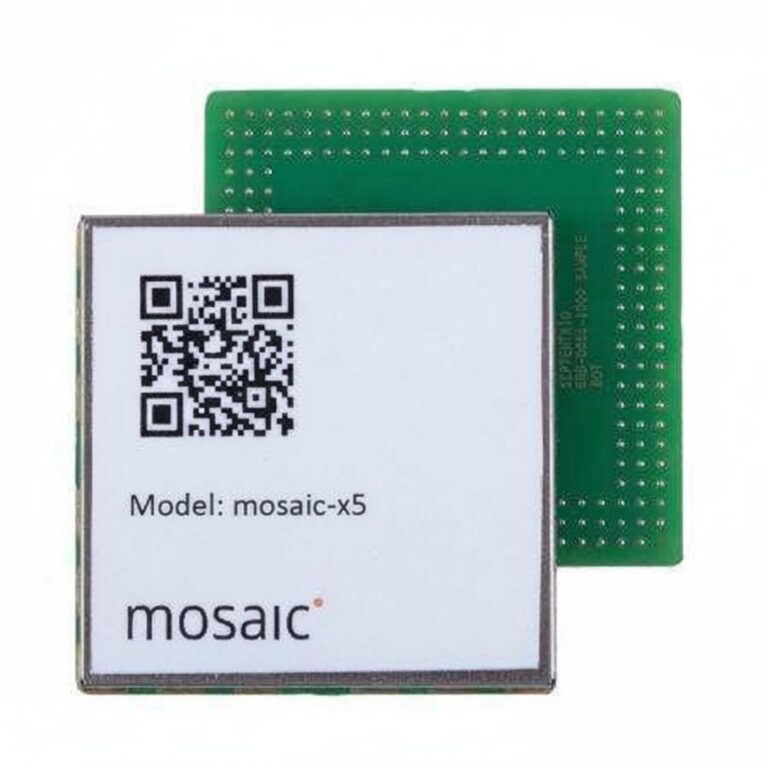
| HB21 GNSS Box Receiver | Mosaic-X5 | 165 g | AIM+, dual-antenna heading, 4G LTE, data logging | Fixed infrastructure, fleet vehicles, marine |
| HB6 GNSS Box Receiver | Mosaic-X5 | 85 g | AIM+, IP67, USB/UART/Ethernet | Drones, robots, surveying |
| EV322 GNSS Receiver | Mosaic-G5 P3H | 48 g | AIM+, triple-band, integrated compass | UAVs, agriculture, compact robotics |
| HB10 Dual-Antenna Receiver | AsteRx-m3 Pro+ | Compact | AIM+, 0.15° heading, 100 Hz output | Precision orientation & heading-critical systems |
Learn more about how AIM+ anti-jamming technology works, or browse the full GNSS receiver collection.
Building a Resilient PNT Strategy: Best Practices
- Audit your dependence: Map every system that consumes GNSS position or time — navigation, logging, sync, geofencing, safety functions.
- Deploy resilient receivers: Choose multi-frequency, multi-constellation receivers with AIM+ or equivalent interference mitigation as your baseline — not single-band consumer chips.
- Add independent sensors: INS, odometry, vision, or barometers give you cross-checks and graceful degradation during outages.
- Plan for holdover: For timing infrastructure, add rubidium or chip-scale atomic clock holdover and alternate time sources (PTP over fiber, eLoran).
- Detect and log: Use receivers with interference detection and logging so attacks are visible, documented, and reportable to regulators.
- Test under real conditions: Participate in or reference events like Norway’s annual Jammertest to validate receiver behavior under realistic attack scenarios.
Frequently Asked Questions
Q: What is the difference between GNSS anti-jamming and anti-spoofing?
Anti-jamming keeps the receiver locked onto satellites when an attacker floods the GNSS bands with noise — typically via adaptive filtering like Septentrio’s AIM+. Anti-spoofing detects and rejects counterfeit signals that pretend to be satellites, using techniques like cross-band consistency checks, RAIM, signal authentication (OS-NMA), and sensor cross-validation.
Q: Do I need anti-jamming if I don’t operate in a conflict zone?
Increasingly, yes. Jamming and spoofing have spread far beyond war zones — affecting the Baltic, Eastern Mediterranean, Gulf corridors, the Korean Peninsula, and even domestic airspace near Denver in 2022. Unintentional interference from personal privacy devices (an estimated 300,000 are in circulation), faulty equipment, and urban RF noise can degrade any GNSS deployment. AIM+ protects against intentional attacks and everyday RF interference alike.
Q: Can software updates add anti-spoofing to an existing receiver?
Some capabilities — like OS-NMA authentication support and improved interference algorithms — can be enabled via firmware on modern receivers. However, hardware-level defenses (multi-frequency RF front ends, CRPA antenna support, tight INS coupling) require the right silicon from the start. That is why choosing a resilient receiver platform at design time matters.
Q: How do Septentrio-based receivers compare to consumer GNSS chips for resilience?
Consumer chips typically track one or two constellations, offer no interference characterization, and fail silently under attack. Septentrio receivers track all constellations across multiple bands, run AIM+ to detect and filter interference in real time, provide integrity flags, and log interference events — the difference between a system that degrades gracefully and one that simply breaks.
Q: What accuracy do I lose when anti-jamming filtering is active?
AIM+ filtering is designed to remove interference while preserving satellite signals, so centimeter-level RTK accuracy is maintained even while jamming is being mitigated. In severe cases, the receiver may exclude specific corrupted signals and rely on remaining satellites, with a temporary, bounded reduction in availability rather than a complete outage.
Related GNSS Products
- HB21 GNSS Box Receiver — all-in-one RTK receiver with 4G LTE and AIM+ anti-jamming
- HB6 GNSS Box Receiver — compact, rugged RTK receiver for drones and robots
- EV322 GNSS Receiver — ultra-lightweight triple-band receiver for UAVs
- HB10 Dual-Antenna RTK Receiver — precision heading with AsteRx-m3 Pro+
- AIM+ Anti-Jamming Technology — how interference mitigation works