Yes — GNSS receivers with CAN bus output exist, and they are the standard way to feed centimeter-level position and heading into construction and agricultural machinery. This guide explains what CAN bus output on a GNSS receiver actually means, what to check on a spec sheet, and how the Septentrio-powered receivers from UAV GNSS handle machine-control integration.
Why machine control needs CAN bus output
Excavators, dozers, graders, sprayers and autonomous farm vehicles do not read NMEA sentences over USB. Their vehicle ECUs and display controllers speak CAN bus — the multi-drop serial bus standardized for heavy-duty vehicles (SAE J1939) and increasingly used as raw CAN 2.0B or CANopen on off-highway machines. A GNSS receiver feeding a machine-control system therefore needs to output position, heading, and status over CAN, either directly or through a gateway.
Without CAN output, an integrator must bolt on an extra serial-to-CAN converter, add wiring, and debug a translation layer themselves. A receiver with CAN output removes that layer and is far easier to install on production machinery.
CAN vs serial: what “CAN bus output” really means
Three things decide whether a receiver truly supports CAN for machine control:
- Native vs external: does the receiver expose a CAN transceiver on its own connector, or do you add one? (Many chips are serial-only — the CAN comes from a carrier board or gateway.)
- Protocol: J1939 (position/heading as standard PGNs), CANopen, or raw CAN 2.0B messages. Machine-control OEMs almost always want J1939.
- Connector & power: dedicated CAN connectors (e.g. M12) that combine CAN + power simplify machine wiring dramatically.
Serial interfaces still matter: RS-232, RS-422, RS-485 and LVTTL UART are how receivers talk to flight controllers, telemetry and custom ECUs. The right product often needs both — serial for integration, CAN for the machine bus.
What to check on any receiver spec sheet
- CAN connector present? Look for explicit “CAN” in the interface table — not just “serial”.
- Protocol support: J1939 / CANopen / raw CAN 2.0B — and whether it is configurable.
- Serial levels: LVTTL vs RS-232/RS-422/RS-485 — many “UART” ports are 3.3 V logic only.
- Timing: 1PPS and event inputs for time-synced machine control.
- Dual-antenna heading: machine control needs heading, not just position — check for a second antenna port.
- Durability: IP rating, temperature range and vibration rating for machine environments.
UAV GNSS receivers for machine-control integration
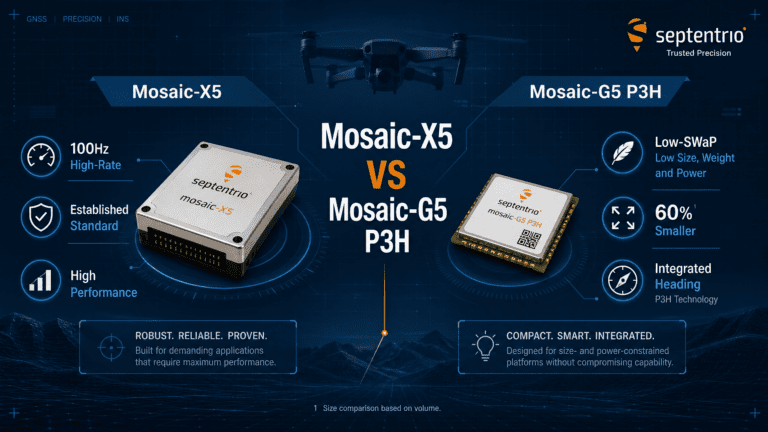
All UAV GNSS receivers are powered by Septentrio silicon (AsteRx-m3 Pro+ or mosaic-X5/mosaic-G5), with AIM+ anti-jamming as standard. Here is how the lineup handles CAN and serial machine-bus integration:
| Receiver | Machine-bus interfaces | Best for |
|---|---|---|
| HB3 (IP67 box) | CAN (PWR) M12 ×2 (CAN + power) · Serial M12 · Ethernet M12 · 4G/UHF | Direct CAN wiring on construction & ag machines — the plug-and-play machine-control box |
| HB10 (module) | 3× UART (LVTTL) · USB-C · 1PPS · EVENT | OEM integration where you add the CAN/RS-232/RS-485 transceiver on your carrier |
| HB59 (OEM board) | 3× UART (LVTTL) · 100M Ethernet · USB-C · 1PPS · EVENT | Machine-control networks and base/rover setups needing Ethernet + serial |
The HB3 is the machine-control flagship: its two CAN (PWR) M12 connectors carry CAN bus and power on the same connector, so the receiver wires straight into a vehicle harness. CAN protocol options (J1939, CANopen or raw CAN 2.0B) and serial levels (RS-232/RS-485) are configured for your application — contact our engineering team for the exact setup.
Integration FAQ
Does the HB3 output J1939 position messages?
The HB3 provides CAN (PWR) M12 connectors and can output position, heading and status on the machine bus. Protocol (J1939 PGNs, CANopen or raw CAN 2.0B) is confirmed with our engineering team for your specific machine model — contact us before specifying.
Do the HB10 and HB59 have CAN output?
No native CAN on the module — their UART ports are high-speed LVTTL (115200–4M bps). For CAN/J1939 or RS-232/RS-485 machine buses, add a standard external transceiver or gateway. Our engineers provide wiring and configuration support.
Do I need dual-antenna heading for machine control?
For blade/bucket control and autosteer, yes. All three receivers support dual-antenna heading: 0.15° at 1 m baseline (0.03° at 5 m) on the AsteRx-m3 Pro+ models — heading, pitch and roll without a separate IMU or magnetometer.
Can the receivers survive construction environments?
The HB3 is IP67 with a 1.5 m drop rating and −40 to +80 °C operation. The HB10/HB59 modules are rated −40 to +85 °C with MIL-STD-810G-class robustness and AIM+ anti-jamming for EMI-heavy sites (power lines, welders, radios).
Get machine-control GNSS advice for your project
Tell us the machine model, the ECU bus (J1939 / CANopen / raw CAN), and the accuracy you need — we will recommend the right receiver and wiring diagram. Request a quote →