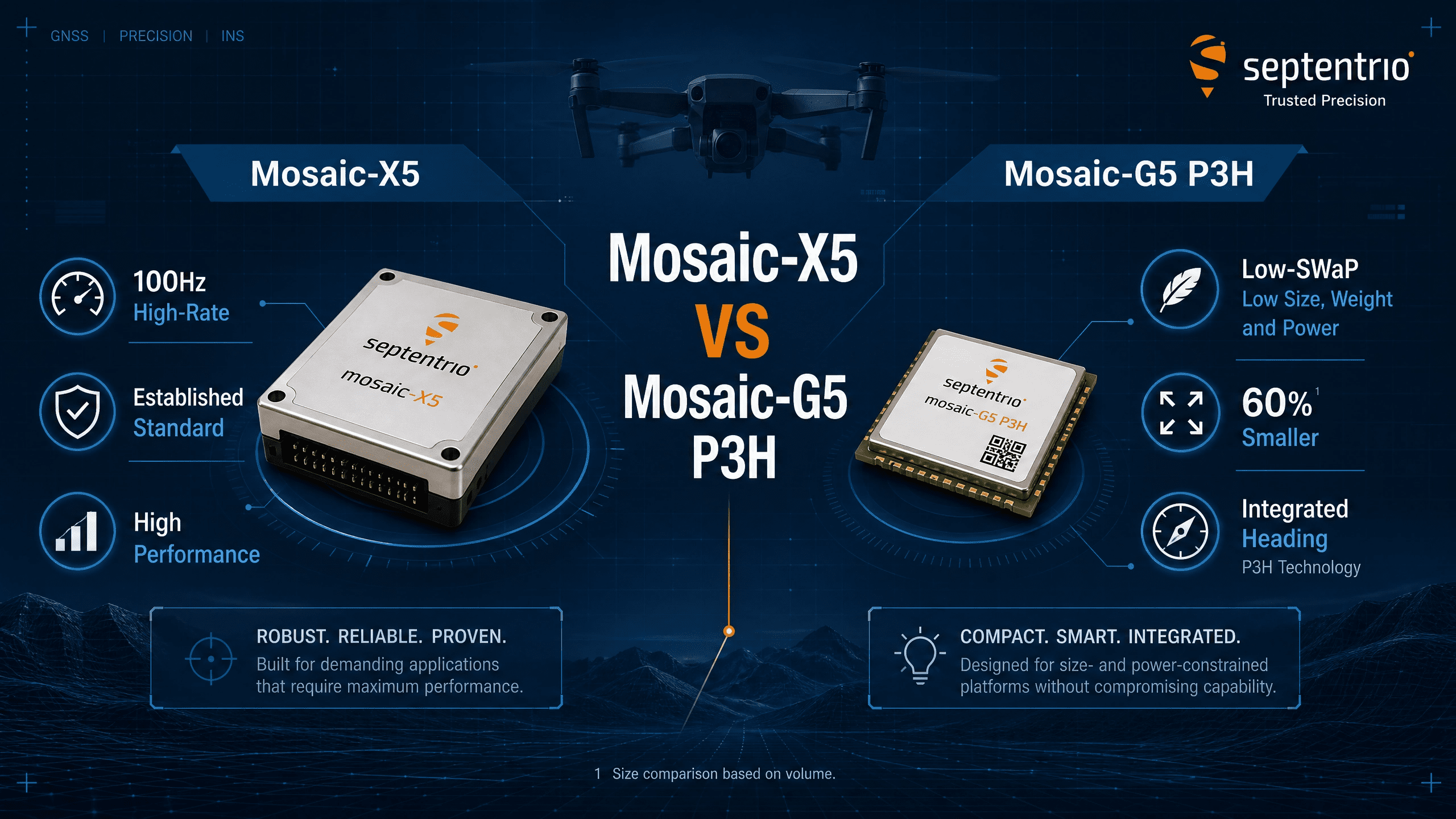
When building a professional UAV, choosing the right GNSS receiver module is one of the most important decisions you’ll make. Septentrio offers two popular modules — the Mosaic-X5 and the Mosaic-G5 P3H — each designed for different applications. In this guide, we break down the key differences to help you choose the right one for your drone platform.
Overview: Two Modules, Different Strengths
The Mosaic-X5 and Mosaic-G5 P3H are both compact, dual-frequency GNSS receiver modules from Septentrio, but they serve different primary purposes:
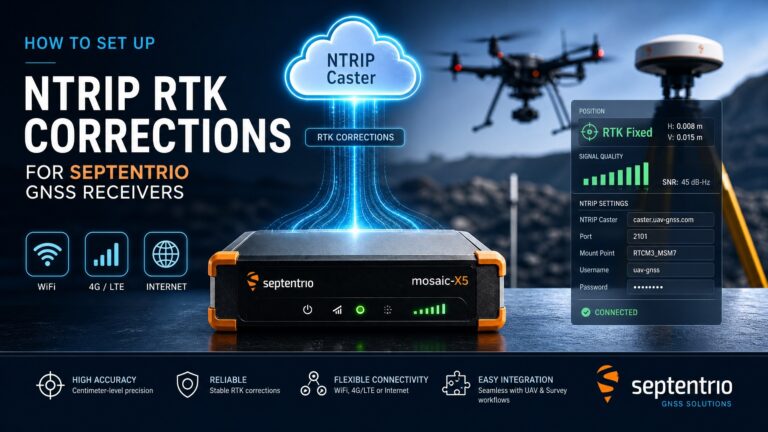
- Mosaic-X5: A high-performance multi-constellation GNSS receiver optimized for RTK-level positioning. It supports GPS L1/L5, GLONASS, Galileo, and BeiDou, delivering centimeter-level accuracy for surveying, mapping, and precision agriculture.
- Mosaic-G5 P3H: A dual-antenna GNSS receiver that adds heading and pitch capabilities on top of RTK positioning. It’s designed for applications where vehicle orientation (yaw) is critical, such as marine operations, corridor mapping, and heavy-lift drones.
Key Specification Comparison
| Feature | Mosaic-X5 | Mosaic-G5 P3H |
|---|---|---|
| Antennas | Single antenna | Dual antenna (heading) |
| Position Accuracy (RTK) | 0.6 cm + 0.5 ppm | 0.6 cm + 0.5 ppm |
| Heading Accuracy | N/A (compass required) | 0.3° RMS (0.5 m baseline) |
| Constellations | GPS + GLONASS + Galileo + BeiDou | GPS + GLONASS + Galileo + BeiDou |
| Anti-Jamming | AIM+ | AIM+ |
| Size | 31 × 31 × 4 mm | 31 × 31 × 4 mm |
| Power Consumption | ~1.0 W | ~1.2 W |
| Best For | Surveying, mapping, agri-drones | BVLOS, marine, heavy-lift, inspection |
When to Choose Mosaic-X5
The Mosaic-X5 is the right choice when your primary requirement is high-accuracy positioning without the need for GNSS-based heading. It’s ideal for:
- Surveying and mapping drones: When you need centimeter-level RTK accuracy for photogrammetry and LiDAR mapping, the Mosaic-X5 delivers exceptional performance at a lower cost.
- Agricultural spray drones: For precision spraying where accurate positioning during autopilot-guided flights is essential, but a standard magnetometer provides sufficient heading data.
- Budget-conscious builds: If your application doesn’t require dual-antenna heading, the Mosaic-X5 offers the same RTK positioning quality for a lower unit cost.
The Mosaic-X5 integrates seamlessly with Pixhawk and ArduPilot autopilots via UART, providing NMEA and RTCM data for centimeter-accurate positioning. Learn more in our guide on Pixhawk integration with Septentrio receivers.
When to Choose Mosaic-G5 P3H
The Mosaic-G5 P3H adds dual-antenna heading capability, making it the superior choice when orientation data is as important as position data:
- BVLOS operations: Beyond Visual Line of Sight operations require reliable heading data without relying on magnetometers that can fail due to magnetic interference.
- Marine and coastal drones: Over-water operations where compasses are unreliable due to hull interference or magnetic anomalies.
- Heavy-lift drones: Large drones with high-current power systems generate significant magnetic fields that corrupt compass readings. The Mosaic-G5 P3H eliminates this problem entirely.
- Corridor mapping: Pipeline, power line, and road surveying requires precise heading to align multi-pass data correctly.
Anti-Jamming: A Shared Advantage
Both modules include Septentrio’s AIM+ anti-jamming and anti-spoofing technology, which is a critical differentiator from consumer-grade GNSS receivers. AIM+ monitors the RF spectrum for interference and automatically mitigates jamming signals, ensuring your drone maintains position lock even in contested environments. This is especially important for drones operating near urban centers, interference zones, or critical infrastructure where GNSS interference is increasingly common. For a deeper dive, see our article on AIM+ anti-jamming protection.
Integration Considerations
Both modules use the same 31 × 31 mm form factor and communicate over UART, SPI, or CAN bus, making them drop-in compatible from a hardware perspective. The key software difference is that the Mosaic-G5 P3H requires dual-antenna configuration and outputs heading data via proprietary NMEA sentences (e.g., PSAT, PHSI).
For ArduPilot integration, both modules work with the standard GPS driver. The Mosaic-G5 P3H’s heading data can be used as the primary yaw source, replacing the magnetometer entirely — a setup we recommend for any drone operating in high-EMI environments.
Price vs. Value
The Mosaic-G5 P3H carries a premium over the Mosaic-X5 due to its additional RF chain and heading processing capabilities. For applications that genuinely need dual-antenna heading, the cost is easily justified by the reliability gains. However, if your drone can operate with a standard compass (after proper calibration), the Mosaic-X5 offers the same RTK positioning at a lower price point.
FAQ
Can the Mosaic-X5 provide heading data?
Are both modules compatible with ArduPilot?
Which module has better positioning accuracy?
Is the Mosaic-G5 P3H worth the extra cost for agricultural drones?
Choosing between the Mosaic-X5 and Mosaic-G5 P3H comes down to one question: do you need GNSS-based heading? If yes, the Mosaic-G5 P3H is the clear choice. If not, the Mosaic-X5 delivers the same exceptional RTK positioning at a lower cost. Both modules represent the gold standard in compact, professional-grade GNSS receivers for UAV applications.
For help selecting the right module for your specific application, read our complete GNSS receiver buyer’s guide or contact our team for a consultation.