
In August 1992, TOPEX/Poseidon carried the first GPS receiver used operationally for precise orbit determination (POD), reconstructing the spacecraft’s orbit to the accuracy required for ocean altimetry. Three decades later, GNSS receivers are the default navigation sensor in space. They fly on scientific Earth-observation missions such as GRACE-FO, the Copernicus Sentinel series and ESA’s Swarm; on commercial weather constellations of 6 kg CubeSats; and now on the low Earth orbit (LEO) satellites being built to broadcast positioning and timing signals of their own. This guide explains what makes a GNSS receiver “space-grade”, how receivers on LEO satellites achieve centimeter-level orbit determination, and why aerospace is one of the fastest-growing buyers of high-performance GNSS hardware.
Why Space Is a Different GNSS Environment
A satellite orbiting at 500 km altitude moves at roughly 7,000 m/s, shifting GNSS carrier frequencies by up to about 36 kHz of Doppler — far beyond what a terrestrial receiver’s acquisition engine is designed to search. That single fact shapes everything about spaceborne GNSS, from acquisition search windows to tracking loops and navigation filters.
Extreme Dynamics and Radiation
Most terrestrial receivers fail to acquire or track satellites reliably in orbit. Space-qualified receivers run firmware tuned for high Doppler, high jerk and rapid signal-to-noise variation as spacecraft antennas sweep the sky, and are re-validated against GNSS signal simulators that reproduce orbital dynamics before launch. Radiation is the second differentiator: trapped particles in LEO accumulate total ionizing dose (TID) and cause single event effects (SEE). Commercial-off-the-shelf (COTS) units typically tolerate roughly 10 kRad TID — enough for several years in LEO — while fully radiation-hardened receivers go further at significantly higher cost and larger size.
Rapidly Changing Geometry — An Advantage
From LEO, the visible GNSS constellation sweeps across the sky quickly, and multipath — the dominant error source on Earth — is essentially absent in orbit. The fast-changing geometry is a genuine advantage: it accelerates carrier-phase ambiguity resolution and sharply shortens precise point positioning (PPP) convergence, which is why LEO receivers can deliver decimeter-level real-time positioning with broadcast-quality corrections.
Precise Orbit Determination: The Core Application
POD is the foundational use of GNSS in space. In post-processing, reduced-dynamic POD — blending the satellite’s force model (gravity, drag, solar radiation pressure) with GNSS carrier-phase measurements — reliably achieves 1–3 cm orbit accuracy for missions such as GRACE-FO, Sentinel-3, Sentinel-6 and Swarm, using precise orbit and clock products from the International GNSS Service (IGS).
Real-time POD has crossed an important threshold. Using the Galileo High Accuracy Service (HAS), which delivers orbit corrections better than 10 cm and clock corrections better than 0.3 ns, researchers demonstrated LEO real-time orbit determination at 10.7 cm 3D with GPS and 9.5 cm 3D with Galileo — improvements of 58.5% and 30.1% over broadcast ephemeris alone. Autonomous orbit determination at this level means a satellite no longer depends on ground tracking. Kinematic processing (GNSS-only) is sensitive to observation geometry; reduced-dynamic processing adds the force model for smoother orbits at the cost of computation — a trade-off well documented from 400 to 800 km altitude.
A new frontier is network processing: combining double-difference observations from eight LEO spacecraft — GRACE-FO C/D, Sentinel-3A/B, Sentinel-6A and Swarm A/B/C — researchers achieved absolute orbit accuracy of 2–2.5 cm (1D RMS), validated against satellite laser ranging. As mega-constellations deploy hundreds of GNSS-equipped satellites, this approach promises centimeter-consistent orbits for entire constellations with no reliance on ground stations.
GNSS as a Science Payload: Occultation and Reflectometry
Beyond navigation, GNSS receivers are scientific instruments. GNSS radio occultation (GNSS-RO) — first demonstrated with GPS/MET in 1995 — measures how signals bend through the atmosphere, yielding global temperature, pressure and humidity profiles that feed operational weather forecasting. The technique has moved from agency missions to commercial constellations: Spire Global’s LEMUR satellites, GeoOptics’ CICERO and PlanetIQ’s GNOMES all fly compact multi-constellation receivers on 3U–12U CubeSats. GNSS reflectometry (GNSS-R) uses reflected signals to measure ocean wind, sea state and soil moisture. DLR’s TET-1 mission showed the COTS route in practice: its Septentrio PolaRx2 receiver provided dual-frequency L1/L2 observations used both for decimeter-level orbit reconstruction and for radio occultation soundings.
What Makes a Receiver “Space-Grade”?
A 2023 survey identified 57 space-capable GNSS receiver models; the clearest trend is miniaturization, with 34 models under 1 kg and the line between L1 navigation receivers and geodetic-grade dual-frequency science receivers blurring. Requirements fall into five areas:
- SWaP: Modern space receivers fit in a few hundred grams and a few watts while retaining dual-frequency carrier-phase capability — critical for CubeSat budgets.
- Radiation tolerance: Documented TID tolerance and SEE/latch-up testing, with error-corrected memory and watchdog protection for single-event upsets.
- High-dynamic tracking: Wide Doppler search, robust tracking loops, high update rates (10 Hz or more) and low measurement latency for 7 km/s platforms.
- Multi-constellation, multi-frequency reception: GPS, Galileo, BeiDou and GLONASS on L1/L2/L5-class frequencies — the reason Sentinel-6A carries a dual-system GPS/Galileo receiver.
- Qualification evidence: Signal simulator, vibration, thermal-vacuum and EMC/EMI testing. DLR has shown COTS receivers pass these tests for LEO at roughly a five-fold cost saving versus fully space-qualified hardware.
From Onboard Sensors to Navigation Infrastructure: LEO-PNT
The most consequential aerospace trend is LEO positioning, navigation and timing (LEO-PNT): broadcasting navigation signals from low Earth orbit. The market was valued at $118.6 million in 2025 and is projected to reach about $2.5 billion by 2036 (32.4% CAGR), driven by jamming and spoofing threats, autonomy and demand for resilient timing. By end-2025, 14 dedicated LEO-PNT constellations had been identified, 13 of them developed by nations that already operate GNSS systems — LEO-PNT is emerging as a strategic extension of national space-based PNT.
Why the excitement? LEO satellites are 10–30 times closer to users than GNSS satellites, so signals arrive far stronger — improving link margin, urban penetration and interference resistance — while fast geometry change accelerates PPP convergence and frequency diversity (Ku, Ka, C-band as well as L-band) adds resilience. Iridium PNT already sells operational LEO timing and location services; Xona Space Systems raised $170 million in March 2026 to build its 258-satellite Pulsar constellation, with first U.S.-built satellites launching this year; ESA’s Celeste mission will demonstrate an 11-satellite LEO complement to Galileo; and TrustPoint is developing a C-band system focused on GPS-independent timing and orbit services for spacecraft operators.
Real-world results confirm the value. China’s CENTISPACE LEO augmentation satellites — each carrying an onboard GNSS receiver and a navigation transmitter — improved BDS-3 orbit accuracy from 54.7 cm to 11.4 cm (79% improvement) when five LEO satellites were integrated, with LEO orbits themselves determined to better than 5 cm; integrating just two LEO satellites cut PPP convergence from 22.4 to 10.8 minutes. Every LEO-PNT satellite depends on its onboard GNSS receiver for its own precise orbit and time — the receiver is simultaneously the sensor that keeps the broadcast ephemeris accurate and the clock that keeps the constellation synchronized.
What to Look For in a GNSS Receiver for Aerospace Programs
- Multi-constellation, multi-frequency tracking: GPS L1/L2/L5, Galileo E1/E5a and BeiDou B1/B2-class signals for availability and ionosphere-free combinations.
- High update rate and low latency: 10 Hz or higher position output at orbital velocities, with minimal measurement delay for control loops.
- High-dynamics tracking: Wide Doppler search and robust re-acquisition engineered for 7 km/s LEO platforms.
- Radiation and environmental data: TID and SEE test reports, vibration and thermal-vacuum qualification evidence.
- Dual-frequency carrier-phase quality: Low-noise raw observables (RINEX/SBF) for post-processed POD and science products.
- RFI robustness: Jamming and spoofing threats are no longer confined to Earth — AIM+ class interference mitigation protects mission and user segment alike.
- Open interfaces: Serial, SPI and Ethernet outputs with standard protocols for spacecraft avionics and ground test benches.
- Compact form factor and low power: CubeSat-compatible size and power budgets without sacrificing dual-frequency capability.
Septentrio-Powered GNSS for Aerospace Applications
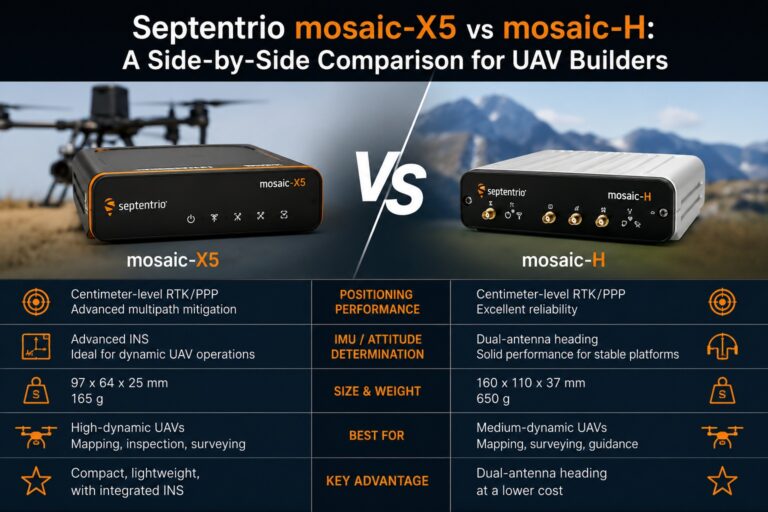
Septentrio receivers have flown in space since DLR qualified the PolaRx2 for LEO, and the mosaic-X5 module is today listed among the company’s space-recommended receivers — engineered to acquire and track GNSS signals at the extreme Doppler of LEO with high-rate, low-latency positions. The same mosaic-X5 and mosaic-G5 silicon powers the receivers offered at uav-gnss.com, making aerospace-grade GNSS accessible to flight hardware integrators, ground segment operators and test programs:
- Septentrio mosaic-X5 Module — The space-ready receiver core: 448 channels, all constellations and frequencies, high update rates and low latency for integrators building flight hardware.
- HB52 Ultralight RTK GNSS Module — A few-gram, mosaic-G5-powered module for SWaP-constrained platforms and rapid prototyping.
- HB51 Positioning & Heading Module — Mosaic-G5 P3H with dual-antenna heading for attitude-constrained platforms and test vehicles.
- HB6 GNSS Box Receiver — Rugged mosaic-X5-based receiver for ground support, test benches and integration labs.
- HB62 Rugged GNSS Reference Station — A turnkey reference receiver for ground segment monitoring, correction infrastructure and validation networks.
- UAV & Aviation Antenna — High-performance multi-frequency antennas for airborne and ground platforms.
Every receiver above includes the AIM+ resilient GNSS technology — advanced interference detection and mitigation that protects against jamming and spoofing in contested environments, on orbit and on the ground. For the free correction service enabling decimeter-level real-time POD, see our guide to Galileo HAS.
Frequently Asked Questions
Q: What accuracy can GNSS provide for LEO satellite orbit determination?
A: Post-processed reduced-dynamic POD with IGS precise products achieves 1–3 cm. Real-time POD using Galileo HAS corrections reaches roughly 10 cm 3D — a 30–58% improvement over broadcast ephemeris. Network processing across multiple LEO satellites has demonstrated 2–2.5 cm absolute accuracy.
Q: Can terrestrial GNSS receivers be used in space?
A: Some COTS geodetic receivers have been qualified for LEO — DLR flew a Septentrio PolaRx2 on TET-1 — but firmware must handle ~36 kHz Doppler and high dynamics, and radiation, vibration and thermal qualification is mandatory. COTS qualification typically costs about five times less than fully space-qualified hardware.
Q: Why do LEO satellites need onboard GNSS if ground stations can track them?
A: Autonomy, accuracy, cost and latency. Onboard GNSS provides real-time state for maneuver planning, collision avoidance and timing, removes dependence on a global ground network, and is essential for LEO-PNT satellites that must broadcast their own precise orbit and time.
Q: What is LEO-PNT and how is it different from GNSS?
A: LEO-PNT broadcasts navigation signals from low Earth orbit instead of medium Earth orbit. Signals are stronger, geometry changes faster (accelerating PPP convergence), and frequencies are more diverse — complementing, not replacing, GNSS. The market is projected to grow from $118.6 million in 2025 to ~$2.5 billion by 2036.
Q: Do CubeSats use the same receivers as large science satellites?
A: Increasingly, yes. Miniaturized dual-frequency receivers now fly on 3U–12U CubeSats — Spire’s 6 kg LEMUR satellites run GNSS-RO payloads, and 34 of 57 surveyed space-capable receiver models weigh under 1 kg. The line between navigation-grade and science-grade space receivers is blurring.
Q: How does radiation affect GNSS receivers in orbit?
A: Total ionizing dose degrades electronics over mission life, while single event effects can corrupt memory or cause latch-up. LEO receivers are typically qualified to roughly 10 kRad TID with SEE testing, and use error-corrected memory and watchdog circuits to recover from upsets.
Related GNSS Products
- Septentrio mosaic-X5 Module — Space-ready receiver core with all-constellation, all-frequency tracking for flight hardware integrators
- HB52 Ultralight RTK Module — Few-gram mosaic-G5 module for SWaP-constrained platforms
- HB6 GNSS Box Receiver — Rugged mosaic-X5 receiver for ground support and test benches
- HB62 Rugged Reference Station — Turnkey receiver for ground segment and correction infrastructure
- AIM+ Anti-Jamming Technology — Interference and spoofing protection for mission-critical GNSS
Browse the full GNSS receiver collection for aerospace, UAV and professional applications.